Kavalan Solist Sherry Cask Review: 4-Year 58%
I poured a Kavalan Solist Sherry Cask beside a Macallan 18 in a Taipei bar in March. The bartender laughed at me for the pairing. Then he tasted them side by side and stopped laughing. The Kavalan was four years old. The Macallan was eighteen. They looked the same colour in the light. They read the same profile — dried figs, espresso, dark chocolate — but the Kavalan hit at 58% against the Macallan’s 43%. What Yilan’s subtropical climate does to oak in four years, Speyside takes eighteen to reach. This is not a marketing claim. It is angel’s share arithmetic.
I have been told, by three separate Scotch drinkers in three separate bars, that Taiwanese whisky is “not real whisky.” All three of them, when I quietly poured them a Solist Sherry Cask blind, could not tell the difference from a sherry-cask Speyside at three times the price. I have stopped arguing about the “real” question. I want to write about the bottle instead, because the bottle is the argument.
The bottle, as it comes
Kavalan Solist Sherry Cask is a single-cask, cask-strength bottling drawn from an individual ex-oloroso sherry butt sourced through Jerez. Every bottle is printed with the cask number and its own natural ABV, which is why the strength on the label wanders around: some casks come out at 55.6%, some at 57.8, some at 58.6, some at 59.4. There is no water added and no chill-filtration; the colour is what four to six years of Spanish oak and Taiwanese heat pulled out of the wood.
That single-cask policy is the point. Most Scotch sherry-cask bottlings you drink are married from dozens of casks to average out the batch — so the label spec is stable but the individual cask voice is gone. Kavalan runs the opposite policy. Each Solist release is one barrel, bottled at its natural voice, sold with the cask number as a kind of receipt. What you drink is the arithmetic of that one specific piece of Spanish oak, sitting in that one specific rack of a Yilan warehouse, for that one specific stretch of Taiwanese summer.
The retail arithmetic, mid-2026: around £120–180 in the UK, $150–200 in the US, ¥15,000–20,000 in Tokyo. That reads expensive against an entry-tier bottling, and it is; it reads cheap against the closest Scottish peer, and it is that too. The comparable Scottish spec — cask strength, non-chill-filtered, first-fill oloroso butt — is Aberlour A’Bunadh at around ¥12,000, and the profile you are actually chasing is Macallan 18 Sherry Oak at ¥45,000. The Kavalan sits between them in price and drinks like the top of that range.
The angels drink faster in Yilan
Every cask of maturing whisky leaks. Spirit evaporates through the wood, and the share that disappears into the air is called, with more romance than the accountants would like, the angel’s share. Harlen Wheatley at Buffalo Trace built a whole warehouse — Warehouse X — with four isolated climate chambers just to measure it, which is how seriously the industry takes this line-item. In a cool, damp Scottish warehouse the angels are abstemious: they take about 2% a year. In Kavalan’s warehouses in Yilan, at 24.7° north, they take 12% a year — sometimes 15 in a hot summer, sometimes 18 in a top-floor rack.
That single difference rewires everything. The subtropical angel’s share is 12 percent a year. In Scotland it is 2. This sounds like a Taiwanese problem — you lose six times as much whisky per year. It is a Scottish problem. Because in four years the Taiwanese barrel is chemically closer to a Scottish twelve-year-old than the Scottish four-year-old ever will be. The clock is not the calendar. The clock is the oak.
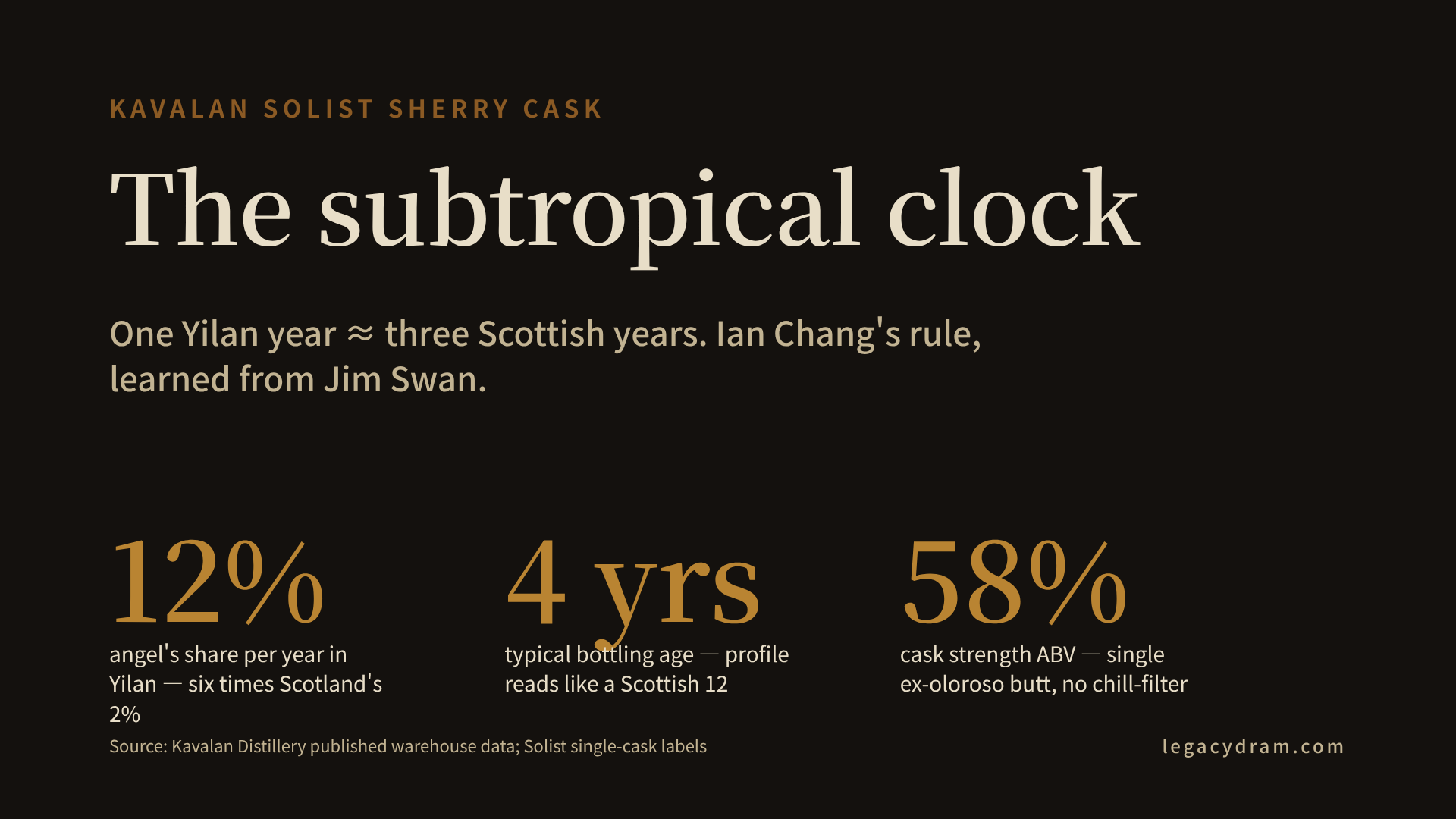
The chemistry underneath is not exotic. Maturation is a set of temperature-driven reactions between the spirit and the oak: ellagitannins bleeding out of the wood as colour and grip, oak lactones (that “coconut-and-cream” note) leaching through the char layer, esters forming inside the spirit, oxygen creeping in through the barrel’s own porosity and rounding the harsh edges off the new-make. Every one of those reactions accelerates with heat. The Yilan warehouse is a low-grade oven with a lid on it: 22°C average, 80% humidity, and a fifteen-degree day-to-night swing in summer that makes the cask breathe in and out through its own pores, sucking spirit into the wood on the hot afternoon and pushing it back out into the barrel at night. In Speyside the same barrel sees a three- or four-degree swing and effectively just sits there. Ian Chang’s design put the racks on the top floor of the warehouse deliberately, to catch the biggest temperature amplitude the building would deliver.
For a first-fill ex-oloroso butt, what that heat draws out is exactly the profile you smell on a much older Scottish sherry-matured malt: dried fig, prune, espresso, dark chocolate, a hint of varnish under the fruit. Four years in Yilan on a top-floor rack does chemically to a butt what fifteen years does in a Speyside dunnage. It is not a shortcut on the reactions. It is running the same reactions faster, with the same wood, at a real cost in yield.
Three people and one climate
The Solist Sherry Cask has three signatures on it, though only the third one is on the label.
Y.T. Lee, founder of the King Car conglomerate, decided in 2005 to build the first single malt distillery in Taiwan. This was widely called impossible at the time. Taiwan had no whisky-making tradition, the climate was assumed to be too hot for maturation, and every consultant in the industry said the same thing: pot-still malt whisky was a Scottish and, at a stretch, a Japanese product. Lee ignored the consultants and built Kavalan anyway.
Dr. Jim Swan was the cask consultant King Car brought in at the start. Swan had spent his career on wood chemistry — he understood ex-bourbon barrels, STR (shaved-toasted-recharred) casks, ex-sherry butts, and had done pioneering work on how new distilleries in unfamiliar climates could compress the traditional Scottish maturation curve. He designed the cask policy for Kavalan’s first years: what to buy, how to prepare it, how to rotate through warehouse racks. He died in 2017. His methods survived him at Kavalan, at Kilchoman, at Penderyn, at Milk & Honey, at half a dozen other “new world” distilleries — a full catalogue of which we cover in our piece on Jim Swan’s STR cask legacy.
Ian Chang joined Kavalan as its founding whisky maker in 2005 and became master blender in 2015. For his first twelve years he was Swan’s apprentice on the ground in Yilan, and for the next four he ran the programme alone. The Solist series is essentially his: the decision to bottle at single-cask, cask-strength, non-chill-filtered, natural-colour, with the cask number printed on the label, is Chang’s editorial choice about what a Kavalan release should look like. He left the distillery in 2020 to co-found Karuizawa Distillers in Japan, where he is now building the Komoro Distillery in Nagano at 700 metres of elevation — a deliberate inversion of the Yilan bet. Same mentor’s methods, opposite climate, different clock. What we have on the JA side is a longer piece on Ian Chang’s Yilan programme that goes deeper into the rate equations Swan taught him.
The barley Kavalan uses is unpeated malted barley shipped from Simpsons and Bairds in Scotland. That is a deliberate design choice. By taking peat out of the equation entirely, Chang isolated the subtropical maturation variable — you are drinking, in a Solist Sherry Cask, the pure output of heat plus Spanish oak plus time, with no smoke to distract from what the wood is doing.
What it tastes like, in specifics
Poured neat, room temperature, in a copita, from a bottle that was 57.8% ABV on the printed label.
- Nose. Dried figs pulled out of the oven a beat too long, so the sugar at the edges has caught. Prune stewed with cinnamon. Espresso grounds, wet. Dark chocolate — 70% cocoa, not sweeter. Orange peel that has been sitting on a warm plate. Somewhere under all of that, a faint varnish note, the smell of a freshly oiled cricket bat, which is the shellac side of aggressive oak extraction.
- Palate. Heavy body, oily in the mouth, the kind of texture cask strength buys you before water gets involved. Sherry butt vanillin at the front. Molasses in the middle. Toasted almond skin. Bitter chocolate. There is a warm, faintly medicinal note like a black cherry cough syrup — that is the raw ellagitannin the heat has yanked out of the European oak, and it is what gives the whisky its grip.
- Finish. Long. Dried fig again, then espresso, then a slow fade into what tastes like tobacco leaf, though there is no smoke in the spirit. That tobacco note is oak char in disguise.
Add three drops of water and the whole thing opens: the varnish note fades, the espresso becomes coffee-with-cream, and a red-fruit high note comes up under the figs that is unmistakably sherry-butt oxidation. Cask strength is not a dare; it is the state the barrel bottled at, and it is telling you where to add water.
When to drink it — and against what
This is not the whisky you open on a weeknight. The pour is heavy, the profile is dense, and at £120-plus a bottle it is a considered purchase rather than a shelf staple. It is a nightcap, an after-dinner dram, and it wants weight on the plate before it lands: dark chocolate cake, walnut tart, a dried-fruit-and-cheese board, or — my preferred pairing — an unwrapped square of Valrhona 70% and nothing else.
Against the field, on price and profile:
- Macallan 18 Sherry Oak at ¥45,000: the same fig-and-espresso profile, softer body, longer finish, and eighteen years of oxidised smoothness the Kavalan cannot replicate at four. The Macallan is what happens when the same chemistry runs on a slower clock in cheaper wood-hours; the Kavalan is what happens when it runs faster on more expensive ones. You are paying twice the Kavalan price for the extra fourteen years, which is either worth it or it isn’t, depending on what you value.
- Aberlour A’Bunadh at ¥12,000: the Scottish cask-strength oloroso peer. Less refined, more raw, more of a “sherry bomb” than a sherry composition. If you want the same texture on a tighter budget and don’t mind the roughness, A’Bunadh is the honest alternative.
- Amrut Fusion at ¥8,000: the Indian cousin, a different tropical maturation programme entirely. Amrut runs at 50% ABV with a 25% peated Scottish malt component and 75% Indian six-row barley, in a warehouse that also drinks 11–12% a year. It is the closest philosophical peer to Kavalan — a “faster clock, same chemistry” bottling — but the profile is peated-and-fruit rather than sherry-and-fig.
- Miyagikyo Single Malt at ¥10,000: the Japanese comparison sits on the opposite pole, a slow-clock Japanese single malt built on soft water and tall stills, no shortcut and no acceleration. If you want to taste the whole Asian whisky triangle in one evening — subtropical Taiwan, tropical India, temperate Japan — this is the third bottle.
The peated Scottish contrasts on the other axis are useful too. A Lagavulin 16 or Talisker 10 will tell you what maritime peat does inside a slow-clock oak programme; a Bowmore 12 will show you the gentler Islay end. Against any of them the Kavalan reads as the sweeter, oakier, non-peated cousin — a reminder that “Asian whisky” and “peated whisky” are two different arguments.
If you want to drink the sherry-butt argument in its Speyside form for reference, GlenDronach 15 Revival is the classic pour — same wood policy (Pedro Ximénez and oloroso butts, natural colour, non-chill-filtered), slower Scottish clock, fifteen years to Kavalan’s four.
The climate wrote itself into the bottle
Ian Chang was trained by Scottish masters. Jim Swan mentored him for twelve years, teaching him the wood chemistry that Scotland spent two hundred years working out. He came back to Yilan, at 24.7 degrees north with the angels drinking six times faster than they do in Speyside, and decided to run the same chemistry with a different clock. Twenty years later, a Scotch drinker in a Taipei bar cannot tell the difference between his four-year Solist and a Speyside eighteen at three times the price. The climate wrote itself into the bottle. And the Scots who taught him are, in the way teachers are surprised by students who use the lesson to prove the teacher wrong, still slightly surprised.
The next time you pour a Solist Sherry Cask, taste for the ellagitannin grip and the fig-and-espresso weight. That is the top-floor Yilan rack, breathing in and out through the pores of a Spanish butt, twelve percent a year, four years running. That is what you are paying for. It is not a shortcut. It is a different clock, and Ian Chang is the person who decided the clock was worth reading.