The Other Distillery: How Masataka Taketsuru Built Miyagikyo as the Opposite of Yoichi
A Friday evening in June, twenty-two degrees in the kitchen, two Glencairn glasses on the same too-tall table I always use and always complain about. On the left, Yoichi Single Malt. On the right, Miyagikyo Single Malt. Both are Nikka. Both are the no-age-statement flagship. Both are bottled at 45%, and both sit at roughly the same place on the shelf. I poured two fingers into each, no water on the first pass, and gave them fifteen minutes to open.
The first nose tells you they were made on different planets. The left glass is wet driftwood pulled off a beach and dropped on a fire: damp smoke, salt, a thin line of engine oil. The right glass is a pear eaten skin and all, with warmed honey somewhere behind it. Same company. Same founder. And the man who designed the smoky one on the left deliberately built the fruity one on the right to be its opposite.
Tonight I want to write about the bottle most people walk past: the one that exists because a man decided his own first masterpiece was too one-sided to be the whole story.
The man who spent three years looking for soft water
Masataka Taketsuru is the name on both distilleries, and most English-language whisky writing stops at the first one. He learned distilling in Scotland in the early 1920s, came home, and in 1934 built Yoichi in Hokkaido: cold, wet, sea-blasted, peated, fired with coal. If you have read the companion piece on Yoichi (it is in Japanese), you know that bottle: heavy, oily, smoky, the most Scottish thing ever made outside Scotland.
Then he did something unusual. Having proved he could make one great thing, he went looking for a place to make its exact opposite.
It took him three years. The constraint that drove the search was water: specifically soft water, low in dissolved minerals, for the mash. He eventually settled on a wooded valley near Sendai, in Miyagi prefecture, where two rivers, the Hirose and the Nikkawa, run together. The Nikkawa carries meltwater off the Zao mountains and is among the softest distilling water in Japan. The story Nikka tells, and the one I am inclined to believe because it is exactly the kind of thing an obsessive does, is that Taketsuru cut a glass of his own Black Nikka blend with water straight from the Nikkawa, tasted it on the riverbank, and decided on the spot.
The distillery opened in 1969 as Sendai Distillery. It was renamed Miyagikyo in 2001, after Asahi took over Nikka’s management, which is why older bottles and older books call it by a name the labels no longer use.
Here is the part the visitor centre soft-pedals. He did not build a second Yoichi as insurance. He built a deliberate counterweight. Yoichi gives Nikka weight; Miyagikyo gives it lightness; and a blender with both on the shelf can reach notes that neither distillery could hit alone. The romantic reading is “the father of Japanese whisky followed his heart to a beautiful valley.” The engineering reading is that one company decided to own both ends of a flavour axis on purpose. The second reading is the one in the bottle.
Steam, not fire
The single decision that separates these two glasses more than any other is how you heat the pot still.
At Yoichi, they still heat the stills with direct coal fire: an open bed of burning coal under the pot, fed by hand. The flame creates fierce, localised hot spots on the base of the still, and at those spots the sugars and amino acids in the wash undergo the Maillard reaction (the same browning chemistry that gives a steak its crust and toast its edge). Some sugar scorches outright. The result runs heavy, roasted, and oily. That is the driftwood-on-a-fire in the left glass.
Miyagikyo does the opposite. The stills are heated by indirect steam: steam piped through coils inside the still, warming the wash gently and evenly, with no scorching hot spot anywhere. The Maillard reaction stays quiet. Nothing burns. The spirit that comes off is lighter and cleaner before a single other variable is touched.
This is not “better.” It is a chosen trade. Direct fire buys you body and roast at the cost of effort and unpredictability; steam buys you cleanliness and consistency at the cost of weight. Taketsuru, having already banked the heavy end at Yoichi, spent the light end at Miyagikyo. The same hand made both choices, thirty-five years apart.
The tallest stills in Japan, and the second bulge
Steam is only half of it. The other half is the shape of the stills and what happens to the vapour inside them.
Miyagikyo’s pot stills are among the largest in Japan, with tall necks and lyne arms (the pipe carrying vapour off the top of the still) angled upward. The bodies are not plain onions either: above the main belly there is a second, smaller bulge, a kind of waist-and-shoulder profile. All of this serves one purpose, which is to increase reflux.
Reflux is worth one clean sentence, because it explains most of what is in the right glass. When alcohol vapour rises up a tall still and meets cooler copper near the top, the heavier compounds condense back into liquid and fall back down to be re-distilled, while only the lightest, most volatile vapour escapes over the top to the condenser. The taller the still and the more upward the lyne arm, the more of that fall-back happens, and the cleaner and more delicate the spirit. A short still with a downward arm gives you a heavy, oily new-make; Miyagikyo’s tall stills with the second bulge and the upward arm give you the opposite.
Add the soft Nikkawa water on the front end, and every lever points the same way: light, fruity, floral. Yoichi’s coal and squat stills point the other way. Two distilleries, one design philosophy, executed as a mirror image.
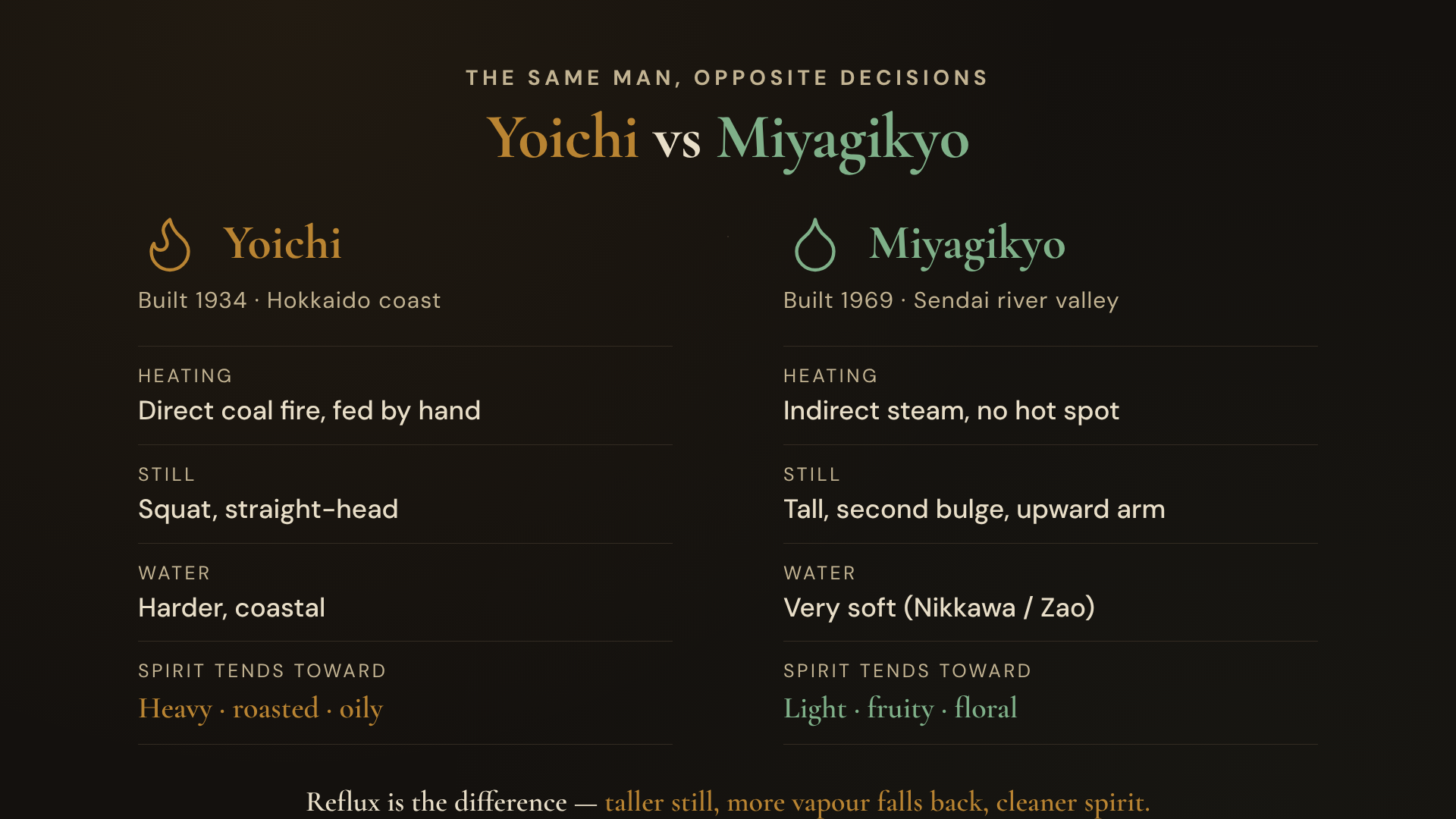
| Yoichi | Miyagikyo | |
|---|---|---|
| Founded | 1934 | 1969 |
| Heating | direct coal fire | indirect steam |
| Stills | squat, straight-head | tall, second bulge, upward arm |
| Water | hard-ish, coastal | very soft (Nikkawa / Zao) |
| New-make tends toward | heavy, roasted, oily | light, fruity, floral |
There is one more thing in this valley worth knowing, because it ties back to a different corner of the Nikka story. In 1999, Nikka moved its two Coffey stills (the continuous columns that make its grain whisky) into Miyagikyo, from the old Nishinomiya plant near Osaka. So the valley that Taketsuru chose for delicate malt is now also where Nikka’s grain spirit is made. If you have read about Takeshi Taketsuru and the Coffey still (also in Japanese), this is where those columns ended up. The fruity malt and the grain backbone of Nikka’s blends now come off the same site.
The glass: pear, not driftwood
Back to the two glasses on the too-tall table.
The Miyagikyo Single Malt, at 45%, opens with that pear-eaten-skin-and-all note, then white peach, then a thin curl of lemon and orange zest. Not juice, but the oil you get on your thumb when you scratch the rind. Under the fruit there is a clean cereal sweetness, like the malty steam off a fresh bowl of porridge before you add anything to it, and a far-off floral note that I can only describe as a flower shop two doors down rather than the flowers in your hand. There is no smoke worth mentioning. Miyagikyo can be lightly peated, but in this bottle the peat is a structural undertone, not a flavour you would name blind.
On the palate it is gentle to the point of being easy to underrate. Honey, almond skin, a dusting of clove and cinnamon near the end, and a soft warmth rather than a kick. The finish is medium and clean and leaves fruit behind, not fire. I will be honest: the first time I poured this expecting “Nikka,” I was a little deflated. I had Yoichi’s oil on my memory and Miyagikyo felt, for thirty seconds, like the polite younger sibling who never raises their voice. That reaction is the trap. The lightness is not an absence of character; it is character that took three years of looking for soft water and a stillhouse full of tall copper to achieve.
Switch back to the Yoichi and the contrast snaps into focus. Same 45%, but the left glass lands oily and roasted on the middle of the tongue, with that cool driftwood smoke behind it. After Yoichi, the Miyagikyo tastes positively luminous: the pear brighter, the florals louder. These two are far more honest about themselves poured side by side than poured alone. Each one confesses what the other is for.
Price, where to find it, and when to pour it
The current Miyagikyo Single Malt is the no-age-statement bottling Nikka made a permanent product in 2016, after the age-stated versions (the old 10, 12, 15) were discontinued in the great Japanese-whisky stock crunch of the mid-2010s. Outside Japan it runs roughly USD 85–95 or GBP 60–70 for a 700ml bottle, and it is, mercifully, actually available, widely stocked in the UK, the US, and Europe, unlike the unicorn age-stated Nikkas that now trade for absurd money at auction. If you want to taste Taketsuru’s light end without remortgaging, this is the bottle that lets you.
Drink it neat and at room temperature first. The fruit and florals are the whole point and they close up if you chill them or drown them; a few drops of water open the pear further, but start dry. For food, it goes where Yoichi cannot: delicate things. Sashimi, a light dashi, a fruit-forward dessert. Yoichi wants smoked cheese and a seared, Maillard-browned piece of fish; Miyagikyo wants the quiet end of the meal. Owning both means cooking can decide which Nikka you reach for, which is a genuinely luxurious problem.
What to verify next time you pour one
Next time there is a Miyagikyo in the glass, do not go looking for smoke or weight: that is grading it on Yoichi’s exam. Instead, check three things.
First, the fruit. Is it pear-and-peach orchard fruit, clean and a little floral, rather than dried dark fruit or citrus juice? That brightness is the soft Nikkawa water and the tall stills working together: the lightest vapour selected out and everything heavy left behind in the pot.
Second, the cleanliness. Notice what is not there: no roast, no scorch, no oily weight sitting on the middle of your tongue. That absence is the steam coils refusing to make a hot spot. It is an achievement disguised as a lack.
Third, the reflux signature: the way the whole thing feels lifted and delicate rather than dense. That is the second bulge in the still and the upward lyne arm sending the heavy fraction back down to be re-distilled, over and over, until only the light part escapes.
If those three are there, you are tasting a deliberate opposite. Taketsuru could have built a second Yoichi and doubled his insurance. Instead he spent three years finding water soft enough to make whisky that his first distillery, by design, could never make. The bottle most people walk past is the one where he proved he could do it twice, in two directions. Pour it next to Yoichi and you can taste the same man disagreeing with himself, on purpose, and being right both times.
Try this bottle
Affiliate link below. If you buy through it, LegacyDram earns a small commission and the price you pay does not change. Alcohol-related links are intended for readers of legal drinking age (20+ in Japan, 21+ in the US).
Related reading
- Shinjiro Torii, Shirofuda, and the 1929 Bet on the Japanese Palate: the other founding figure of Japanese whisky, and the opposite commercial instinct: build for the local tongue first, not the Scottish template
- The Reflux Equation: Why Glenmorangie’s Stills Are 5.14 Metres Tall (and What Bill Lumsden Inherited): the same physics that makes Miyagikyo light, pushed to its tallest-still extreme in the Highlands
- 余市シングルモルトと石炭直火蒸留 (Yoichi Single Malt and direct coal firing): the heavy-end companion to this bottle, the distillery Miyagikyo was built to oppose (Japanese)
Sources
- Miyagikyo distillery — Nikka Whisky official
- Miyagikyo Single Malt — Nikka Whisky brands
- Miyagikyo distillery — Wikipedia
- Miyagikyo (Nikka) Distillery — whisky.com database
- “Diverse Distillation: Miyagikyo Distillery” — Mark Littler Ltd
- Miyagikyo distillery profile — Whisky For Everyone
- Dave Broom, The Way of Whisky: A Journey Around Japanese Whisky (Mitchell Beazley, 2017)
- Stefan Van Eycken, Whisky Rising (Cider Mill Press, 2017)