Aberfeldy 12 vs 21: MacLeod's Sherry Bill, 40%
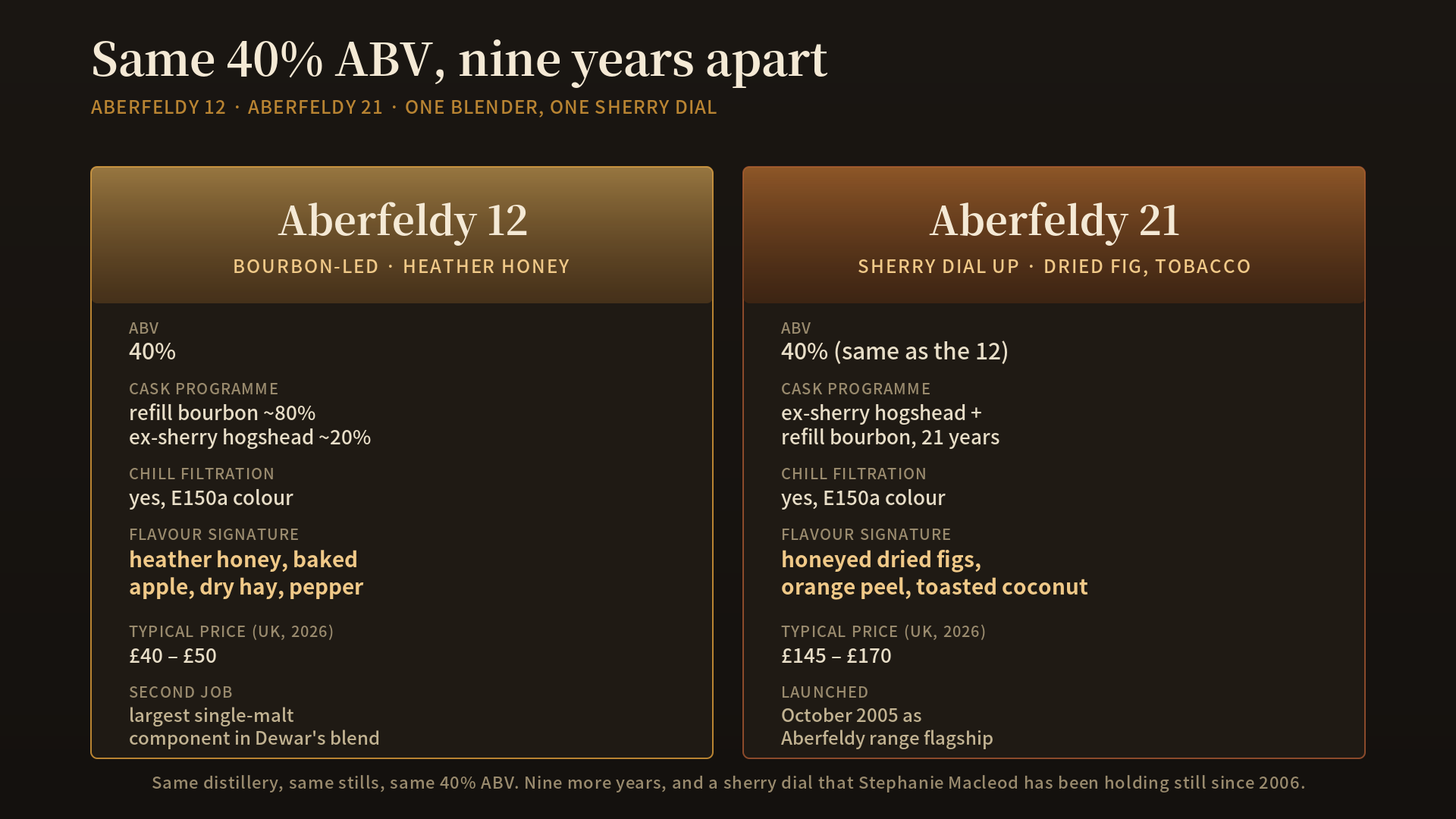
I poured Aberfeldy 12 and Aberfeldy 21 side by side on a Wednesday evening in September, two Glencairns on the same coaster, room temperature, no water, no plan. The 12 was warm amber, the way maple syrup looks against a west-facing window. The 21 was a shade darker — copper leaning into old rose gold — and the difference between the two glasses was the entire story before I had taken a sip of either. Same distillery. Same Pitilie Burn water. Same 72-to-88-hour fermentation. Same shell-and-tube condenser stills the Dewar family installed with Forsyths in the 1972 refurbishment. Same 40% ABV on both labels. The only variable that changed between the two glasses was nine more years in oak and a wider ex-sherry share of the cask bill.
That variable is the one Stephanie Macleod — Master Blender at John Dewar & Sons since July 2006, and the person who signs off on every bottle of both of these — has held in position for two decades.
The flagship she inherited nine months before the job
I want to start with a small chronological fact that the marketing does not lean on. Aberfeldy 21 launched in October 2005 as the new flagship of the Aberfeldy single-malt range, over the signature of Macleod’s predecessor Tom Aitken. Nine months later, in July 2006, Macleod stepped into the Master Blender chair. The 21-year-old that has been on the shelf ever since is, in a strict sense, a bottle she inherited rather than one she designed. It is also, in every practical sense, a bottle she has now signed off on for two decades running — longer than Aitken had it in production. It is her bottle now.
The interesting part of that inheritance is that Aitken and Macleod are, judging by what has and has not changed since 2005, aligned on the same idea of what Aberfeldy 21 is for. Both put it out at 40% ABV. Both chill-filtered it. Both used the standard caramel adjustment to keep the colour in bottle stable across batches. Both leaned the cask programme on refill bourbon barrels with a wider share of ex-sherry hogsheads than the 12 gets. Both let it sit in oak for a full 21 years before pulling it. In an industry where a change of master blender is often the trigger for a re-launched flagship at a higher ABV and a fancier finish, Macleod’s answer for the last twenty years has been to leave the recipe where she found it. That is a whole design philosophy, expressed by absence.
The 2024 Aberfeldy 21 Malbec Cask Finish — 46% ABV, non-chill filtered, natural colour, eight months in French oak Argentine Malbec casks in collaboration with winemaker Daniel Pi at Finca Ambrosia — is her proof that the alternative exists. She can, and does, push the 21-year-old spirit into a 46% cask-strength-adjacent presentation when the brief is a limited release for the collector shelf. What she does not do is put that treatment on the flagship. The flagship stays at 40%, chill-filtered, with the honey signature intact. Two different customers, same warehouse.
What actually changes between age 12 and age 21 in an oak cask
The distillery does not publish the exact ex-bourbon to ex-sherry ratio for either bottle. Working from cask-strength single-cask Aberfeldy releases and from the ex-sherry-heavier 18-year-old that sits between the two in the range, the standard assumption is something like an 80/20 bourbon-to-sherry cask bill for the 12 and something meaningfully closer to 60/40 or 55/45 for the 21, with the sherry casks doing more of the flavour work on top of a longer maturation.
Two things happen to Aberfeldy new-make spirit as it sits in oak between year 12 and year 21, and both of them are visible in the glass.
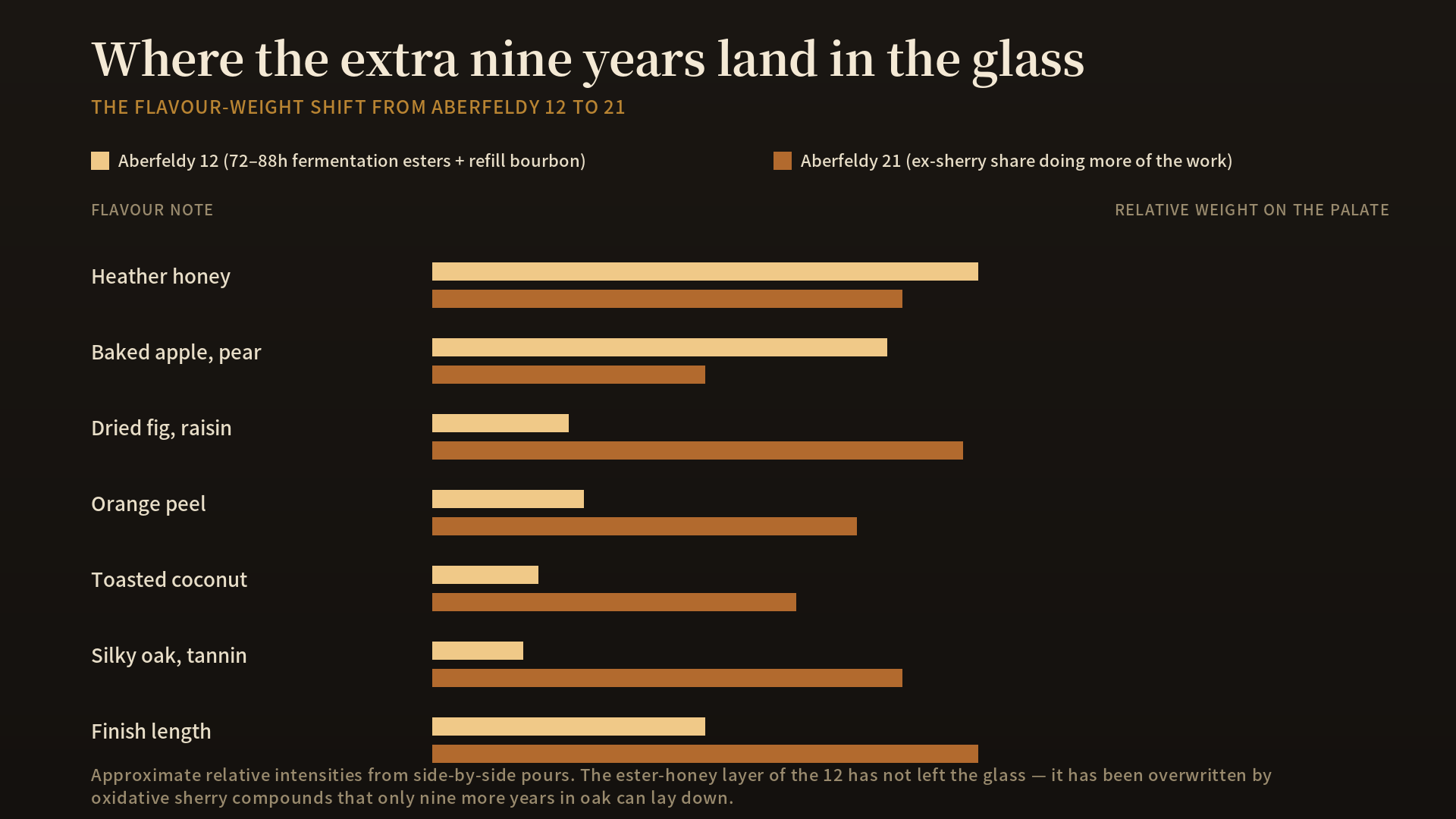
The first is oxidation through the cask walls. Oak is porous. Over nine additional years, small amounts of atmospheric oxygen keep reaching the spirit and slowly transforming the ester layer — the fruity apple-pear-honey compounds the long Perthshire fermentation laid down — into heavier, less volatile molecules. The bright pear-drop note softens. The apple loses its skin-crisp edge and gains a baked, almost dried-apple weight. The honey stops smelling floral and starts smelling more like the caramelised layer at the top of a pot of honey that has been left near a warm stove.
The second is ellagitannin extraction from the sherry oak. European oak (Q. robur / Q. petraea), the standard sherry-cask species, is dense with hydrolysable tannins that migrate into the spirit slowly. Over twenty-one years, with a wider ex-sherry share to draw from, the drying tannic layer builds up until it becomes a visible mouthfeel — the slight astringent grip on the back of the tongue that a young bourbon-matured malt does not have. Combined with the oxidised sugars from the sherry itself soaking into the wood, this is what produces the dried fig, raisin, orange marmalade register that any independent taster reaches for when describing an Aberfeldy 21.
The 21 is not louder than the 12. The 21 has a different balance of the same underlying spirit. The heather-honey base note is still there. It has just been overwritten, on top, by a sherry-and-oak signature the 12 does not have room to build.
Two Glencairns on the same coaster
Back to the Wednesday. Both pours had ten minutes to open, no water added, side by side on a plain wooden coaster. This is the honest report.
Aberfeldy 12, 40%. Nose: heather honey from a wax-sealed jar, baked apple skin, a thread of lemon zest that arrived on the third sniff. Underneath, a faint note of toasted oats. Palate: 40% light body, the centre of the tongue rather than the sides. Honeycomb wax, brown sugar on porridge, a whisper of almond. The finish is short-to-medium, dry hay and soft vanilla, and the tiny prickle of white pepper I remember from the last time I poured this one. Nothing has changed in the 12 since the last review — which is precisely the point.
Aberfeldy 21, 40%. Nose: the honey is still there, but the wax-jar note now comes with warm, oven-softened figs on top of it, and a genuine hit of orange peel that is not there in the 12. Behind those, a soft toasted-coconut note (the whisky-lactone signature of long bourbon-cask maturation, showing through the sherry) and a whisper of dry tobacco leaf. Palate: the same 40% light body — this is the surprise if you were expecting the 21 to feel heavier — carrying dried fig, orange marmalade on brown toast, a fine grain of almond, and a slow drying-tannin grip that arrives late on the back of the tongue and stays. The finish is longer than the 12’s, cocoa-adjacent, with the sherry-oak dryness lingering past the point where the 12 has already left the glass.
Add a single drop of water to the 21 and the fig softens toward date, the marmalade loosens, and the finish shortens by a beat. I preferred it neat. Your kilometre may vary.
The honey seam between the two bottles is what I would have you pay attention to. In the 12, the heather-honey nose is unavoidable and reads as the whole story. In the 21, the same honey layer is still present underneath, but you have to hunt for it — the sherry and oak have moved on top of it. Sniff for the honey first in the 21, then chase the fig; you can feel the layer boundary as a small sensory shelf. That shelf is what nine more years and a wider ex-sherry share do to Aberfeldy new-make spirit.
The 40% decision, and why it holds
There is one question that every serious Aberfeldy drinker eventually asks, and it is this: why is the 21-year-old flagship still at 40% ABV, chill-filtered, when almost every peer at the £150-plus single-malt price band has moved to 46% or higher and gone non-chill filtered? Rachel Barrie’s GlenDronach 21 Parliament sits at 48% NCF. Sandy Hyslop’s Ballantine’s 17 stayed at 40% but Ballantine’s 21 pushed to 43%. Bill Lumsden’s Glenmorangie 18 sits at 43%, still chill-filtered but a step up in strength. The 40% chill-filtered treatment is, in 2026, a minority position at this age.
Macleod’s answer is the whole reason I wanted to write this comparison. The Aberfeldy range is a single presentation, from the 12 to the 21, with the flavour weight shifting inside a fixed alcohol frame. Push the 21 to 46% and you break the range. The 12 drinker who trades up cannot recognise the bottle. The gift-market customer who wants the 21 as a signature Perthshire flagship gets a spikier, more astringent pour than they were told to expect. The Dewar’s blend side of the business — where Aberfeldy malt is the largest single-malt component — loses its most important shelf reference for what “Aberfeldy character” means at retail.
Keeping the 21 at 40% chill-filtered, in a bottle that looks and behaves like the 12 with more colour and more sherry weight, is the version of the flagship that keeps the whole line coherent. It is a Bacardi-owned brand’s answer to house consistency, and it is also — I want to give Macleod the credit here — a thoroughly defensible answer. If you want the same spirit at 46% cask-strength-adjacent, you pay double again and buy the Malbec Cask Finish. The flagship stays where it is.
This is the same logic Sandy Hyslop applied for twenty years at Chivas Brothers: the master blender’s most important responsibility is often the flagship they inherited, and the biggest decision is the one to not change it. Ballantine’s 17 stayed George Robertson’s 1937 recipe on Hyslop’s watch. Aberfeldy 21 stays Tom Aitken’s 2005 recipe on Macleod’s. In both cases the blender’s name does not appear on the front label, and the consistency across two decades of production is the invisible product.
It is also the counterweight to what Rachel Barrie built at BenRiach, GlenDronach and Glenglassaugh — a different contemporary female master blender working at comparable scale, who chose the opposite: push each distillery hard toward its own signature, at higher ABVs, with NCF the default. Two answers to the same question, and both women win Master Blender of the Year on different years for different reasons. Barrie for range and range-difference; Macleod for holding a signature still.
What to confirm next time you pour one
If you have both bottles in front of you — and I recognise that £150 for the 21 is a lot of money to spend for a comparison — the specific thing to verify is the layer boundary between honey and sherry in the 21.
Pour the 12 first. Give it five minutes in a Glencairn. Confirm the heather-honey nose and the baked-apple palate. That is your reference for what the underlying Aberfeldy new-make spirit smells like after twelve years in mostly-bourbon casks.
Then pour the 21 alongside it. Sniff for the honey layer first — it is still there, deeper in the glass, underneath the sherry. Then chase the fig, marmalade and coconut sitting on top. You should be able to feel the seam between the two layers as an almost physical shelf, the way you can feel the join between two layers of a well-made trifle without disturbing either. That seam is what nine more years of oxidation through porous oak, plus a wider ex-sherry share, do to the same spirit.
If you do not have the 21, the Aberfeldy 12 review from earlier this year is the reference for the honey signature at its purest. The 21 is that signature under a sherry blanket. Same recipe, wider dial.
Stephanie Macleod inherited the flagship nine months into her first year and has held it steady for twenty. Nothing about the bottle says so. The bottle just says Aberfeldy 21, 40%, and the man on the back label is Tommy Dewar, who died in 1930 and has never blended a batch. The chemist who has kept the recipe in alignment with itself since Blair’s final term is not named. In this industry, that is what a job well done looks like.
The next time you reach for an Aberfeldy 21, you are drinking a Perthshire spirit that has spent nine more years in a wider ex-sherry hand than the 12, at the same 40% frame, under the same signature held by the same woman for two decades. The sherry share is not louder. It is patient. Nine years of patient.
Try this bottle
Affiliate link below. If you buy through it, LegacyDram earns a small commission and the price you pay does not change. Alcohol-related links are intended for readers of legal drinking age (20+ in Japan, 21+ in the US).
- Aberfeldy 21 Year (700ml) on Amazon.co.jp
- Aberfeldy 12 Year (700ml) on Amazon.co.jp — the reference point for the honey signature at 40%
Related reading
- Aberfeldy 12 Review: Heather Honey, 40% ABV — the underlying reference on the ester chemistry, the shell-and-tube stillhouse, and Macleod’s laboratory-to-Master-Blender arc. The 21 is that recipe with nine more years and a wider sherry share.
- Sandy Hyslop: 20 Years of Ballantine’s 17 at Chivas Brothers — the direct parallel. A master blender’s most important responsibility is often a bottle they inherited, and the design philosophy is expressed by refusing to change it.
- Rachel Barrie and the Blend Matrix: BenRiach, GlenDronach, Glenglassaugh — the opposite contemporary answer. Barrie pushes each distillery toward its own signature at higher ABVs; Macleod holds a fixed 40% frame across an entire range. Both are Master Blender of the Year winners.
- VAT 69: The 1882 Blind Tasting That Chose Sanderson’s Blend — the deep-history counterpart on how a house-style single presentation gets chosen in the first place, before anyone starts holding it steady across generations of master blender.
Sources
- Aberfeldy distillery official, 21 Year Old page — aberfeldy.com
- Difford’s Guide, Aberfeldy 21 Year Old — diffordsguide.com
- Whisky Advocate, “Aberfeldy’s New 21 Year Old Malbec Cask Finish” — whiskyadvocate.com
- The Spirits Business, “Aberfeldy adds Malbec finish to wine cask range” — thespiritsbusiness.com
- Master of Malt, Aberfeldy 21 Malbec Cask Finish — masterofmalt.com
- Dewar’s, “double aged” blending process — dewars.com
- Bacardi corporate, “Stephanie Macleod Wins ‘Master Blender of the Year’ for Record-Breaking Sixth Time” — bacardilimited.com
- Wikipedia, Aberfeldy distillery — en.wikipedia.org
- Whisky Magazine, “Master blender Stephanie Macleod on the future of Dewar’s” — whiskymag.com
- Charles MacLean, Whiskypedia (Birlinn, 2014)
- Dave Broom, The World Atlas of Whisky (Mitchell Beazley, 3rd ed. 2020)