Amrut Fusion Review: 4-Year Bangalore, 50% ABV
The first time someone poured me an Amrut Fusion, they made me guess the age before they showed me the bottle. I sniffed, tasted, sat with it for a minute, and said “fourteen, fifteen?” — there was that mellow, oxidised, slightly figgy depth I associate with a Scotch that has been sitting in a cask through a couple of British recessions. The actual answer is that the whisky in the glass had spent about four years in wood. I was off by a decade, and not because I have a bad palate. I was off because I was reading the whisky as if it had been aged in Scotland, and it had not. It had been aged in Bangalore, where time runs at a different speed.
I had it neat, at room temperature, in a standard copita, next to a young Speyside of roughly the same actual age so I could feel the gap. The Speyside tasted like what it was: a four-year-old, all raw spirit and pale new oak, not ready. The Amrut tasted finished. That is the whole strange pleasure of this bottle, and it comes down to a number most drinkers never think about — the rate at which whisky disappears from the cask while you are not looking.
The bottle, before the heat
Amrut Fusion is bottled at 50% ABV, non-chill-filtered, and sits at around £45–55 on the British market (roughly $60–75 in the US, and widely available in Japan in the ¥7,000–9,000 band). For a single malt that gets talked about the way this one does, it is cheap, and it is the bottle I hand to anyone who still thinks “Indian whisky” means a cheap molasses blend. It is stocked in most decent specialist shops. You do not have to chase it.
Here is what I taste, and what I think each note is actually made of:
- Candied orange peel pulled through smoke. The fruit hits first — proper marmalade, the kind left on the toast a beat too long so the sugar catches and goes bitter at the edge — and the smoke sits behind it rather than on top of it.
- Barley you can almost chew. A thick, cereal sweetness, like porridge with brown sugar stirred in. This is the Indian malt talking, and it gives the whole dram a body that the price has no business buying.
- Young oak with a blue, spiky edge. A note like biting the end of a fresh pencil — bright, slightly raw spice. This is the tell that the wood is young, even though the fruit is reading old.
- A bonfire two gardens away. The peat never arrives as a wall. It is a thread of woodsmoke under the orange, present on the finish, gone before it turns into an ashtray.
That third note is the honest one. The fruit and the oxidation say “old whisky”; the bright, spiky oak says “young whisky.” Both are true at once, and the reason is a warehouse.
The angel drinks faster in Bangalore
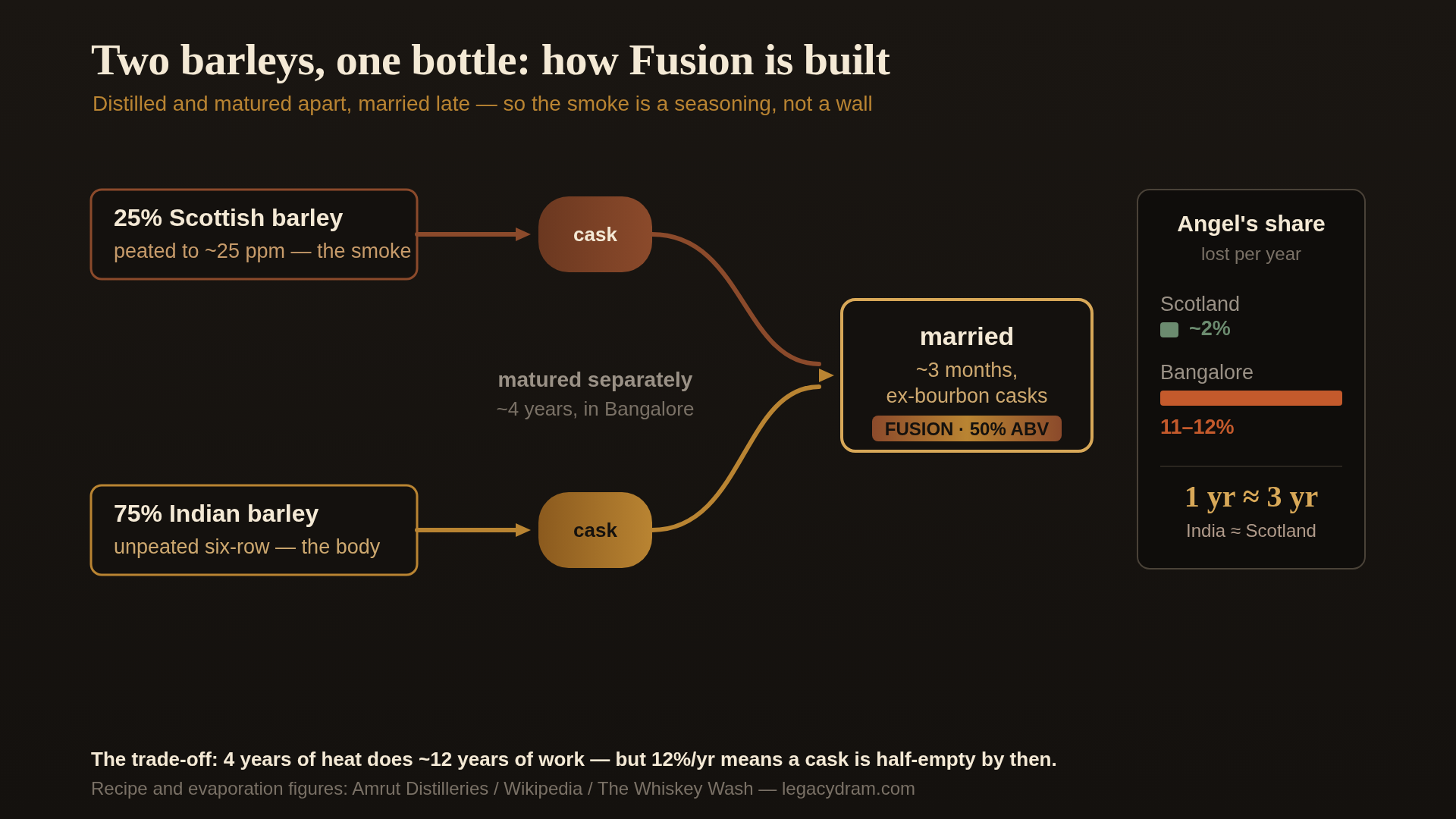
Every cask of maturing whisky leaks. Spirit evaporates through the wood, and the share that disappears into the air is called, with more romance than the accountants would like, the angel’s share — the portion of every barrel that the angels take before you ever get to it. In a cool, damp Scottish warehouse, the angels are abstemious: they take about 2% a year. In Amrut’s warehouses in Bangalore — on a plateau at roughly 3,000 feet, but tropical and hot — they take 11 to 12% a year. (Wikipedia)
That single difference rewires everything. Maturation is a set of temperature-driven chemical reactions — the spirit pushing into the wood and pulling colour, tannin and vanilla back out; oxygen creeping in and rounding off the harsh edges; esters forming that read as fruit. Heat is the accelerator on all of it. Amrut’s own rule of thumb, which their master blender has repeated for years, is that one year of maturation in Bangalore is worth about three years in Scotland. (The Whiskey Wash) A four-year-old Fusion is, by that arithmetic, doing an impression of a twelve-year-old Scotch — which is exactly the bottle I tasted, and exactly why I guessed so badly.
Now, the temptation is to call this a free lunch: same flavour, third of the time. It is not. When the angels take 12% a year, the maths is brutal — after four years a cask has lost roughly half its contents to the air. That is wood worn out fast, casks you cannot re-use as many times, and a hard ceiling on how old you can take the spirit before there is simply nothing left in the barrel to bottle. Scotland’s slow angels are the reason a 25-year-old Scotch can exist at all. In Bangalore, a 25-year-old single malt is more or less a physical impossibility; the angels would have drunk the lot. Fast maturation is not a cheat code. It is a trade: you buy intensity and speed, and you pay in yield and in the long-aged expressions you will never be able to make.
The man who designed around the heat
The person who decided to treat that heat as a feature rather than a defect is Surinder Kumar, Amrut’s long-serving master blender. Kumar is not a marketing invention bolted onto a backstory; he trained in food technology at the research institute in Mysore, started out as a working chemist, and then spent the better part of two decades inside Amrut learning what the Indian climate does to spirit. (Global Indian) He is the one who put a number on the three-to-one maturation ratio, which is to say he is the one who decided you could plan a whisky around it.
His design decision is in the name. Fusion is 25% peated Scottish barley and 75% unpeated Indian six-row barley — and the two are not simply mashed together. They are distilled separately and matured separately, in their own casks, for around four years, and only then married for about three months in ex-bourbon wood before bottling. (Wikipedia, Master of Malt) The Scottish barley is peated to roughly 25 ppm, so it brings the smoke; the Indian barley brings that thick, chewable cereal weight. Keeping them apart until the end is the engineering. If you peat the whole mash, the smoke flattens the fruit. By running two separate spirits and joining them late, Kumar gets to dial the smoke as a seasoning — a quarter of the blend — over a base that is all Indian malt and tropical-fast oak. That is why the peat in the glass reads as “bonfire two gardens away” and not “I am drinking an Islay.” It was metered in on purpose.
Two barleys, two grain types, two climates of origin, joined at the last possible moment. The word Fusion is doing real work; it is not a flavour adjective, it is a description of the build.
The bet underneath the bottle
None of this would matter if nobody outside India had been willing to take it seriously, and for a long time nobody was. Indian whisky meant, to the Scotch-drinking world, cheap molasses-based spirit — not malt at all. The wedge that changed that was, of all things, a student dissertation: Rakshit Jagdale, of the founding family, was sent to investigate the UK export market while doing an MBA at Newcastle, and wrote his thesis on marketing an Indian single malt in the home of whisky itself. (Wikipedia, Amrut Distilleries) The brand launched not in Mumbai but in Glasgow, on 24 August 2004 — which takes a particular kind of nerve, walking the first Indian single malt into the one city most entitled to laugh at it.
It worked, and then it worked almost too well. In his 2010 Whisky Bible, Jim Murray named Fusion the third-finest whisky in the world, and the bottle went from curiosity to cult overnight. (Wikipedia) It is worth being honest about that moment rather than just repeating it as a trophy: a single influential reviewer’s superlative is a marketing event, not a law of nature, and “third best in the world” is the kind of line that sells bottles long after anyone has stopped asking whether it was ever a measurable claim. The good news is that the whisky underneath the hype is genuinely worth the shelf space — which is rarer than the hype itself.
Three ways to cheat time
Amrut is not the only new-world distillery that figured out how to make whisky taste older than it is, and the comparison is the interesting part. The late Jim Swan built an entire consultancy on compressing maturation with wood — his shaved-toasted-recharred casks give young spirit a head start by re-energising the oak. That is time bought through the barrel. Kavalan in Taiwan does it with heat, the same lever Amrut pulls, choosing a hot, humid climate and letting the accelerated angels do the work — a single control variable, turned up (covered in our Japanese piece on Ian Chang and Kavalan’s subtropical maturation, in Japanese).
Amrut sits a step beyond both. It takes the heat as given, the way Kavalan does — but then adds a second decision on top of it, fusing two different barleys to control what that fast, intense maturation acts on. Swan compresses time with wood; Kavalan compresses it with climate; Amrut compresses it with climate and then composes the input. Same problem — make young whisky taste resolved — three genuinely different answers.
Next time you pour one
Buy the Fusion. It is cheap, it is stocked, and it is the most articulate cheap single malt I know for tasting an idea rather than just a flavour. Pour it neat first, at room temperature, in a glass that narrows at the top. Then, if you want to feel what Bangalore actually did, put a young Scotch of roughly the same age beside it — anything four or five years old — and taste them back to back.
What you are checking for is the seam. The Amrut should taste older than the Scotch in its fruit and its roundness, and yet you should still be able to find the young, spiky oak underneath if you look — the pencil-edge note that gives the real age away. Hold both of those in your mouth at once. That contradiction is the whole bottle: tropical heat doing twelve years of work in four, and a master blender who built the recipe to spend that speed wisely instead of pretending it wasn’t happening. You are tasting a decision to stop apologising for the climate and start designing around it. It costs about fifty quid, and the angels already took their half.
Related reading
- Jim Swan and the Cask That Shaved Years Off Time — compressing maturation through the wood (STR casks) rather than the climate; the man who built the modern new-world distillery playbook
- Ian Chang and Kavalan’s Subtropical Maturation — (in Japanese) the other tropical-fast single malt, and the cleanest contrast: heat as a single control variable
- The Purifier on a Peated Still: Ardbeg 10 — how peat ppm gets metered into a spirit, the Islay way
Sources
- Amrut (whisky) (Wikipedia) — en.wikipedia.org/wiki/Amrut_(whisky)
- Amrut Distilleries (Wikipedia) — en.wikipedia.org/wiki/Amrut_Distilleries
- The Whiskey Wash — Amrut Whisky: The Ultimate Guide to the Indian Whisky Giant
- Global Indian — How Master Blender Surrinder Kumar is putting Indian whiskey on the global map
- Master of Malt — Amrut Fusion 70cl
- Amrut Distilleries — Leadership