John Glaser at Compass Box: The Transparency Fight He Lost Twice
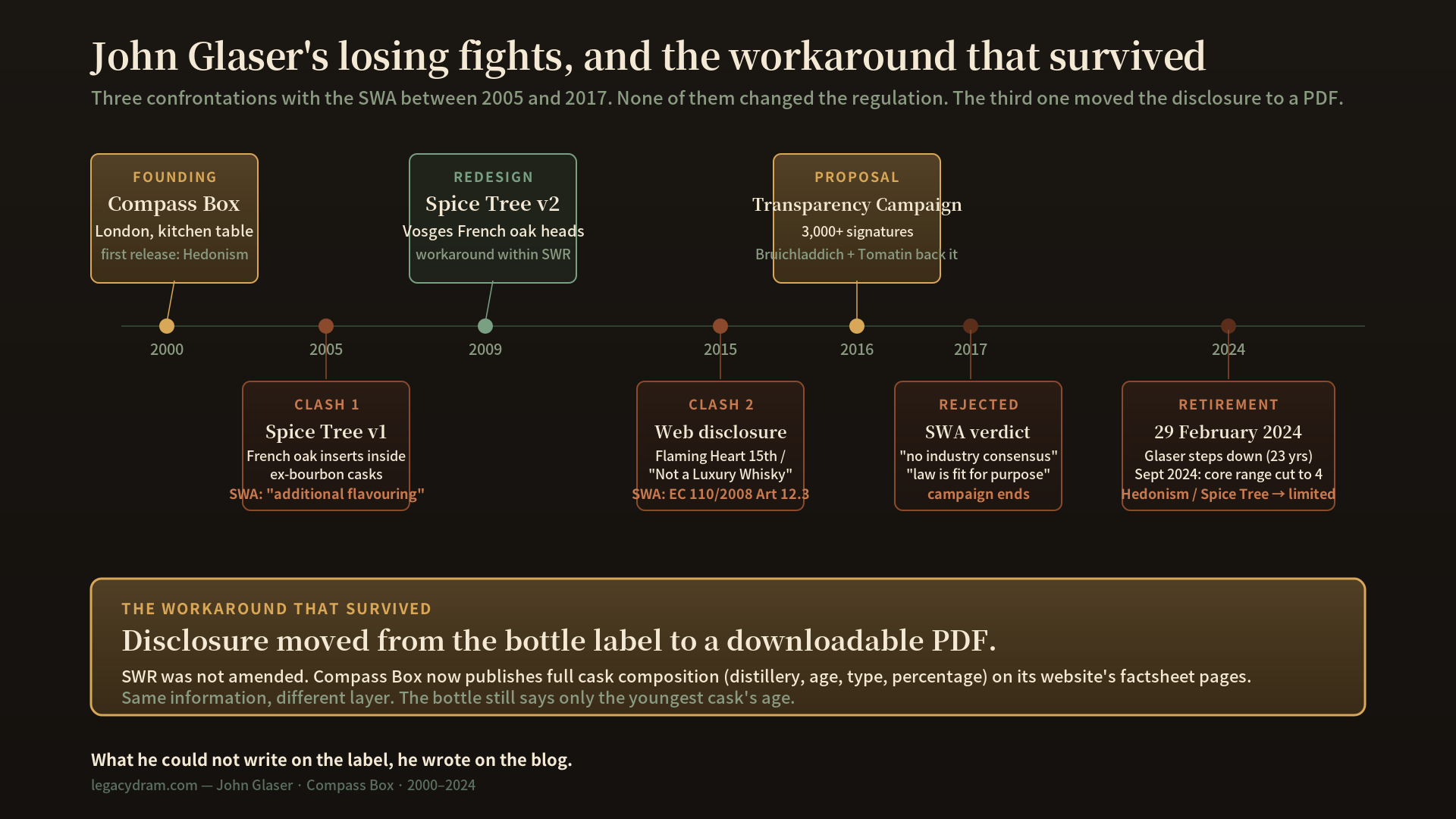
In autumn 2015, a small London blender called Compass Box published a document on its website that broke a rule nobody outside the industry knew existed. The document was a factsheet for two bottlings, the Flaming Heart 15th Anniversary edition and one called This Is Not a Luxury Whisky. It listed every constituent malt and grain in each blend by distillery, by age in years, and by percentage of the total. That kind of disclosure, in the century-and-a-half history of Scotch, had been done almost never. Within weeks the Scotch Whisky Association had issued a formal notice: the disclosure was in breach of European regulation. Compass Box took the pages down. Then it launched a campaign to change the regulation.
The founder’s name is John Glaser. I want to talk about how a former marketing director at Johnnie Walker ended up as the industry’s most public dissenter, and why the fight he lost is still shaping what you can and cannot read on the back of a bottle.
The marketing man who bet on grain
Glaser grew up in Minnesota, took a degree at Miami University in Ohio, and spent his twenties in the wine trade, first in Burgundy, then in Napa Valley. He arrived at the Scotch industry sideways, through the marketing organisation at Diageo’s Johnnie Walker in the 1990s. Trade press from the period lists his exit title as Global Marketing Director. In 2000 he resigned that job and founded Compass Box on the kitchen table of his flat in west London.
The first release, Hedonism, was a blended grain Scotch: made entirely of grain whiskies, no single malt anywhere in the recipe. Grain is the category most Scotch drinkers cannot name because they have only ever met it as the invisible backbone of blends. A man who had spent the previous decade watching Johnnie Walker’s blended architecture from the inside came out of that building and, as his first move, put grain in the lead role. The choice reads like a statement, and probably was, but I do not think it was aimed at Diageo. It reads more like a man rearranging his own curiosity. It cost him nothing to send a signal because nobody was watching yet.
The two regulatory collisions came later, and they were the reason anyone started to watch.
First collision: Spice Tree, 2005 to 2009
The first fight was about wood chemistry, not labels.
In 2005 Compass Box released The Spice Tree. The recipe was an ex-bourbon cask, seasoned in the ordinary way, but with narrow staves of French oak hung inside the barrel during a secondary maturation. The idea was to introduce the spicy, tannic congeners of French oak at the same time as the vanilla lactones of American oak, in the same cask. It was not a finish, in the industry sense of transferring the spirit to a second cask type. It was a hybrid environment inside a single vessel.
The SWA read this as additional flavouring. The definition of Scotch requires that flavour be derived from traditional oak-cask maturation alone, and inserting fresh wood into a spent cask, in their reading, crossed that line. In 2006 Compass Box withdrew Spice Tree from production.
What Glaser did next is the interesting part. He spent roughly three years working out where the boundary was, and in September 2009 relaunched Spice Tree with a different construction: the cask heads, meaning the flat wooden ends of the barrel, were replaced with heavily toasted Vosges French oak, while the side staves remained American oak. Rebuilding a cask’s heads is a traditional cooperage operation, so the redesigned Spice Tree fell inside the SWA’s interpretation of ordinary practice. The spice character survived, in a slightly quieter form, without the technical violation.
Engineers will recognise this shape. It is a workaround that does not break the spec but delivers the feature through an approved code path. I would like to say it was a stroke of design brilliance. In fact it was three years of trial-and-error with the trade body, and what Glaser actually deployed was not inventiveness but patience. He learned, on this first fight, exactly where the SWA drew its lines and how much give there was around each one.
Second collision: transparency, 2015
Ten years later, the second fight was not about the wood in the cask but about the information about the wood in the cask.
The Flaming Heart 15th Anniversary bottling came with an unusual companion piece: a PDF, hosted on the Compass Box website, listing every component in the blend. The strategist notes for this article ask me to keep the distillery list short, so I will say the disclosed components included a small percentage of a very old Caol Ila alongside stocks from other closed and long-aged houses, with the age and percentage of each one written out. Nobody in modern Scotch had published this level of detail. Within weeks the SWA issued a violation notice, citing Article 12.3 of EC Regulation 110/2008. The relevant text says, in effect: if you make an age statement, it must be the age of the youngest alcoholic component of the blend, and you must not refer to older ages of any component.
The subtlety worth pausing on is that the bottle label was compliant. The name “Flaming Heart 15th” refers to an anniversary, not an age. The problem, in the SWA’s reading, was the marketing material around the bottle (the website factsheet), because listing the age of a thirty-year-old constituent in a fifteen-year-old blend could imply to a consumer that the whole bottle was older than its youngest component. The consumer protection concern is not unreasonable. Historic abuses of age statements in the 1970s and 1980s are the reason the rule exists.
Glaser’s counter-argument was that the rule was a floor, a guarantee of minimum age, and that voluntary disclosure of older components was a ceiling, extra information, a different kind of speech. In principle these two ideas can be separated. In the actual text of Article 12.3, they could not. Any disclosure of an older component’s age, however voluntary, however carefully footnoted, was a violation.
Compass Box pulled the detailed factsheets down between October and November 2015. The fight had lasted, as a public event, about six weeks.
Third decision: taking the fight to the rulebook, 2016
Most companies stop there. On 18 February 2016, Compass Box launched the Scotch Whisky Transparency Campaign. The proposal was narrow and specific: amend Article 12.3, and the corresponding sections of the UK Scotch Whisky Regulations 2009, to permit optional disclosure of the ages and proportions of all components, in addition to the mandatory youngest-age statement. Not a rewrite. An additive amendment.
More than three thousand consumers signed the online petition. Public support from other producers was thinner. Mark Reynier’s Bruichladdich, which had already spent a decade fighting adjacent battles on terroir and provenance, signed on from Islay. Tomatin, notable as the only SWA member to publicly support the campaign, backed it from Speyside. Kilchoman, the small farm distillery on the west of Islay, also signed. The larger houses stayed silent. Diageo, Pernod Ricard, Edrington, William Grant, all declined to endorse.
I would like to write that Glaser’s campaign succeeded. It did not. In 2017 the SWA published a decision declining to revise the regulation, on the grounds that no industry consensus for change existed and the current text remained fit for purpose. Glaser closed the campaign the same year. His comment to the trade press was that this was “the end of the campaign for now.” The two words at the end are the ones I keep noticing. They read as both a concession and a placeholder.
The doctrine on the other side of the argument
To see what Glaser was arguing against, it helps to look at the doctrine of the man on the other side of the philosophical fence. Alexander Walker (1837-1889), who is the actual architect of the Johnnie Walker brand, decided in the 1860s that the point of a blend was to make each bottle taste identical to the last one, and that all the individual components should be suppressed in the interest of a repeatable house style. Every generation of Johnnie Walker’s Master Blenders since, including Jim Beveridge, the sixth in that lineage, has run some version of that doctrine.
Alexander Walker’s law says: the consumer needs one number, the flavour, and that number should stay stable, and the mechanism by which it stays stable is the blender’s private business.
Glaser’s law says: the consumer needs more numbers than that, and the mechanism should be public.
Both positions are internally coherent, and both can be defended as consumer protection. They just disagree about what the consumer needs to be protected from. Walker’s doctrine protects the consumer from variance. Glaser’s doctrine protects the consumer from opacity. The regulation Glaser fought was, in his reading, the residue of a decision the industry made in the last century to prioritise the first kind of protection and to make the second kind quietly illegal.
The workaround that lives on a server
After the 2017 rejection, Compass Box did not close the factsheets down. It moved them. The bottle labels stayed compliant with Article 12.3 (youngest age only, no reference to older components), but the website kept publishing detailed PDFs for each release, on a page a consumer had to navigate to voluntarily. The trade body’s position and the founder’s position both survived, in different physical locations. The regulator won the label. The founder won the URL.
To translate this into engineering terms, the SWA is the standards body and Article 12.3 is the API spec. Glaser filed an RFC. The RFC was not accepted. His workaround was to keep the spec compliance clean on the primary endpoint (the bottle) and put the extended data on a documentation site that clients could hit if they wanted. This is structurally the same solution he used on Spice Tree in 2009, when he moved the French oak from an unauthorised insert to an authorised cask head. On both fights, the pattern is: comply with the letter of the rule, deliver the feature through a permitted route.
His record against the trade body is, taken as a whole, a losing one. Spice Tree cost him three years of production. The 2015 disclosures came down. The 2016 campaign did not amend the regulation. Compass Box spent most of the twenty-plus years of his tenure in a slightly awkward position relative to the SWA, and the credit it received from the mainstream Scotch establishment was correspondingly reserved.
The thing that survived is smaller than the campaign asked for but larger than nothing: the existence in the public record of an industry-internal proposal to expand disclosure. The regulation is unchanged, but a formal question — how much should a blender be allowed to tell you? — is now attached to it, with a specific date and a specific author.
The leap day exit
Glaser stepped down as head of Compass Box on 29 February 2024, twenty-three years after he founded it. Along the way he had made compromises the transparency argument did not always sit comfortably beside: Bacardi took a minority stake in 2015, and Caelum Capital, an investment fund, became majority owner in April 2022. The independent London blender who quit Diageo in 2000 was not, at the point of his exit, an entirely independent company any more. That is part of the shape of the career too, and pretending otherwise would be exactly the sort of hagiography this site tries not to write.
In September 2024, six months after his retirement, Compass Box reorganised its core range. The four bottles at the front are now The Peat Monster, Orchard House, Crimson Casks and Nectarosity. Hedonism, Spice Tree, and Flaming Heart, the three bottles most identified with Glaser personally, moved to limited-edition status. They are still being made. They are just no longer the storefront. The founder retired on a leap day, which happens once every four years, and the range that came out the following autumn was recognisably not his any more. There is a symmetry to that timing I do not want to over-read.
The last part of the story is quiet enough to miss. The Compass Box website still publishes cask factsheets for every core bottling. The Peat Monster’s PDF, Orchard House’s PDF, the whole set. Distillery names, cask types, ages, percentages. On the bottle, still nothing beyond what the regulation permits. On the server, still everything the regulation would not let him print. He moved the truth from the label to the blog, and it stayed there.
I sometimes wonder whether that counts as winning. If you are an engineer, and you look at the shape of the fix, you probably recognise it as a compromise that keeps the API compliant and the documentation full, and you probably think it is the correct engineering answer to a spec that refused to change. The bottles that came out of the twenty-three years he ran the company are still on my shelf. The information about what is in them is on a server I have to click to reach. He put it there, and the reason it is there is that a rule wrote itself around him, and he chose, instead of leaving or breaking, to build a small parallel document that outlives the rule.
For the Japanese-language treatment of the same story, with the primary sources set out in full, see the companion piece on john-glaser-compass-box-transparency.
Related reading
- Alexander Walker’s consistency doctrine (JA) — the opposite pole of the transparency argument, from the man who invented the modern blended-Scotch playbook in the 1860s.
- Jim Beveridge and Johnnie Walker Ghost & Rare — the sixth Master Blender in the Walker line, and what happened when even he signed off on a bottle that broke the consistency rule.
- Mark Reynier and Bruichladdich (JA) — one of the three producers who publicly supported the 2016 Transparency Campaign, and the terroir-and-provenance argument that fed into it.
- Rachel Barrie’s blend matrix — a very different kind of blender-as-chemist, running three distilleries under one office instead of one blender running one campaign against the trade body.
- Frank McHardy and Springbank’s silent years — the counter-figure: an inheritor rather than a disruptor, protecting an existing practice for eighteen years while Glaser was outside trying to change one.
Primary sources
- Compass Box, official website — the current factsheet PDFs for every core release.
- WhiskyCast, “Compass Box’s Glaser: Transparency in Scotch Whisky Sadly Illegal” (3 November 2015).
- Scotchwhisky.com, “Compass Box launches transparency campaign” (18 February 2016).
- Scotchwhisky.com, “Compass Box ends transparency drive… for now” (2017).
- Whisky Advocate, “Compass Box Founder John Glaser Steps Down” (February 2024).
- Whisky Advocate, “Compass Box Announces New Core Collection” (30 September 2024).
- The Spirits Business, “Compass Box names new majority investor” (April 2022, on the Caelum Capital deal).
- Scotch Whisky Regulations 2009 (SI 2009/2890), UK legislation.gov.uk.
- EC Regulation 110/2008, Article 12.3, on age statements for spirit drinks.
- Charleston City Paper, “John Glaser is breaking some rules with Compass Box Whisky” (May 2012, biographical interview).