Billy Walker: Four Rescues and Independent at 71
Billy Walker’s career has a shape that almost nobody else in Scotch follows.
Most of the names on the back of your bottle work for one company for forty years, outlast several reorganisations, and retire with a long-service pin. Walker spent his first thirty-two years in the industry that way, quietly, as a chemist and master blender for other people’s companies. Then, in his late fifties, when most of his peers were sketching out retirement, he started buying distilleries.
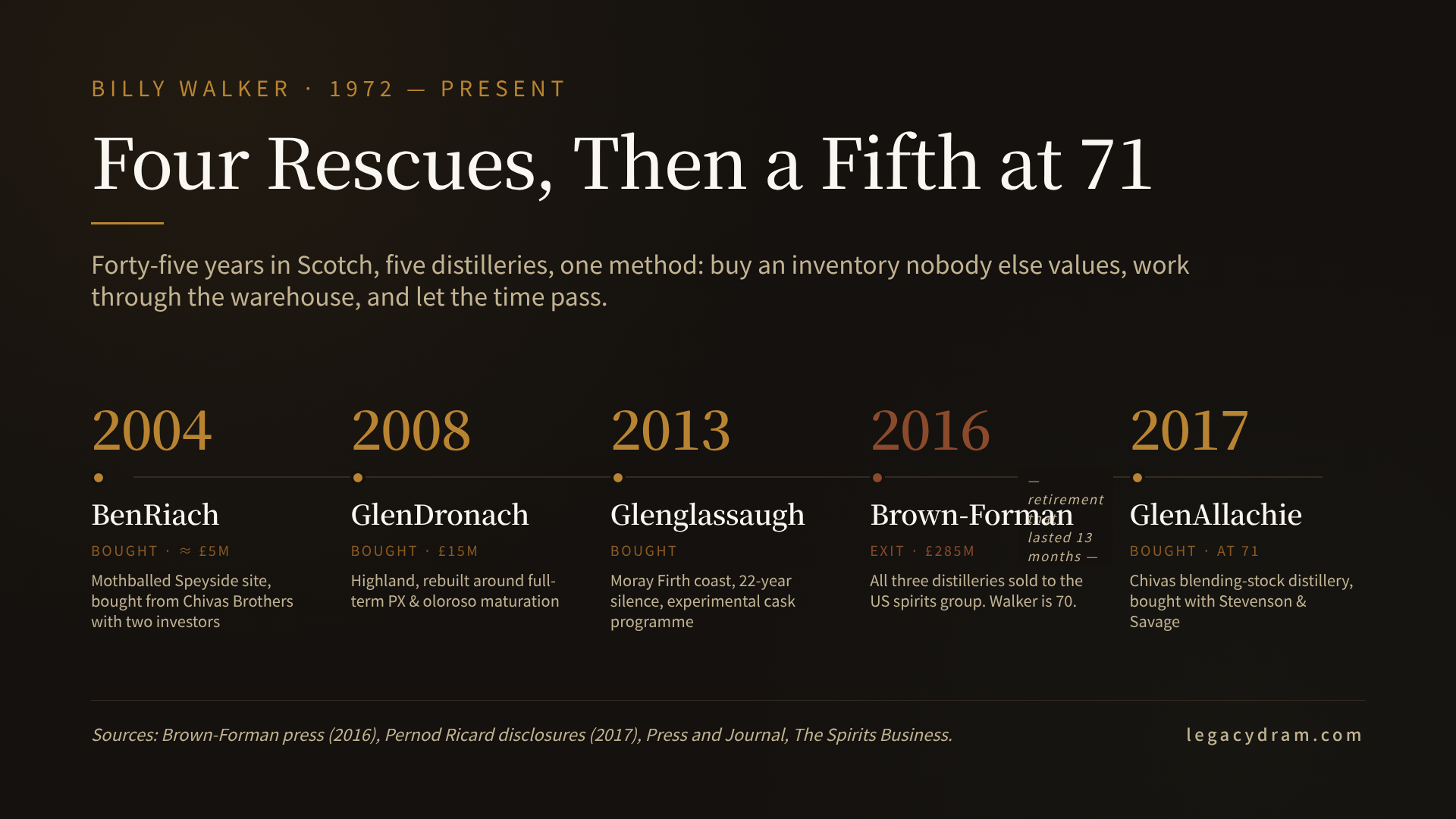
In 2004 he bought BenRiach, a mothballed Speyside site that its larger owner no longer wanted. Over the next nine years he added two more. In 2016 the three distilleries he had rebuilt were sold to an American drinks group for £285 million. He was seventy. The obvious move was to retire.
He did not retire. In 2017, at seventy-one, he bought a fifth distillery, GlenAllachie, and started again. He was still running the place when I wrote this, at eighty.
The standard write-ups tend to flatten this. The man who revived GlenDronach. The chemist who bought BenRiach. Both are true. Both miss the shape. I want to walk through what he actually did, because what he did is not the career of a master blender. It is the career of someone who kept noticing that distilleries built on inventory other people had stopped valuing could be bought at the cost of patience, and that the one trick he had (knowing how long to wait) was not something anyone else could buy at any price.
Before 2004: thirty-two quiet years
Walker joined the Scotch industry in 1972. He is a chemistry graduate — BSc Honours from the University of Glasgow in 1967, per the GlenAllachie biography — and his first job was with Hiram Walker & Sons in Dumbarton, blending for Ballantine’s. He is not related to that Walker. The surname is a coincidence that has caused thirty years of readers to assume he was born into the trade. He wasn’t. He walked into it with a chemistry degree and no family claim on any of its brands.
He spent four years at Hiram Walker, then moved to Inver House Distillers for six years as master blender, then to Burn Stewart Distillers in the early 1980s, where he stayed for about twenty years. Burn Stewart assembled a small-distillery portfolio over his tenure — Deanston in 1990, Tobermory in 1993, Bunnahabhain in 2003 — three sites that nobody paid much attention to at the time, which is probably why Walker was given room to run them. The master-blender work during these years was legitimately good, but the shape of the work was conventional. He was an employee. He signed off on the recipes other people had decided to bottle, under brands other people owned.
He was in his late fifties when the shape of his career changed. By any ordinary measure, that is late.
2004: BenRiach
The thing to understand about BenRiach in 2004 is that nobody wanted it. The distillery had been built in 1898, mothballed for most of the twentieth century, briefly restarted by The Glenlivet Distillers in the mid-1960s, then closed again in 2002 when Chivas Brothers rationalised its Speyside portfolio. A silent distillery is cheap. The stills are already in place. The warehouses are full of inventory somebody else paid to put there. What is expensive is the belief that the inventory, taken off the shelf and dusted off, is still worth anything.
Walker believed it. In April 2004, with two South African investors named Geoff Bell and Wayne Kieswetter, he bought the mothballed BenRiach from Chivas Brothers for about £5 million. The company he put around it was called the BenRiach Distillery Company. He was its managing director, master blender, and the shareholder whose name was on the door.
The first year was mostly archaeology. The warehouses held a back-catalogue of casks laid down by owners who had treated BenRiach as a blending-stock supplier rather than a single-malt brand, and Walker spent his time working through them, sampling, deciding what was good enough to bottle under its own name. The restart of distillation came later that year, and the first new-make under Walker’s recipe went into cask in 2004. By 2006 the first bottlings under the restored BenRiach name were on sale.
The signature of the method, visible in retrospect, is already here. Walker did not come in with a sweeping new-make specification or a radical fermentation change. He came in with a different attitude to what was already in the building. The inventory other people had stopped caring about was the asset. The job was to work out which casks could carry a release and which needed re-racking into something more interesting. Later he would call this wood-led maturation. At the time it was closer to inventory triage done by someone who knew enough chemistry to argue with his own stocklist.
2008: GlenDronach, and the sherry decision
In September 2008 the BenRiach Distillery Company bought a second site, GlenDronach, from Chivas Brothers for £15 million. GlenDronach is a Highland distillery near Huntly, built in 1826, mothballed from 1996 to 2002, and most of a decade later still carrying the dent of that gap in its warehouse. Chivas had restarted the stills in 2002 and let the company fill its casks mostly with bourbon barrels, in line with where the broader industry was going.
Walker went the other way. GlenDronach, under his ownership, was rebuilt around full-term maturation in Spanish-oak sherry casks. The casks were Pedro Ximénez and oloroso, held for the full age stated on the label, not a short finish bolted onto a bourbon base. The 15 year old was relaunched in 2009 as Revival. The 18 year old got its historical name Allardice back. The 21 year old was called Parliament, after the colony of rooks that lives in the trees by the distillery pond.
The economics of this decision were brutal and the strategist is right to want them written down. First-fill Spanish-oak sherry casks cost several times what a refill bourbon barrel costs. The money sits in the cask for the full fifteen or eighteen or twenty-one years, earning nothing, during which the company has to be solvent on the back of its younger bottlings and its continuing BenRiach cashflow. A publicly traded whisky company would have had an investor conference call about the opportunity cost. Walker and his two partners did not. They owned the thing. They could decide what to do with the warehouse without defending the decision to a quarterly earnings cycle.
The 15 Revival disappeared from shelves in 2015 because the demand it generated outran the stock Walker had laid down, and it came back in 2018, three years after he had sold the company. The gap is the clearest statement in the whole career of what his method really is: he made a decision in 2009 that put a specific flavour in a bottle in 2024, and the only way to get there was to let the time pass.
2013: Glenglassaugh, and the hardest math
In March 2013 the BenRiach Distillery Company bought its third site, Glenglassaugh, from Lumiere Holdings, an Amsterdam-based private equity group that had taken the distillery over in 2012 from the Scaent Group — a Russian-backed consortium that had restarted it in 2008 after twenty-two years of silence. Glenglassaugh sits on the Moray Firth coast near Portsoy. It had been closed in 1986, which meant that in 2013 almost nothing in the warehouse was between seven and twenty-eight years old. The missing cohort was a hole the whole shape of a human generation.
This is the acquisition that is hardest to make a case for on paper. BenRiach was a sleeping distillery with usable inventory; GlenDronach was a sherry rebuild on top of a working stillhouse; Glenglassaugh was a coastal site whose middle-aged stock did not exist. Walker bought it anyway, I think, because the two things he was good at by 2013 (restarting silent stills and running an experimental cask programme on top of a thin inventory) were exactly the things Glenglassaugh needed, and nobody else was willing to pay for them. The subsequent product line, including a very young Revival and a peated Torfa and a parade of unusual finishes, is what you release when the shelf is almost empty and the next bottle is five years away.
I want to deflate something here, because the industry writes Walker up as a visionary and he will outlive the hagiographies. By 2013 he was not making brilliant moves. He was making the only moves that remained consistent with what he already owned. BenRiach was fruity Speyside, GlenDronach was heavy sherry, Glenglassaugh gave him a coastal, experimental testbed with a very thin stock constraint. Three distilleries, three contrasting profiles, one master-blender office. If you squint, it looks like strategy. From inside, I suspect it looked more like someone who had learned a particular trick with silent distilleries and was running out of silent distilleries to apply it to.
2016: the exit
In April 2016 Brown-Forman, the Louisville-based American spirits company that owns Jack Daniel’s, announced that it was buying the BenRiach Distillery Company for £285 million. The deal closed in June. The three distilleries had been held together for just over three years at that point; the parent company had held BenRiach alone for twelve. Walker, who had been a founding equity shareholder since 2004, left with the share of the proceeds his holding entitled him to. The public filings do not disclose exactly what proportion of the £285 million landed in his personal account, and I will not invent a number here. What is clear is that it was enough to retire on several times over.
Rachel Barrie came in as group master blender for the three distilleries in February 2017, eight months after the sale closed, and has run them since. Her job is to hold the shape of the catalogues that Walker set up without the owner’s authority Walker had to set them up in the first place. It is a different kind of job and she is unusually suited to it, but the delegation of authority inside the catalogues shifted the day Brown-Forman signed the cheque.
Walker was seventy. He had sold his life’s work for an eight-figure sum. The ordinary move was to stop.
2017: the retirement that lasted thirteen months
He stopped for about a year. In July 2017 Pernod Ricard announced that Walker, together with two business partners, had bought another Chivas Brothers distillery. The partners were Graham Stevenson, a former managing director of Inver House, and Trisha Savage, a former colleague from Burn Stewart and the BenRiach Distillery Company. The deal closed on 2 October 2017. The site was GlenAllachie, a 1967 Speyside distillery that had spent most of its working life quietly producing blending stock for Chivas Regal. The purchase came with the distillery’s own inventory and two secondary blended Scotch brands, MacNair’s and White Heather.
Walker was seventy-one. The Press and Journal, reporting the deal that July, used the number. By the time GlenAllachie’s first Walker-era release came out in March 2018 he was seventy-two.
An interviewer asked him in 2017, straight, whether this did not look like the sort of decision a man his age ought to walk away from. His answer survives in the record: That would be death. And then: Life is always about arriving and then buying a ticket for the next train. An obvious hook for a lifestyle section, but I want to leave it here because the method is the content and the content is the method. He did not know how to not be the man buying the next ticket.
What he actually did
The thing he did at each of the four distilleries he bought was the same thing, which is why it is a method and not a run of good luck.
He walked into a warehouse full of other people’s inventory, inherited at a discount because the previous owner had stopped believing in it. He assessed, cask by cask, which stock could carry a release under its own name and which needed to be moved into a different, more active, more interesting cask for a further year or two of maturation. The industry calls this re-racking. In Walker’s hands it was less a cask-finishing programme than a form of financial engineering done in oak, where the input was somebody else’s forgotten liquid and the output was a bottling line that could pay for the warehouse by itself inside three years.
The chemistry he brought to this was not the chemistry of invention. He did not design new yeast strains or novel still geometries. He understood which oak carried which congeners: the heavy whisky lactones of American white oak, the ellagitannins and dried-fruit sugars of Spanish-oak sherry casks, the raisin-and-fig load of a Pedro Ximénez butt against the walnut and bitter edge of an oloroso. And he could estimate, in his head, how long any particular new cask would need to make its mark on any particular old spirit. Eighteen months is the number he quoted publicly, which is roughly the time it takes for the first stage of re-rack extraction to flatten out. Beyond that, the gains are mostly marginal. He was running an extraction curve in his head, against an inventory calendar in a spreadsheet, with the constraint that time, once committed, could not be moved around.
The one thing he was better at than almost anyone else in the trade is that he knew, at any point, which of his casks were nearly ready and which were two years off. The method is boring. The patience it requires is not.
The pathos
What makes the career hard to write about honestly is that it looks heroic from the outside and, I think, was never meant to. Walker did not invent the sherry-cask style; he was given a Highland distillery that already had sherry casks and the money to buy more. He did not resurrect dead distilleries on his own; he bought ones whose previous owners had stopped caring and worked through their warehouses. He did not fund the fifth acquisition out of nothing; he funded it out of the proceeds of the first four, during the biggest period of acquisition activity in modern Scotch.
The thing he did that is actually unusual is that he kept the risk on his own balance sheet. The reason the GlenDronach 15 came back in 2018 after a three-year gap is that Walker in 2008 made a decision about Spanish-oak casks that his successors in 2018 did not have to defend to anyone. The reason GlenAllachie exists today as a bottled single malt rather than as a blending-stock supplier is that in 2017 a seventy-one-year-old chemist decided to pay for the inventory out of his own pocket and wait. There are not many people in the Scotch industry who are allowed to make either decision. There is almost nobody who has made all four.
The quiet thing about this career, the part you only see once you stand back from it, is that Walker never got to drink the full shape of what he set up. The GlenDronach 25 bottled this year is spirit laid down the year before he bought the distillery; by the time it bottles out, he will have been in retirement, or dead, for the span of its own warehouse. The eighteens from his GlenAllachie restart will arrive after his working life. The same is true for Jim Beveridge at Diageo, for Rachel Barrie, for any of the Walkers who put their name on a bottle, for anyone who takes the time constraint seriously. The man who spent forty-five years lining casks up for the future knew, at every step, that most of the bottles would arrive at the shelf after he had left the room.
He is still in the room, at the time of writing. He is eighty. The last message I can find from him in the trade press is from a 2024 panel, where he was asked, again, whether he had ever considered retirement, and he gave the same answer. He had not. He was busy watching the eighteens come up.
Related reading
- GlenDronach 15 Revival Review: Full-Term PX Sherry, 46% — the single Walker bottling that most clearly shows the method in a glass
- Rachel Barrie: Master Blender Behind BenRiach & GlenDronach — who inherited Walker’s three distilleries when Brown-Forman bought them
- Jim Beveridge: Johnnie Walker Blue, and the Ghost Rare Rule He Broke — the opposite shape of career, forty years inside one company
- Alexander Walker 1865: Johnnie Walker’s Rule — a different Walker, a different century, the same discipline
Sources
- Billy Walker sells BenRiach for £285 million — Press and Journal
- Billy Walker on his plans for GlenAllachie — The Spirits Business, May 2018
- Why did Billy Walker buy Glenallachie? — Scotch Whisky Magazine
- Billy Walker completes GlenAllachie Distillery deal — The Spirits Business, October 2017
- BenRiach acquires Glendronach from Chivas Brothers — Harpers Wine & Spirit Trade News
- Pernod Ricard sells Glenallachie to Billy Walker consortium — Pernod Ricard press release
- Billy Walker’s Journey to the Whisky Magazine’s Hall of Fame — The GlenAllachie Distillery