Non-Chill Filtered: Why 46% ABV Keeps the Wax
The first time I put a bottle of Clynelish 14 in a hotel-room minibar fridge for an hour, I pulled it out and it had gone cloudy. For about three seconds I thought I had bought a bad bottle. Then I remembered what the label said and left it on the desk, and over the next twenty minutes the cloudiness drained out of the liquid like a slow bath, and the whisky was clear again. The haze was reversible, which is the diagnostic you want. It meant I had bought a non-chill filtered whisky and the physics of its fatty-acid esters was behaving exactly as the back label promised.
This essay is about those esters: why they come out of solution, why 46% alcohol by volume is the empirical floor for keeping them in, and why three distilleries — one Highland, one Islay, one London blender — chose to accept the inconvenient physics instead of filtering it away. If you have ever wondered why your Clynelish bottle is 46% and your Glenlivet 12 is 40%, the answer is in this piece.
The esters are the point
Scotch new-make spirit is around 70% ABV. Among the thousand or so volatile and semi-volatile compounds that come off the second distillation, a few dozen are long-chain fatty-acid ethyl esters. The ones that matter for haze are the C12 to C18 group: ethyl dodecanoate (C12, ethyl laurate), ethyl tetradecanoate (C14, ethyl myristate), ethyl hexadecanoate (C16, ethyl palmitate), ethyl octadecanoate (C18, ethyl stearate), and the unsaturated C18 variants ethyl oleate (C18:1) and ethyl linoleate (C18:2). They are produced during fermentation by yeast, which esterifies free fatty acids in the wort with the ethanol it is simultaneously making. The chemistry has one line: fatty acid + ethanol → ester + water, catalysed by yeast acyltransferases.
These molecules are hydrocarbons with an ester group on one end. The hydrocarbon tail is hydrophobic; it does not like water. At 70% ethanol, the solvent is more than half organic by volume and the esters sit happily in solution. Push the ABV down — by cask dilution for maturation, by water addition at vatting, by reduction to bottling strength — and the solvent becomes progressively more aqueous. By 40% ABV the hydrocarbon tails are no longer entirely comfortable; they are soluble, but close to their limit. Cool the mixture, and the molecules lose kinetic energy, their mutual attraction wins over their individual solvation, and they aggregate into droplets a few micrometres across. Those droplets scatter visible light. That is the chill haze.
(I always have to resist calling this a phase transition. It is more like a solubility collapse. Pedants in the physical-chemistry wing of your audience will correct you if you say phase transition. They will do it kindly, but they will do it.)
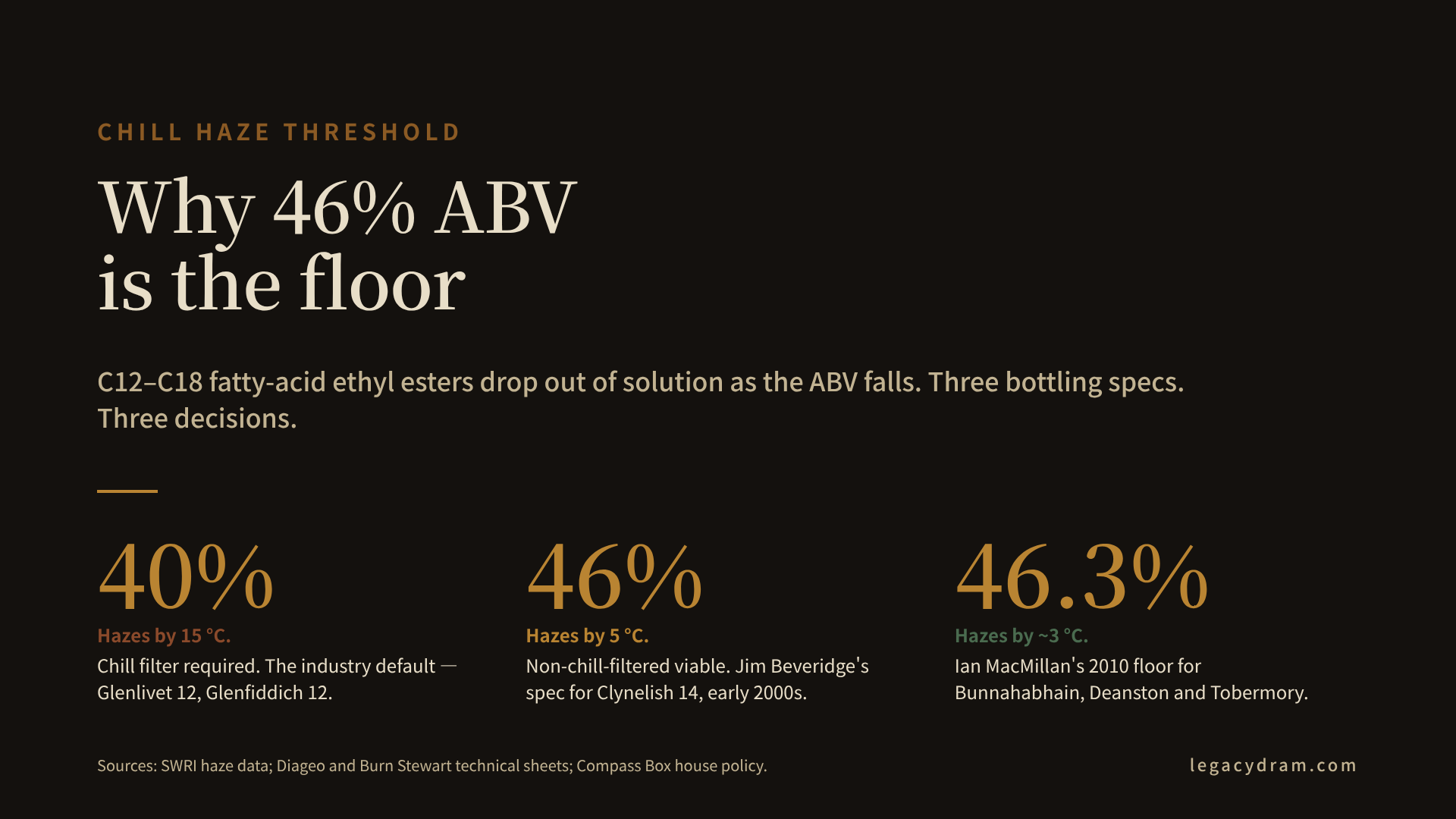
The temperature at which the collapse happens depends on ABV. At 46% and above, you have to drop below about 5°C to see the haze, which means the bottle has to be in a fridge or outdoors in winter. At 43%, the haze shows up by about 10°C — a cool kitchen in Edinburgh in October. At 40%, it will cloud at 15°C, which is a shipping container temperature in a Scottish winter and a warehouse temperature across half of Europe for a quarter of the year. This is why the industry developed chill filtration in the first place. It is also why the industry’s non-chill-filtered revival is clustered at or just above 46%: that is where you can skip the filter and ship worldwide without customer complaints.
What the chill filter actually does
The industrial step is not complicated. Before bottling, the whisky is dropped in a jacketed tank to around -2°C to -10°C — most references I have read for standard practice sit around -4°C — and held there until the esters have precipitated into visible haze. Then it is pumped through a plate-and-frame or cartridge filter loaded with cellulose pads of about 1 to 10 micrometre pore size. The pads catch the aggregated ester droplets. The clear filtrate is returned to a holding tank, warmed back to room temperature, and goes to the bottling line clear and brilliant.
The removed material is a small fraction by mass — low grams per hectolitre — but it is heavily weighted toward exactly the long-chain esters that give mouthfeel. Shorter-chain esters (ethyl acetate, ethyl hexanoate, the fruity top-notes you nose) are not affected, because they are small enough to remain soluble even in cold aqueous ethanol. The filter does not remove aroma. It removes texture.
A note on terminology that will matter when you read other sources. “Chill filtration” and “cold filtration” are usually synonymous in the Scotch industry. “Barrier filtration” and “polish filtration” refer to a lighter pass at ambient temperature — larger pore sizes, no chilling — intended to catch cask splinters and tank sediment rather than esters. Many non-chill-filtered whiskies still get a barrier filter, which is legitimate and should not be a scandal; the point of the “non-chill-filtered” claim is that the texture-bearing esters survive, not that the liquid is unfiltered. If you want the full you-get-what-the-vatting-tank-held experience, you want to see the words “non chill filtered” and ideally “unfiltered” together, which is rarer.
The 46% threshold is empirical, not fundamental
I have been writing as if 46% is a sharp physical number. It is not. It is a convention the industry has converged on because it clears the room-temperature haze threshold with a reasonable safety margin. The experiments that nailed down the convention were run across the last quarter of the twentieth century at the Pentlands Scotch Whisky Research laboratory (founded in 1974, the predecessor of the Scotch Whisky Research Institute) and inside producer R&D labs, correlating ABV, ester concentration and haze onset temperature across hundreds of samples. The headline finding was that for typical malt-whisky ester profiles, 46% was the lowest ABV at which the finished bottle would reliably stay clear through a worst-case shipping cycle (a container at 10°C followed by a shop shelf at 20°C) without filtration. Push below 46% and the complaint rate rose non-linearly.
Nothing in physics says 46 is special. If your esters are at the low end of the typical range — a Lowland-style spirit, say, with less heavy fermentation character — you can get away with 43% non-chill-filtered and be fine most of the year. If your esters are at the high end (a sulphury worm-tub whisky with heavy ferments, or a long-fermentation Islay spirit), you may want 48% to stay safe. 46% is the median answer across the typical range of Scotch malt profiles, treated as a specification constant because engineering benefits from constants. The reader with any taste for pedantry can calculate for themselves which direction to adjust for their favourite distillery; the table of ester concentrations is not published in a single convenient place and I am not going to pretend otherwise.
Jim Beveridge and the Clynelish relaunch
The first person I want to name is Dr Jim Beveridge. He joined the Distillers Company (later Diageo) as an analytical chemist in 1979, worked through two decades of blending, took the Johnnie Walker master blender role around 2001, and retired on 31 December 2021 after roughly forty years with the company. He was awarded an OBE in 2019.
The decision that puts him in this essay is a bottling specification. Diageo’s original Clynelish 14 in the Flora & Fauna range in the early 1990s was 43% ABV and chill-filtered. When the whisky was relaunched as a core-range flagship in the early 2000s, the ABV was raised to 46% and the chill filter was taken off. That was Beveridge’s call, and it was defensible by one argument and one argument only: Clynelish’s identity is in its waxy mouthfeel, generated by an unscrubbed low-wines-and-feints receiver whose walls have accumulated fatty-acid residues over decades of production. Those residues redissolve into every batch of new-make that passes through the tank, pushing Clynelish’s C12-C18 ester concentration well above the Scotch malt median. At 43% chill-filtered, a measurable fraction of exactly those esters would be stripped by the pads before bottling. The whole plant’s expensive production quirk would be undone at the last step.
Beveridge did the arithmetic the other way. If you have built an entire plant around producing a texturally unusual spirit, you spend the few extra percent of alcohol it costs to keep that texture in the bottle. 46% was the floor that cleared the haze threshold for Clynelish’s unusually high ester load; non-chill-filtered was the specification that made the previous four thousand metres of the production chain actually matter. The specification has survived the handover to Dr Emma Walker in 2022 without change.
The counter-argument he had to defeat, which the Diageo accountants presumably put in front of him, is that 46% versus 40% is a measurable per-bottle alcohol cost (duty is paid per litre of pure alcohol in the UK), and that chill-filtered 40% ships without customer confusion about haze. “The texture is the point” is not an argument that wins by itself in a spreadsheet. It wins when the texture is the thing a globally standardised blend — Johnnie Walker Gold — is designed around. The blend’s dependence on Clynelish was Beveridge’s lever. The single-malt spec got to stay unmolested because the blend needed it to.
Ian MacMillan and the 2010 Burn Stewart decision
The second person is Ian MacMillan. He started at Glengoyne in 1973, moved to Burn Stewart Distillers in 1991, and spent the next twenty-four years as master distiller across Bunnahabhain (Islay), Deanston (southern Highlands) and Tobermory with its peated line Ledaig (Mull). He left Burn Stewart in 2015, spent three years at Bladnoch, and then ran his own consultancy until it was wound up in mid-2026.
The decision that puts him here is a 2010 specification change applied to all three distilleries’ standard ranges simultaneously. Raise ABV from 40% to 46.3%. Stop chill filtration. Stop adding E150a caramel colouring. Three changes, no new equipment, applied to the flagship lines in one calendar year. His public argument to Scotch Whisky magazine at the time was a question: “The flavour and aroma compounds have taken years to develop, so why would we want to lose some of them just to make the whisky pretty?”
The 46.3% number is worth pausing on. It is not cask strength. It is a reduction number — water has been added to the vatting tank to bring the ABV down from the cask average — but MacMillan stopped the reduction at the first integer above 46 that let him get consistent batch-to-batch output. Any lower and he would start to hit the haze threshold; any higher and he would be paying unnecessary duty on alcohol the recipe did not need. 46.3% is an engineering compromise, parked a hair above the empirical floor, exactly where the physics tells you to park it.
Where Beveridge’s decision was defended by a global blend’s dependence on Clynelish’s texture, MacMillan’s was defended by a group-wide bet that the premium end of the single-malt market was moving toward producer transparency and texture authenticity. He was right. The flagship 12-year-olds from Bunnahabhain, Deanston and Tobermory all now sit at 46.3% non-chill filtered natural colour; the retail premium on those bottles over the previous 40% specification is comfortably more than the alcohol duty cost. The spreadsheet closed on his side of the ledger.
John Glaser and the natural-colour, non-chill principle
The third person is John Glaser, founder of Compass Box in 2000 and its chief whisky maker until he retired on 29 February 2024. Compass Box is a London blender, not a distillery, which means Glaser’s engineering decisions are made at the vatting-and-bottling stage rather than at the still. He has run every Compass Box release — Hedonism, Spice Tree, Flaming Heart, The Peat Monster and the rest — at natural colour and non-chill filtered, as a matter of house policy, since the company’s first release.
What makes Glaser worth naming here is that he treats the no-filter decision as a transparency principle rather than a texture-engineering choice. The argument he has made in print and on panels for twenty years, paraphrased: a cask of Scotch spent somewhere between eight and thirty-five years in oak at a stable 50-ish percent, developing a specific chemistry. The industrial last step undoes some of that chemistry in order to make the bottle look identical to every other bottle. If you are selling the maturation, you should sell the maturation; if you are selling a cosmetic uniformity, you should sell that instead. The customer should not have to guess which product they bought.
The engineering consequence is the same specification floor the other two reached by different routes: Compass Box’s bottlings run at 46% ABV or above (most at 46%, some at cask strength), non-chill filtered, natural colour. The reasoning path is different — Beveridge was defending a mouthfeel; MacMillan was repositioning a group portfolio; Glaser is defending an epistemic principle — but the equipment downstream of the vatting tank, by the time all three have made their decisions, is doing exactly the same thing: nothing.
The trade-off ledger
Nothing in this essay should sound as though the chill filter is a villain. Here is the honest accounting from the industry’s perspective, which is what any engineer should want to see.
For chill filtering, at a lower ABV (typically 40% or 43%):
- The bottle looks the same temperature-independently. Haze-induced returns drop to nearly zero.
- The lower ABV costs less in alcohol duty per bottle, which for a high-volume product (think Johnnie Walker Red, Famous Grouse, Chivas 12) is a meaningful line item.
- Reduction to lower ABV allows the vatting recipe to stretch further — a given cask volume yields more bottles.
- The aromatic top-notes (short-chain esters, aldehydes, higher alcohols) are largely preserved.
- The mouthfeel is lighter, which some blenders see as a feature (easier drinking for a mass audience) rather than a loss.
Against chill filtering, at 46% ABV and above:
- The long-chain fatty-acid esters that carry mouthfeel survive to the glass.
- The finish is measurably longer in sensory panels.
- The whisky can honestly claim “non-chill filtered” on the label, which has become a premium-market signal.
- Water addition at the glass (a few drops) does not strip texture, because the esters are already at the top of their stable concentration range.
- There is no last-step “unmake” of flavour the distillery and warehouse spent years making.
Which column wins depends entirely on what the bottle is for. A supermarket flagship at £22 is not the same product as a specialist bottling at £55, and the engineering decisions are legitimately different. The widespread assumption among whisky forum users that chill filtration is a cost-cutting trick aimed at consumers is close to the truth for some bottles (the ABV reduction is where most of the actual saving is) and misleading for others (the Glenlivet 12 was engineered to a specific texture by Alan Winchester and his team, and the chill filter at 40% is part of that engineering, not a betrayal of it). The honest view is that there are two viable specifications and the industry is right to run both.
What this means at the glass
Three practical consequences for the drinker, in order of certainty.
First. If your non-chill filtered whisky goes cloudy in the fridge, that is physics telling you the specification is honest. Reversibility is the diagnostic: let the bottle warm back to room temperature, and it should go clear again within thirty minutes. If it stays cloudy at room temperature, something else is wrong (dissolved metal, oxidation, a packaging contamination), not chill haze.
Second. The mouthfeel difference between a 46% non-chill-filtered whisky and the same spirit at 40% chill-filtered is real and reproducible in blind tasting. It is not large, in the sense that both liquids remain recognisably whisky, but it is reliable. If you want to feel it for yourself, pour a 40% chill-filtered Glenlivet 12 alongside a 46% non-chill-filtered Glenfarclas 12 or Arran 10, both at room temperature, and swirl each for a few seconds on the tongue before swallowing. The slower-draining film on the second glass is the ester fraction the first glass lost at the filter.
Third. Adding water to a non-chill-filtered whisky at 46% is safer than adding water to a chill-filtered whisky at 40%, in the sense that you have more texture to lose before you reach the floor. A few drops of water on a 46% spirit opens the aromatics without stripping mouthfeel. The same volume on a 40% chill-filtered spirit will tip the ABV below the point where the already-reduced ester fraction stays in solution, and the texture collapses in ways you can taste. If a bottle at 40% needs water to open, it is close to the thermodynamic edge of its own recipe, and you are drinking what is left after that edge is crossed. This is why cask-strength bottlings reward water and 40% bottlings mostly do not.
Related reading
- Clynelish 14 Review: 46% Waxy, No Chill Filter — the bottle where Beveridge’s specification is most visible on the tongue.
- Bunnahabhain 12 Review: Ian MacMillan’s Unpeated Islay at 46.3% — the three-way 2010 Burn Stewart specification change.
- John Glaser at Compass Box: The Transparency Fight He Lost Twice — the non-chill-filter principle as transparency rather than texture engineering.
- Clynelish 14 Waxy: 50 Years of Uncleaned Feints — where Clynelish’s unusually high ester load actually comes from, upstream of the bottling decision.