Arran 10 Review: Harold Currie's 1995 Bet
Plenty of people retire to play golf. Harold Currie retired to build a distillery, on an island that had not legally made a drop of whisky in over a century and a half. By then he had spent a career near the top of one of the biggest names in the trade, and instead of a quiet pension he picked a field at Lochranza, on the north end of Arran, and started from bare ground.
I poured the Arran 10 expecting the thin, apologetic spirit a young island distillery usually hands you: the kind that tastes like it is still apologising for not being older. It was not thin. It was clean, faintly salted, with a barley sweetness that did not need a sherry cask to hide behind. So I went looking for who had decided it should taste like that. The answer turned out to be two men, twelve years apart: the one who built the place, and the one he brought over from Islay to run the stills.
The man who left the top to start from a field
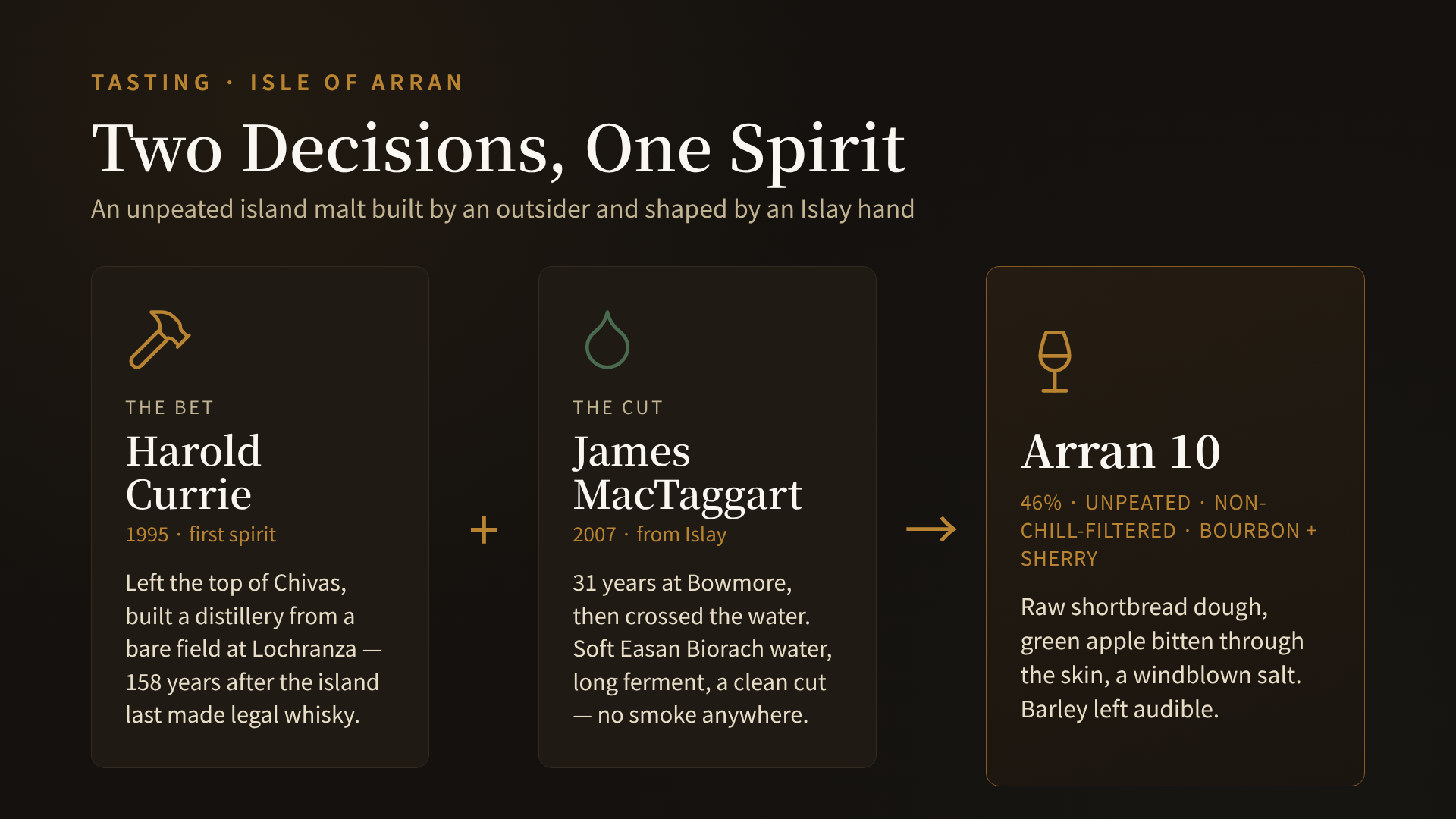
The bottle on the shelf is the Arran 10: 46% ABV, no chill filtration, no added colour, matured mostly in ex-bourbon casks with a smaller share of sherry. It costs about £40 in the UK and somewhere near $55 in the US, and you can find it almost anywhere that stocks more than the supermarket names. It is, in every commercial sense, an unremarkable entry-level single malt. The remarkable part is that it exists at all.
Harold Currie was not a distiller. He came up through the commercial side. After the war (he had landed in Normandy with an armoured regiment) he went into wine and spirits in Liverpool, then joined Seagram, and in 1961 was sent north to run Chivas Brothers in Scotland. The job he is remembered for there is a marketing one: pushing Chivas Regal up-market to take on Johnnie Walker. He ran Seagram’s Scottish operations for years. By any reasonable measure he had already had the career.
Then he retired, did a short stint with Pernod Ricard, and in the early 1990s did the thing that does not fit the obituary template. He decided to build his own distillery, with two of his sons, on Arran. The site he chose at Lochranza had soft water running down off the hills through a burn called Easan Biorach (“sharp waterfalls” in Gaelic), six granite falls’ worth of it, which is the kind of detail that sounds like marketing until you taste how little the spirit has to fight against. Construction started in December 1994. The first new make ran through the spirit safe the following summer.
Here is the part the brochure underplays. No licensed distillery had operated on Arran since 1837, a gap of 158 years. The island had a long history of whisky, but most of it was the illegal kind; “Arran Waters” was a smuggler’s product, not a brand. Currie was not reviving a famous old name. He was betting that an unknown spirit, from an island nobody associated with legal whisky, made by a company with no track record, would find buyers before the money ran out. That is an uncomfortable wager, and he made it in the decade most men spend slowing down. He did not live to see the distillery reach the scale it has now; he died in 2016, by which point the place he started in a field was selling its whisky in more than forty countries. The bottle is the receipt for a wager that very nearly did not pay off.
The Islay hand that shaped the spirit
Building a distillery and making good spirit are two different problems, and the second one took longer. For its first decade Arran was a young distillery doing what young distilleries do: releasing spirit before it was ready, learning the stills, finding out what the site could give. The man who turned that into a house style arrived in 2007.
James MacTaggart was headhunted from Bowmore, where he had worked for thirty-one years. He is an Islay man through and through: he came up through the warehouses and malt barns, ended as assistant manager, and then crossed the water to take the senior job at Lochranza. This is the quiet joke at the centre of the Arran 10: its clean, unpeated, almost gentle character was shaped by a man who spent three decades inside one of the most heavily peated distilleries in Scotland. The Islay hand brought no smoke from Islay, only something less visible: judgement about where to make the cut, how long to ferment, how much copper the vapour should touch.
That judgement is what you are tasting, and it is worth being concrete about it rather than waving at “craftsmanship”. The soft Easan Biorach water means the spirit is not carrying mineral weight it then has to be distilled away from. Long fermentations push the new make toward fruit rather than cereal. A cut taken in the right place keeps the heavy, oily tails out, which is why a ten-year-old spirit at 46% reads as clean rather than raw. And the cask policy (a backbone of first-fill bourbon with sherry as seasoning, not as a mask) is a deliberate refusal to do the easy thing. The easy thing, for a young distillery, is to dump the spirit into active sherry casks and let the wood do the talking, because wood is faster than time. MacTaggart’s Arran does the harder thing: it leaves the barley audible. You can hear the spirit because nothing has been parked on top of it.
Three glasses, no ranking
On the kitchen table this evening: Arran 10 at 46%, Caol Ila 12 at 43%, Highland Park 12 at 40%. Three island malts, three different answers to the question of what an island spirit should taste like. No flight order beyond the colours lining up palest to darkest, because that is what three Glencairns mechanically want to do.
The Arran 10 smells, first, of raw shortbread dough: the sweet, slightly buttery smell of the mix before it goes anywhere near the oven. Behind that is a green apple bitten through the skin, and a thinner citrus that is closer to grapefruit pith than to lemon. There is salt in it, the kind a wind carries off the water rather than the iodine-and-seaweed weight of an Islay, the kind you taste on your own lips after a walk on a cold beach. On the palate the barley sweetness arrives first (vanilla fudge softening on a warm windowsill, a little tinned-pineapple sweetness underneath, the cheap kind in syrup), then a dry cinnamon-and-biscuit finish that is medium-length and stops before it outstays its welcome. Three drops of water and the apple gets greener and the fudge recedes. This is a spirit with nowhere to hide and, it turns out, nothing it needs to hide.
The Caol Ila 12 next to it is the peated counter-argument from one island west. Its smoke is a cold beach bonfire the morning after: ash on damp wood, a wedge of discarded lemon oxidising in the salt air. Where the Arran is barley-forward and quiet, the Caol Ila is smoke-forward and clean in a different way: the peat is loud but the spirit underneath is, like the Arran, light on its feet. Putting them side by side is the most useful thing you can do to understand the Arran, because it shows you that “island malt” is not a flavour. It is a postcode. (For the full story of how Caol Ila gets heavy peat to behave like a light spirit, that distillery has its own piece here.)
The Highland Park 12 is the third corner: Orkney, further north than either, with about 10–20 ppm of its own heather-peated malt and a generous slug of sherry cask. Next to it the Arran’s restraint becomes obvious. Highland Park gives you a low, sweet smoke and a dried-fruit, honeyed body from the sherry. It is the island malt that wears a coat. The Arran is the one that does not. None of these three is better than the others; they are three distilleries answering the same geography in three voices, and the only ranking that matters is which one suits the hour. The Highland Park is a fireside whisky. The Caol Ila is a kitchen-while-cooking whisky. The Arran is the one I would pour for someone who says they “don’t really like whisky” and means they have only ever been handed the loud ones.
What to verify next time you pour one
If there is an Arran 10 in the house and you want to taste the two decisions rather than the marketing, three things to check.
First, the barley. The dough-before-the-oven sweetness should be right at the front, audible, not buried under wood. If all you can taste is sherry and spice, you are most likely drinking the Sherry Cask edition or an older sherried release, not the standard 10. The whole point of MacTaggart’s house style is that the spirit stays in the foreground.
Second, the salt. It should be the clean, windblown kind, not the medicinal iodine of an Islay. That clean salinity, with no peat under it, is the Arran signature: soft water, long ferment, a careful cut, and nothing smoked anywhere in the process.
Third, the finish that knows when to leave. The Arran 10 does not have a long, demanding close, and that short finish is honest rather than thin. It is a young-ish, unpeated, lightly sherried malt that tastes like exactly that. A distillery that started in a field in 1995 has no fifty-year-old casks to lean on and does not pretend otherwise.
That honesty is the through-line, and it runs from the founder to the stillman. Harold Currie made a wager that an outsider could build something legitimate on an island that had spent 158 years making whisky in the dark. James MacTaggart made sure that when the bottle finally arrived, it told the truth about itself: barley, soft water, sea, and a cut taken by a man who knew exactly where to take it. You can taste both decisions for about £40, which makes the Arran 10 one of the better-value confessions on the shelf. Most retirement projects do not end up in a glass you can buy. This one did.
Try this bottle
Affiliate link below. If you buy through it, LegacyDram earns a small commission and the price you pay does not change. Alcohol-related links are intended for readers of legal drinking age (20+ in Japan, 21+ in the US).
Related reading
- Caol Ila 12, Billy Stitchell, and the Islay Distillery That Outproduces the Ones You Already Know: the peated island counter-argument one ferry west, and another spirit engineered to be cleaner than its inputs
- The Asymmetric Five: Highland Park 12, Gordon Motion, and What Orkney Adds: a third island answering the same geography with heather-peat and sherry instead of restraint
- Joseph Hobbs, Ben Nevis, and the Canadian Outsider Who Bought a Distillery: another man who came from outside the trade and bet on a distillery — Currie’s nearest neighbour on the “outsider’s wager” shelf
Sources
- Whisky Heroes: Harold Currie, Isle of Arran — Scotch Whisky
- Arran founder Harold Currie passes away — Scotch Whisky
- Lochranza distillery — Wikipedia
- How Lochranza Distillery Changed The Narrative Of The Whisky Industry — Arran Whisky
- Chatting with James MacTaggart, production director at Arran — Pour & Sip
- Arran malt marks distiller anniversary — Scotch Whisky
- Arran 10 Year Old — Master of Malt
- Arran 10 Year Old Review — Maltspedia