Coffey Still vs Pot Still: 94% Grain, 65% Malt
In 1830, a former Inspector General of Excise for Ireland walked into the British patent office in London and filed patent number 5974 for a still that never had to be emptied. That filing quietly redefined what the word Scotch whisky would legally cover for the next two hundred years, and it is a large part of why the bottle of Johnnie Walker on the shelf costs what it does. The man was Aeneas Coffey. The still bears his name to this day, though it was neither the first continuous still to work in Britain — Robert Stein’s did, in 1827 — nor a Coffey original in any strong sense. Coffey had spent the last years of his Excise career watching Stein-family machines run, imperfectly, on the Scottish side of the Irish Sea, and he had gone home to build the plainer, sturdier version of what he had seen.
This is a piece about what the two stills actually do, chemically, and about why the plain one won. If you have ever watched a more elegant piece of engineering lose to a clumsier one that was simply easier to keep running, you already know the shape of this. There is not a hero at the end of it. There is a distillery in Fife that has been producing about a hundred million litres of neutral spirit a year for very nearly two centuries because, in 1830, the tax inspector’s version was the version that stayed up on weekends.
What a pot still actually does
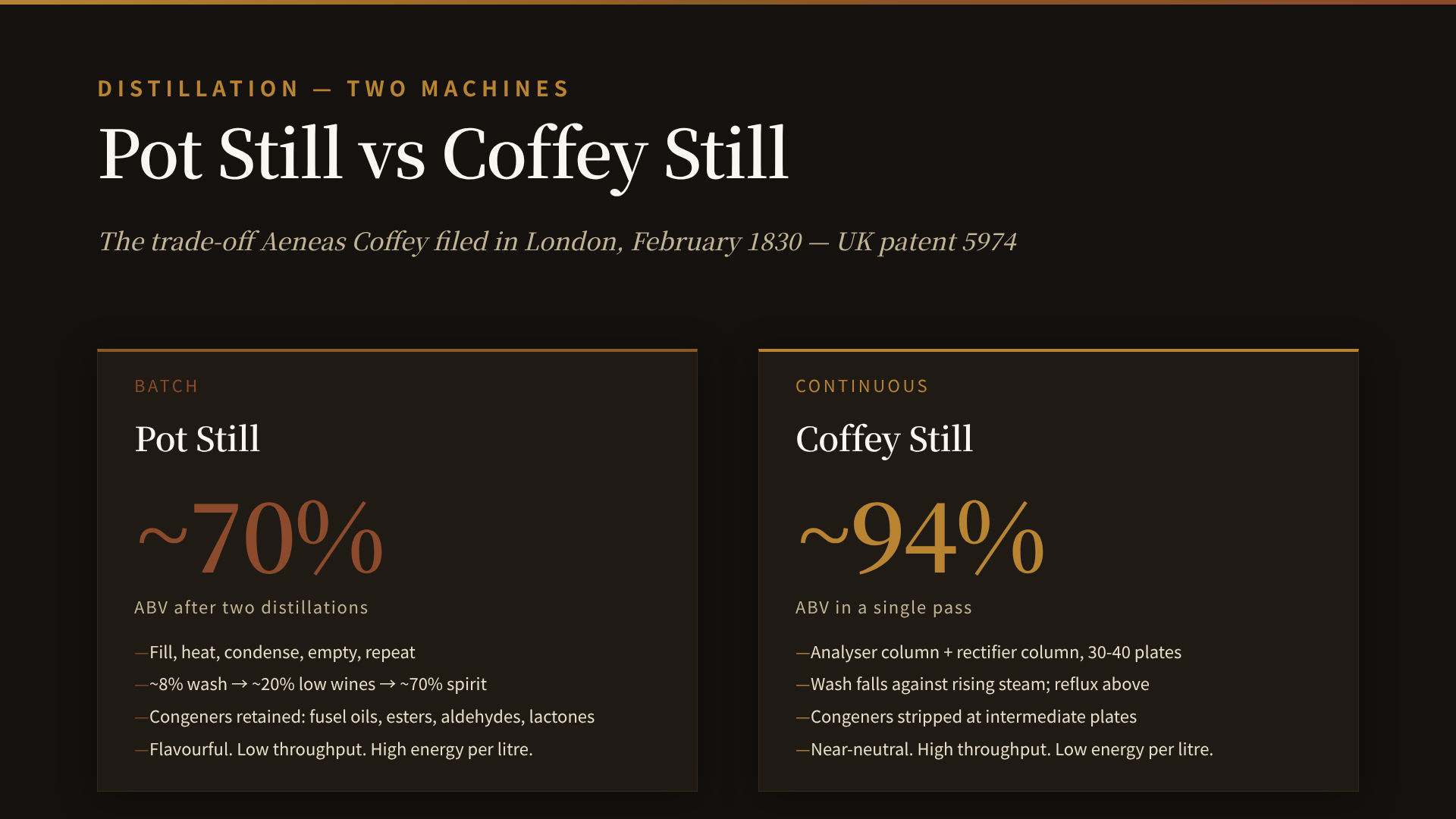
A pot still is, in modern engineering vocabulary, a batch reactor. You fill a copper vessel with fermented wash at around 8% ABV, heat it from below, and the ethanol vaporises before the water because ethanol’s boiling point (78.4°C at 1 atm) sits below water’s (100°C at 1 atm). The vapour rises through the swan neck, hits a condenser — a copper worm in cold water in the older distilleries, a shell-and-tube heat exchanger in the modern shells — and drips out as low wines at around 20-25% ABV. That is one distillation.
Then you empty the still. You clean it. You refill it with the low wines and run it again. The second distillation gives you spirit at around 65-72% ABV. To go higher you must distil a third time (which is what Auchentoshan does, and what Springbank’s Hazelburn does, and what most of the Irish pot-still houses were doing in 1830). Each pass throws away roughly ninety percent of the mass and the same fraction of the heat you put in, to recover a small, purer slug.
The pot still keeps congeners. Congeners is the umbrella term for every non-ethanol volatile in the distillate — fusel oils (isoamyl alcohol, isobutanol, propanol), esters (ethyl acetate for solvent notes, ethyl hexanoate for pear, ethyl octanoate for green apple), aldehydes (acetaldehyde for cut-grass sharpness), fatty acids, lactones, terpenes. These are the things that make single malt taste of anything. They ride the vapour up because they are volatile at ethanol’s operating temperature, and they arrive at the condenser mostly intact. This is why a pot still is, from a flavour standpoint, generous: it does a bad separation, and the impurities are exactly the interesting parts.
But — this is where the arithmetic starts to hurt — pot-still throughput is fixed by vessel volume, and vessel volume is fixed by copper cost and how large a fire you can build under it. A 20,000-litre pot still can turn over roughly one full charge every eight to twelve hours. To increase output, you build more stills. Every marginal litre costs about the same as the last one. This is the linear-fixed-cost curve every Highland distillery lives on, and it is what the reader who is about to calculate whether a fifty-still Speyside operation could ever compete with a two-column Fife operation is about to discover: it cannot.
What Coffey actually patented
Coffey’s patent describes two vertical columns connected by a pipe. The first is the analyser. Wash enters near the top and falls down over a series of perforated plates. Steam is injected at the base and rises through the same plates. On every plate, the two streams meet. The steam picks up volatile ethanol from the falling wash; the wash gives it up and continues down, poorer, until it drains out of the base as spent wash — essentially water and grain solids. The steam, by the time it reaches the top of the analyser, is carrying most of the alcohol from the wash.
That alcohol-loaded steam is piped into the base of the second column, the rectifier. The rectifier is the same shape and carries the same plates, but here the rising vapour exchanges not with fresh wash but with its own condensate — the reflux — which trickles back down from a condenser at the top. Every plate is a small equilibrium stage: hotter vapour rises, cooler liquid descends, and at each plate the ethanol fraction gets a little richer while the higher-boiling congeners fall out and drop back down the column with the reflux. If you stack thirty to forty plates, you get thirty to forty theoretical distillations in series. The spirit is drawn off near the top of the rectifier at around 94% ABV, close to the ethanol-water azeotrope (95.6% ABV at 1 atm — the atmospheric ceiling for any distillation, because past that point the vapour and the liquid have the same composition and no further separation is possible).
The chemistry that makes this work is what a chemical engineer would today call McCabe-Thiele in copper form. Petroleum refineries adopted the same design forty years later to fractionate crude oil into naphtha, kerosene, and gas oil, and the fractional distillation column in a refinery today is a Coffey still with more plates, better metallurgy, and instrumentation Coffey did not have. You cannot patent that any more. Coffey’s patent lapsed in the 1840s. The design is public. Every vodka distillery in Europe uses one.
Two features of Coffey’s specific implementation matter for the story that follows. First, there are no moving parts of any importance — no cloth, no spray gear, no seals that abrade. Just fixed metal plates, steam, and gravity. Second, continuous operation. You feed wash in the top and steam in the bottom, and spirit comes out one side and spent wash comes out the base, forever, as long as you keep the feeds running. Output scales linearly with column diameter, not with vessel count. Energy per litre drops because you can recover heat from the outgoing spent wash back into the incoming wash. A distillery with two Coffey stills the size of a house can outproduce every pot-still distillery in Speyside combined, and does — Cameronbridge in Fife runs at roughly 105 million litres of pure alcohol a year, against Glenfiddich’s fourteen.
The Stein detour
Three years before Coffey, in December 1827, a Scottish Lowland distiller named Robert Stein filed UK patent 5583 at Kilbagie in Clackmannanshire. Stein’s still was continuous too, and it worked. It used a fine mist of wash forced through jets into chambers separated by woven horsehair partitions. The horsehair acted as both filter and rectifier — a differential-permeability surface that, in modern vocabulary, is closer to a membrane distillation module than to a plate column. It was, by all accounts, the more selective machine.
It also had cloth in it. Cloth fouled. Cloth wore. Cloth had to be replaced. The Stein still produced excellent spirit when its horsehair was fresh and slowly-worsening spirit until the horsehair was replaced. The plants at Kilbagie and Kirkliston struggled with maintenance in a way the Coffey design would not, because Coffey’s design had nothing in it that abraded.
Coffey studied Stein’s machine while working the Excise beat in Ireland — the two men would certainly have known each other’s work through the trade press, and the Steins and the Haigs were connected by marriage, which meant technical drawings did not stay confidential long. Coffey’s patent, filed in London in February 1830, described a system with no cloth. The plates were metal. There was nothing to replace. The industry saw the difference and, within a decade, the Stein design was dead. I have written elsewhere about why Stein’s arguably better machine lost; this piece will not re-litigate that.
Coffey himself was, unfortunately for his marketing, extremely unpopular in Ireland. The Irish pot-still distillers — whose whiskey was already recognised as the best in the world and whose margins were fine — refused to license the patent, partly on grounds of quality (Coffey-still spirit was, they correctly noted, less flavourful) and partly on grounds of professional resentment (Coffey had spent his career auditing them). He moved his workshop to East London in the mid-1830s and licensed the design instead to the Scottish grain distillers, who were shipping their product south to be turned into gin and whose customers cared about volume and price rather than aromatic complexity. Neutral spirit was, for them, a feature. The Coffey still crossed the Irish Sea in the wrong direction and, over the next fifty years, ended up defining Scotch whisky rather than Irish.
The Cameronbridge implementation
The distiller who took the licence in Scotland was John Haig, a Fife-based Lowland grain distiller whose family had been running Stein-design continuous stills for a generation and whose mother, unsurprisingly, was a Stein. Haig installed a Coffey still at Cameronbridge in the mid-1830s (the exact year is unrecorded; secondary sources give somewhere between 1834 and 1838). Within a decade Cameronbridge was the largest grain distillery in Scotland. Within thirty years the Lowland grain trade was an oligopoly. In 1877 six of the largest grain distillers federated as the Distillers Company Limited (DCL), which after a chain of acquisitions is today Diageo. Cameronbridge is still running Coffey stills on the same site, and it is where most of the grain in most of Diageo’s blends is made.
The Highland malt distillers, watching this, spent the last decade of the nineteenth century trying to legislate the Coffey still out of the definition of Scotch whisky. They failed. The 1908 Royal Commission on Whiskey and Other Potable Spirits heard both sides for a year and ruled in 1909 that whisky was a spirit obtained by distillation from a mash of cereal grains saccharified by the diastase of malt — a definition covering both pot-still and patent-still spirit, and therefore blessing blended Scotch as legally whisky. The Highland side had gone to court to kill grain whisky and had, instead, handed it a constitutional charter. That fight is Haig’s story, not the still’s, and I have covered it in the piece on him.
The trade-off, not the answer
I want to be careful not to write the sentence that people writing about industrial distillation always want to write, which is that one still is correct and the other is wrong. Neither is correct. They are two different objects, engineered for two different products.
- A pot still is a batch reactor optimised to keep congeners. It produces flavourful spirit in low volumes at high per-litre cost. It is the right tool if your product is defined by aroma.
- A Coffey still is a continuous column optimised to strip congeners. It produces near-neutral spirit in high volumes at low per-litre cost. It is the right tool if your product is a base for blending, or if you want the cask (not the distillate) to be the flavour engine — which is why grain whisky matured in first-fill bourbon casks can be surprisingly interesting after twelve or fifteen years. Compass Box Hedonism and Nikka Coffey Grain are proof-of-concept for that.
Blended Scotch was born because the format lets you use both. A typical blend is roughly 60-70% Coffey-still grain plus 30-40% pot-still malt. The grain component is engineered to be neutral and cheap; the malt component is engineered to deliver identifiable flavour. The blender’s job is arithmetic: pick a ratio, keep it consistent across batches, ship it. Masataka Taketsuru, who studied both processes at Longmorn and Bo’ness in 1919 and brought the two-still architecture back to Japan, would build the entire Nikka distillery structure on this model. He went further in 1963 and installed a full Coffey still at Nikka’s Nishinomiya plant, importing the columns from Scotland; his nephew and adopted son Takeshi Taketsuru later ran those columns for three decades and, in 1999, had them moved to Miyagikyo, where Nikka today runs them alongside the steam-heated pot stills. The trade-off is portable. It does not belong to Scotland.
Single-malt purists sometimes describe grain whisky as a lesser whisky. This is a category error. Grain whisky is not a worse version of malt whisky; it is a different chemical object. Complaining that Coffey-still grain is short on esters is like complaining that vodka is short on esters, or that distilled water is short on minerals. It was engineered not to have them. The fact that grain whisky is treated as second-tier in the retail marketing of Scotch is a consequence of a hundred years of pot-still lobbying, not of any technical inferiority in the spirit.
What is in your glass
If you drink Johnnie Walker Red, Famous Grouse, Ballantine’s Finest, Chivas Regal, J&B, or any other blended Scotch, sixty to seventy percent of the liquid in your glass came off a Coffey still. Most of it came off the Coffey stills at Cameronbridge. If you drink Nikka From The Barrel, roughly half of what you are drinking came off Nikka’s Coffey stills in Japan. If you drink Compass Box Hedonism, Nikka Coffey Grain, or Haig Club, you are drinking Coffey-still spirit unblended — the grain distillate matured in oak long enough for the cask to fill in what the still deliberately left out.
The next time you have a blend in one hand and a single malt in the other, the interesting exercise is not to decide which one is better. The interesting exercise is to try to taste the ratio. The malt’s ester profile — the pear from ethyl hexanoate, the wax from long-chain lactones, the peat if it is Islay — is what the malt component is doing. The clean, slightly sweet, slightly one-note backbone underneath is what the grain component is doing. If you can find the seam between the two on the palate, you are tasting the decision Aeneas Coffey made in a London workshop in 1830, and the follow-up decision John Haig made in Fife shortly after.
Coda
Cameronbridge is still there, in Windygates, on the same site John Haig started it on in 1824. It has been in production for very nearly two hundred years, closed only for maintenance and for a six-year wartime shutdown between 1941 and 1947. Coffey stills are today the standard base-spirit technology of the whisky, vodka, gin, and neutral-industrial-alcohol industries worldwide, and the plate-column design is standard equipment in every petroleum refinery on earth. The most important patent in the modern spirits industry was filed by a former tax inspector who could not sell it to his own countrymen.
Aeneas Coffey died in Bromley, Middlesex, in November 1852, having spent the last dozen or so years of his life running Aeneas Coffey & Sons out of a workshop in Bow, in the East End of London. The firm passed to his son Aeneas Jr. and, later, to Coffey’s long-serving foreman John Dore, who took it over in 1872 and rebuilt it as John Dore & Co. The Coffey family name has not been on a working still-builder’s brass plate since.
The still that carries his name is running as I write this in seventy-odd distilleries between Fife and Sendai. It is what most of the whisky you drink comes off. It is not what the label tells you about. That is, I suspect, exactly the outcome Coffey would have expected — he was, after all, an exciseman, and excisemen prefer to be invisible.
Related on legacydram: the John Haig implementation at Cameronbridge is the commercial half of this story; Robert Stein’s 1827 continuous still at Kilbagie is the more elegant precursor that lost; Miyagikyo’s steam-heated pot stills show the same two-still architecture running in Japan under Masataka Taketsuru’s design. My broader argument about who owns what in modern Scotch is at kenimoto.dev.