VAT 69: The 1882 Blind Tasting That Chose Sanderson's Blend
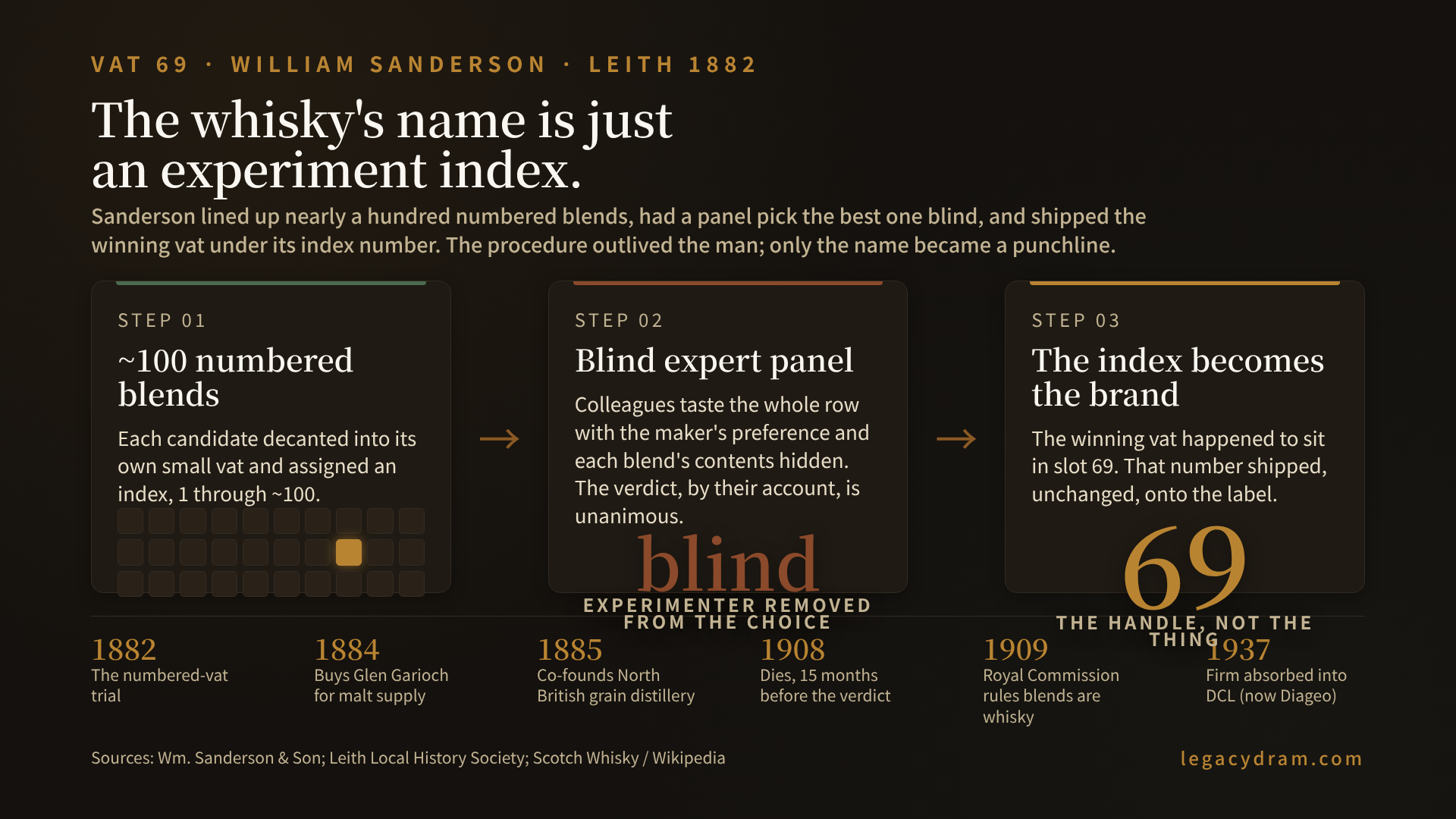
In 1882, in a Leith warehouse, William Sanderson lined up almost a hundred of his own whisky blends in small vats, numbered each one, and handed the problem to other people. He invited a panel of colleagues to taste through the row and tell him which was best, and he did not tell them what was in any of the vats or which ones he himself preferred. The panel worked down the line and arrived, by their account unanimously, at the vat marked 69. That number is the whole reason a bottle on a supermarket shelf today is called VAT 69. Not a recipe, not a year, not a place. A position in a numbered experiment that happened to win.
I want to start there because it is the most modern thing anyone in Victorian whisky did, and almost nobody remembers it was Sanderson who did it. The man ran a blind, indexed, comparative trial to select a product, let the result of the trial become the product’s name, and then shipped it. If you have ever pushed experiment-69 to production because it beat the other ninety-eight on the dashboard and never got around to renaming it, you have done exactly what Sanderson did, minus the warehouse.
A merchant who turned taste into a protocol
Sanderson (1839–1908) did not invent blending, and he was not, as far as I can tell, a more gifted taster than the dozens of other Leith and Edinburgh merchants doing the same work. He was sent at thirteen to apprentice under a wine and spirit merchant named Matthew Buchan on Bernard Street, stayed until Buchan retired around 1860, and by 1863 had his own small operation making British wines, cordials, ginger and rhubarb concoctions, and whisky. His first recorded whisky recipe was a blend of Glenlivet, a Pitlochry malt, and grain spirit. This is an ordinary biography for the trade in that decade. Plenty of men had it.
What separates Sanderson is not the palate. It is the method he reached for when he had to choose. The hard problem in blending has always been that the thing you are optimising (whether a given marriage of malts and grain is the best of the available options) lives entirely inside one person’s mouth and one person’s memory, and is therefore unauditable, unrepeatable, and impossible to defend when a customer or a competitor disagrees with you. The standard Victorian solution was for the master blender to declare the answer and stake his reputation on it. Sanderson’s solution was to externalise the judgement: lay all the candidates out at once, strip the labels, and let a panel converge on an answer he himself was not allowed to bias.
That is a comparative blind evaluation with the variable under test isolated and the experimenter blinded. We would now call it good methodology and consider it unremarkable, which is the point. He was formalising the craftsman’s intuition into something that produced the same answer no matter who was holding the glass, turning a private act of taste into a procedure that could, in principle, be run again and audited. He is, in spirit, doing what the master blenders who came after him built whole consistency doctrines around: trying to make a subjective verdict survive being handed to someone else.
The contingency he was honest about
Here is the part I find genuinely funny, and I think Sanderson did too, because he never dressed it up. He did not choose the name. The experiment did.
I would love to tell you that 69 was selected for some reason: a lucky number, a meaningful date, the year of something. It was not. It was the index of the vat that happened to be standing in the sixty-ninth slot when the panel reached its verdict. The winning blend could as easily have been in vat 14 or vat 88, and we would be drinking VAT 14, and bartenders would make a different set of jokes. Because, of course, the jokes came immediately: Victorian wits decided almost at once that VAT 69 must be the Pope’s telephone number, and the gag has outlived nearly everyone who first told it. A serious, reproducible selection protocol produced a brand name that sounds like a punchline, and Sanderson kept it anyway. He understood something that takes most people a career to learn, which is that the rigour goes into choosing the thing and the name is just the handle you grabbed it by. Renaming experiment-69 to something dignified would have changed nothing about what was in the vat.
He committed to the handle completely. With his son William Mark, he picked a deliberately old-fashioned, wide-shouldered bottle and a label that said, with no false modesty, Quality tells, sealed with the family’s Talbot hound crest in red wax. The bottle shape was so settled that it essentially did not change for the next hundred years. Having let chance assign the name, he stopped leaving anything else to chance.
What he built around the bottle, and what it cost
A blend is only as repeatable as its supply, and this is where Sanderson stops being a clever merchant and starts being an industrialist making real trade-offs. A winning recipe is worthless if you cannot make it again next year, and in the 1880s the inputs to a blend (malt from the Highlands, grain spirit from the Lowland patent stills) were controlled by other people, increasingly by a single combine. Sanderson’s protocol had given him an answer; the rest of his career was spent making sure he could keep reproducing that answer at scale.
So in 1884 he bought the Glen Garioch distillery in Aberdeenshire, not because he wanted to be a distiller but because he wanted a captive, constant supply of malt he controlled. That is vertical integration as a hedge against your dependencies, made by a man who had just proven, empirically, which inputs his flagship needed.
The grain side was the harder problem, and his answer to it is the most consequential thing he ever did (more than VAT 69, though no one names it after him). Grain whisky, the light spirit from continuous Coffey-type stills that made blended Scotch possible in the first place, was effectively monopolised by the Distillers Company Limited, which meant every independent blender in Scotland bought a critical input from a single supplier who was also, increasingly, a competitor. In 1885 Sanderson did something about it: with three other independent houses (Andrew Usher & Co, John Crabbie & Co, and James Watson & Co), he co-founded the North British Distillery in Edinburgh, a grain distillery owned by blenders, for blenders, specifically to break the single-supplier dependency. It opened in 1887 with Sanderson as its managing director. He had recognised the single point of failure in his own supply chain and built a redundant source, with allies, to remove it. North British is still running today. It is the most durable thing he made, and his name is nowhere on it.
I should be fair about the limits of the man, because the editorial line of this site is that nobody here is a hero. Sanderson was not a lone visionary; he was an able, ambitious Leith businessman (councillor, magistrate, Docks Commissioner) who happened to reach for better methods than his peers and who had the capital and the connections to act on them. The blind panel was clever; it was also, conveniently, a marketing asset, a story he could tell about why his whisky was better. The North British venture was principled and self-interested at the same time. He read his constraints accurately and chose well within them, which is most of what good engineering ever is, and it is enough. It does not need to be genius.
The methodology outlived the man, and the brand outlived its dignity
There are two endings here, and they pull against each other, which is why I wanted to write this one.
The first is that Sanderson won the argument he could not live to hear settled. For decades the trade fought over whether blended whisky (grain spirit married to malt, the entire category his life’s work depended on) could even legally be called whisky at all, or whether only pot-still malt deserved the name. The question went to a Royal Commission. It ruled, in July 1909, that blended whisky was whisky: a full vindication of the thing Sanderson had spent forty years perfecting and defending. He had died on the 3rd of April, 1908, fifteen months too early. He was, by the accounts, universally mourned in Leith, and he went to his grave not knowing whether the law would decide his whole trade had been a fraud or a craft. It decided craft. He never heard it.
The second ending is the deflation, and it is unkind in the way that history is unkind. The selection method (the blind, numbered, comparative trial) quietly won everything. It is now simply how serious blending houses choose, the unremarkable standard, the thing you do not even argue about. Sanderson’s procedure is everywhere. His company was absorbed into the Distillers Company in 1937 and rolled onward into what is now Diageo. And VAT 69 itself, the whisky that a panel of experts once unanimously crowned out of nearly a hundred contenders, is today a roughly forty-component blend that lives on the second-cheapest shelf at the airport, a competent, unglamorous bottle whose most famous attribute is a joke about the Pope’s phone. The most rigorously selected whisky of its century ended as the one you buy when you are not really choosing.
I find the combination strangely honest. The thing Sanderson actually built (a way of choosing that removes the chooser’s ego from the choice) was always more valuable than any single output of it, and it survived precisely because it was a method and not a name. Methods are portable; brands decay. He let an experiment name his whisky, lived long enough to make it the tenth best-selling spirit in the world, died before the law agreed it counted, and left behind a grain distillery that runs to this day under someone else’s banner and a selection protocol so completely absorbed into the trade that no one credits it to anyone. The winner named itself, in the end, and then the winner was forgotten and only the winning survived. I think he would have found that an acceptable trade. He was, after all, a man who understood that the handle is not the thing.
Related reading from the same era and the same port: the Pattison brothers, also of Leith, who scaled blending on borrowed conviction and nearly took the whole industry down with them; John Haig at Cameronbridge and Robert Stein before him, the grain-whisky technology that made every blend, Sanderson’s included, possible; and on the discipline of making a verdict survive being handed to someone else, Alexander Walker’s doctrine that the blend must taste the same forever (in Japanese). My broader writing on whisky and who built what is at kenimoto.dev.