Glenlivet 12 vs Glenfiddich 12: Which Is Better
I have poured Glenlivet 12 and Glenfiddich 12 side by side for something like forty people over the years. Almost no one can tell them apart from the bottle silhouette. Almost everyone can tell them apart from the first sniff. Glenlivet gives you orange peel and almond. Glenfiddich gives you pear and vanilla. Same region, same age statement, same forty percent ABV, same price shelf. Different fruit entirely.
This is not a coincidence, and it is not marketing. George Smith took the first legal Highland distilling licence in 1824. William Grant built Glenfiddich sixty-two years later with second-hand stills he bought from Cardhu for less than one hundred and twenty pounds. Two Speyside founding families, two decisions about copper geometry, two centuries of consequence. The bottle you pick up at the airport is the surviving record of both.
I have also, more than once, been told by three separate Scotch drinkers that “Glenfiddich is a beginner whisky and Glenlivet is a beginner whisky and neither one is worth drinking.” All three, when I quietly poured them each blind, could not identify which was which. I have stopped defending the entry-level Speyside honour. I would rather explain what is actually in the glass.
Two founders, sixty-two years apart
Every unchanging bottle has a founder somewhere behind it whose decisions the current owners are still being paid to protect. On these two, the founders were born to different centuries and behaved accordingly.
George Smith was a Ballindalloch farmer who kept a small illicit still, like most of his neighbours, when the British Parliament passed the 1823 Excise Act and made legal Highland distilling economically viable for the first time. In 1824, he was first in the region to take out a licence. The neighbours, who were still distilling illegally, considered this a betrayal. One of them promised, in Smith’s own words later recorded by Alfred Barnard, to “burn the distillery to the ground, and me at the heart of it.” A local landlord, James Gordon, gave Smith a pair of flintlock duelling pistols. Smith carried them on his hip for the better part of a decade. He was, as far as the records show, the first Highland distiller to go to work armed against the neighbours.
That is the founding story of the whisky you can buy for ¥5,000 at any Tokyo Bic Camera. A licence, two pistols, and a working farm that decided to stop hiding.
William Grant was a different animal entirely. Born in Dufftown in 1839, the son of a tailor, he took a job as bookkeeper at Mortlach distillery in 1866 under George Cowie and stayed there for twenty years, ending as manager. Twenty years of somebody else’s ledger. When he finally resigned in September 1886, at forty-six, he had saved enough for exactly one thing. He walked twelve miles across Speyside to Cardow, where Elizabeth Cumming was rebuilding her still house and selling off the old plant, and offered her everything he had. She took £119 19s 10d — tuppence short of a hundred and twenty pounds — for the entire second-hand kit. He carted it home to a leased patch of ground called Glenfiddich, the “valley of the deer,” and built the distillery around it with his seven sons, two daughters, and a single hired stonemason. The first spirit ran on Christmas Day 1887. There is a fuller version of this history in the standalone piece on William Grant and the Cardhu stills, and the shape of the decision he was making — a middle-aged man with no capital for new equipment betting on used copper — is a large part of why Glenfiddich still tastes the way it does.
One founder went legal in 1824 with a pistol on his hip because the trade would not let him alone. The other went legal in 1886 with second-hand copper because he could not afford to be picky. Neither story is romantic. Both are legible in the glass.
Two stillhouses of very different sizes
Speyside is a small region, and its distilleries are close together. Glenlivet and Glenfiddich sit about twenty-five kilometres apart across the valley. They have grown to be very unequal in scale.
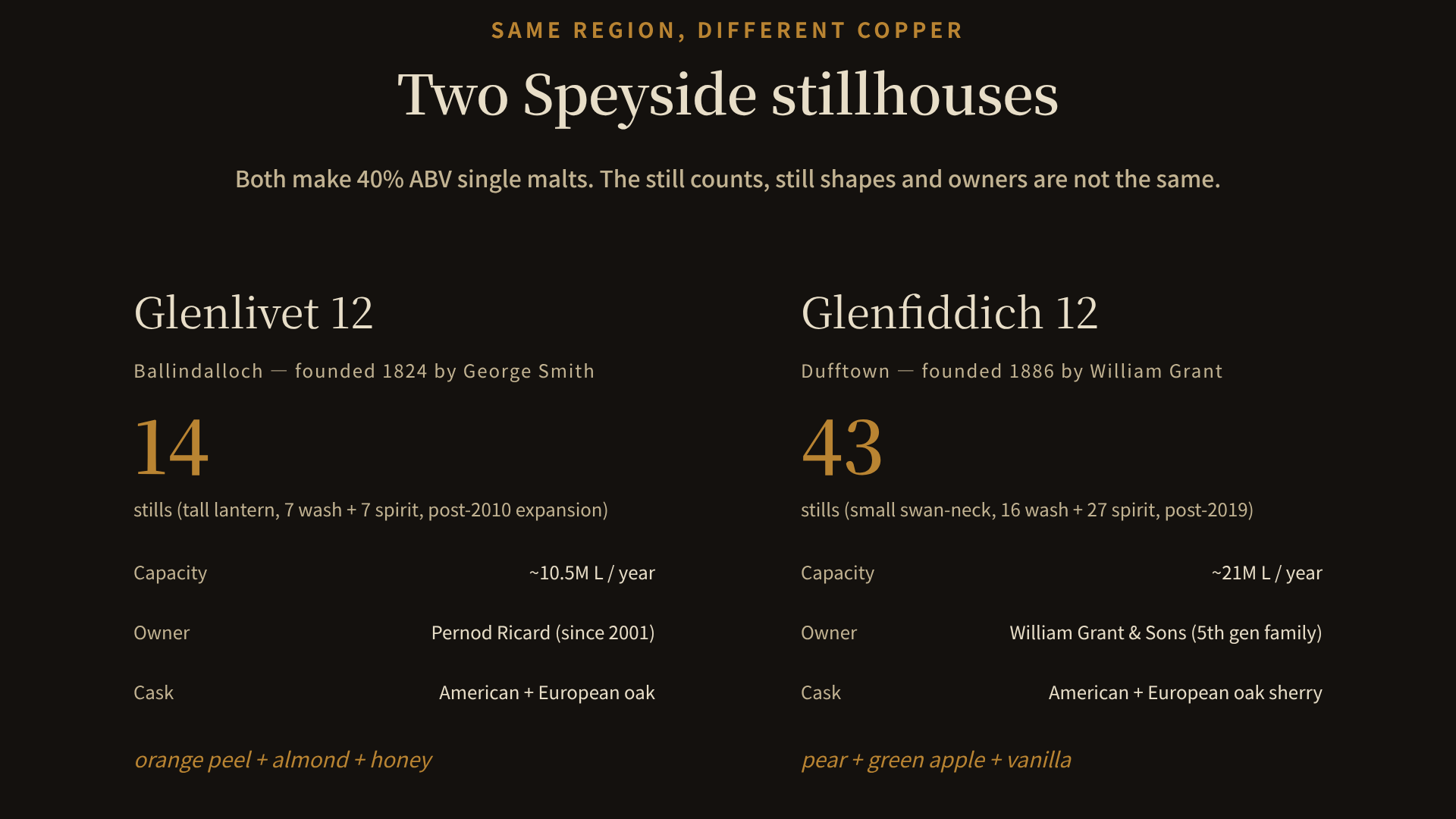
Glenlivet, after its £15 million 2010 expansion opened by the then Prince of Wales, runs fourteen pot stills — seven wash stills of 15,000 litres and seven spirit stills of 10,000 litres — producing roughly 10.5 million litres of pure alcohol a year. The stills are lantern-shaped with tall necks. Tall necks encourage reflux (heavy vapour condenses inside the neck and falls back into the pot for another go), which strips out oilier, sulphury compounds and lets lighter, fruitier esters through into the spirit. That is where the citrus-and-almond profile begins.
The engineer who chaperoned the 2010 expansion, Alan Winchester (Glenlivet master distiller 2009–2018), made the deliberate decision to build the six new stills to the exact same geometry as the existing eight — down to the profile of the boil ball and the angle of the lyne arm — because nobody at Forsyths, the Rothes coppersmiths who built them, could prove which curve was the one carrying the character. The full argument for that decision is in the craft piece on Winchester and copying the dents. The short version: when you cannot prove which variable matters, you change none of them.
Glenfiddich, on the other bank of the valley, went in the opposite direction. Where Glenlivet has fourteen large stills, Glenfiddich has forty-three small ones — sixteen wash stills of roughly 9,500 litres and twenty-seven spirit stills of about 5,900 litres — producing about 21 million litres of pure alcohol a year, twice Glenlivet’s output. The stills are smaller than any of the other major Speyside plants, and they are what the distillery calls “swan-neck” — variations of the lantern shape but on a smaller footprint. Fifteen of them are still direct-fired with gas rather than steam-coiled, which is rare in modern Scotch. William Grant’s original decision to buy second-hand copper is why the shape is small in the first place: the Cardow stills he could afford were small, so the new stills built to replace them, one at a time over a hundred and forty years, were built to the same small dimensions. What began as a founder’s budget constraint has become a house style.
Same region, same fermentation window of about fifty-five to sixty-five hours, similar barley, similar water. The lever that decided the fruit was the copper. Bigger, taller, fewer stills at Glenlivet produce an orange-peel-and-almond spirit. Smaller, more numerous, gas-fired stills at Glenfiddich produce a pear-and-vanilla spirit. Neither is an accident. Both are architecture.
Two cask policies, one price shelf
The cask assembly then finishes the divergence.
Glenlivet 12 — currently marketed as “Double Oak” since the 2019 label revision — matures in a combination of American oak and European oak sherry casks and is bottled at 40% ABV. The American oak dominates, and the sherry component contributes background structure rather than a top layer of dried fruit. The colour is pale gold; the palate carries orange peel, honey, almond and a faint oak spice; the finish is medium-light and clean.
Glenfiddich 12, the plain flagship (not the newer 12 Sherry Cask Finish, which is a different bottle finished in Amontillado), matures in a combination of American oak ex-bourbon and European oak sherry casks, married together in a large marrying tun for a final period before bottling at 40% ABV. The Solera Vat you may have read about is a different bottle again — that is the 15-year-old, introduced by David Stewart in 1998 and now the responsibility of malt master Brian Kinsman. The 12 is a more conventional marriage. The colour is amber-copper; the palate carries pear, green apple, vanilla and a background structural sherry sweetness; the finish is medium.
Both are natural colour and non-chill-filtered denial is not a claim either brand makes at 40% ABV — small amounts of E150a caramel colouring are legal in Scotch and standard at this price shelf. The colour difference you see between the two bottles is doing partly honest work — Glenfiddich has more first-fill sherry influence — and partly cosmetic work. Do not try to read the depth of maturation off the glass alone.
Two glasses on my kitchen table, a Tuesday in July
Both poured at room temperature, no water in the first pass. Ten minutes to open. Two Glencairn glasses.
Glenlivet 12. Colour, pale gold, catching the kitchen ceiling light the way weak jasmine tea catches a lamp. Nose, orange peel that has been sitting on a wooden cutting board for an hour, honeydew melon rind, a background almond that reads like the middle of a whole marzipan bar, and a faint clean-cotton smell underneath. Palate, medium-light body, first sweetness of orange peel and honey, then a mid-palate turn into almond spice and a light oak, then a short-medium finish of citrus zest and faint oak. Water at three drops brings the melon forward and softens the almond into something closer to sweet cream. What it wants next to it, on the table, is a piece of smoked salmon or an oyster. It does not want dessert.
Glenfiddich 12. Colour, amber-copper, catching the same light the way weak Assam catches it — a shade darker than the Glenlivet by real cask influence rather than caramel drama. Nose, ripe pear that has been left on a windowsill for a day, green apple skin, vanilla that reads like the middle of a supermarket vanilla ice cream rather than a whole bean, a faint honey underneath. Palate, light-medium body, first sweetness of pear and honey, then a mid-palate turn into vanilla and a light oak spice, then a medium finish of pear and faint oak. Water at three drops opens the pear into something closer to poached pear and softens the vanilla. What it wants next to it is an apple tart or a mild cheese. It is dessert-adjacent.
The two glasses do not fight. They occupy different chairs. Glenlivet is what you pour before dinner to open the appetite. Glenfiddich is what you pour after dinner to close it.
If you already own a peated Islay like Ardbeg 10, and you are trying to fill in the unpeated side of your Speyside shelf, both of these bottles do useful work. Glenlivet 12 is the drier, more citrus-forward direction. Glenfiddich 12 is the sweeter, fruitier direction. If you also want a light peat thread on the Speyside side of the shelf — a rebuilt version of what the region used to be before it went sweet — the Benromach 10 review covers the standalone case. And if you want to read the comparison pattern under a peated register, the Lagavulin 16 vs Talisker 10 piece uses the same structure at a heavier weight.
Price, meal, and when to pour
In Tokyo retail this summer, Glenlivet 12 sits at about ¥5,000–5,500 and Glenfiddich 12 at about ¥5,500–6,500. UK retail runs roughly £30–36 for Glenlivet and £34–40 for Glenfiddich. Duty free is another £5–8 off each, when the airport gods align. Per year of stated age, Glenlivet 12 is fractionally the cheaper pour, which is the correct pattern given the ownership split — a corporate brand under a French multinational has more pricing pressure to hit a specific bourbon-drinker’s shelf than a family firm does.
Both bottles hold water gracefully. Neither is worth chilling. Both are lightly under-strength for food at 40% ABV — you can taste them next to raw fish or a piece of cured meat, but they do not shove back at richer fats the way a 43% or 46% Islay would.
The pairing I keep coming back to: Glenlivet 12 with a small plate of oysters or smoked salmon, half an hour before dinner. Glenfiddich 12 with a slice of apple tart or a hard aged cheese, thirty minutes after. Neither is a substitute for the other. They are book-ends on the same evening.
What each bottle is a record of
At the end of my kitchen table on that Tuesday in July, both glasses were about half full. My wife walked past and pointed at the Glenfiddich and said, “That one is browner and it smells like Christmas.” She was right on both counts. The Glenfiddich colour is genuinely darker, and the aroma register — pear and vanilla and background honey — is closer to a supermarket Christmas cake than the Glenlivet’s dryer citrus profile.
But the two brownnesses point at different owners, too. The Grant family still owns Glenfiddich in 2026 — fifth generation of William Grant’s descendants — the largest single-malt distillery in Scotland that is still owned by the family that founded it. The Glenlivet passed through Seagram (from 1978, when the Canadian conglomerate that had already bought Glen Grant and Longmorn scooped it up) to Pernod Ricard (from 2001, when Pernod Ricard bought Seagram’s spirits business), and is now a corporate line item in a portfolio managed from Paris. Both distilleries produce more single malt every year than the founders would have believed possible. Both bottles cost roughly the same at the same shelf. The difference is that in Dufftown, five generations of Grant still sit on the board and the malt master answers to them. And in Ballindalloch, the man who signed the 1824 licence is buried in the local churchyard, and the still house that carries his name is answerable to a French corporation that has never met him.
The sixty-two-year gap between the two founders is still visible in the fruit. The one hundred and thirty-five years since William Grant died in 1923 is visible in who signs the malt master’s paycheck. Both facts are in the glass.
Next time you pour them, taste for that. Not for which one is better. For which century each fruit is the record of, and for who is still in the room deciding whether it stays that way.
Related on Legacy Dram
- Glenfiddich 1886 Origins: William Grant’s Second-Hand Stills — the standalone story of the £119 19s 10d Cardhu purchase and how used copper became a permanent house style.
- Glenlivet Distillery Expansion: How Alan Winchester Doubled Capacity by Copying the Dents — the 2010 expansion, still-geometry replication, and why nobody at Glenlivet is allowed to guess which curve matters.
- Benromach 10 Review: The Speyside the 1960s Threw Away — the counter-example. What the modern Speyside consensus deliberately deprecated, and what Gordon & MacPhail rebuilt from the output.
- Lagavulin 16 vs Talisker 10 Review: Islay Peat, Skye Worm Tubs — the same comparison structure at a peated weight. Two Diageo flagships that share a shelf tag and almost nothing else.
- Ardbeg 10 vs Laphroaig 10 Review: The Purifier and 55 vs 40 ppm — the Islay comparison that inverts input and output: the more heavily peated whisky drinks lighter, because of one small pipe.