Spirit Safe Whisky: 1823 Excise Act Brass Lock
Walk into any Scottish malt distillery on a tour and you will stop, at some point, in front of a brass-framed glass box the size of a bedside table, bolted onto a brass pipe between the spirit still and the receiver room. The guide will tell you it is called the spirit safe. If the guide is good, she will mention that until 1983 the padlock on the side was opened only by the tax inspector; if she is very good, she will say something about James Fox and 1823. Then everyone will move on to the warehouse.
This is a piece about the box itself. About why Parliament required it, who built it, what the lock was actually for, and why — forty-plus years after the lock went away — the box is still there in every working Scotch distillery. If you have ever worked on a system that was designed to meet a regulation that no longer exists in the same form, and you have watched the system outlive the regulation anyway because it had quietly become the thing people trusted, you already know the shape of this. I keep coming back to this box for exactly that reason.
1823: the deal
By the early 1820s, roughly fourteen thousand illicit stills a year were being seized in Scotland, and senior officials in Edinburgh had admitted — in writing — that more than half the whisky actually drunk in the country had never seen a licence. The duty rate was high enough that paying it meant losing money against the smuggler across the hill; the smuggler’s margin was wide enough that the magistracy had largely given up on winning. One of the people lobbying hardest for a different approach was the Fourth Duke of Gordon, whose estates in the north-east sat on top of some of the busiest unlicensed stills in the country and whose own tenants were paying his rent in white spirit.
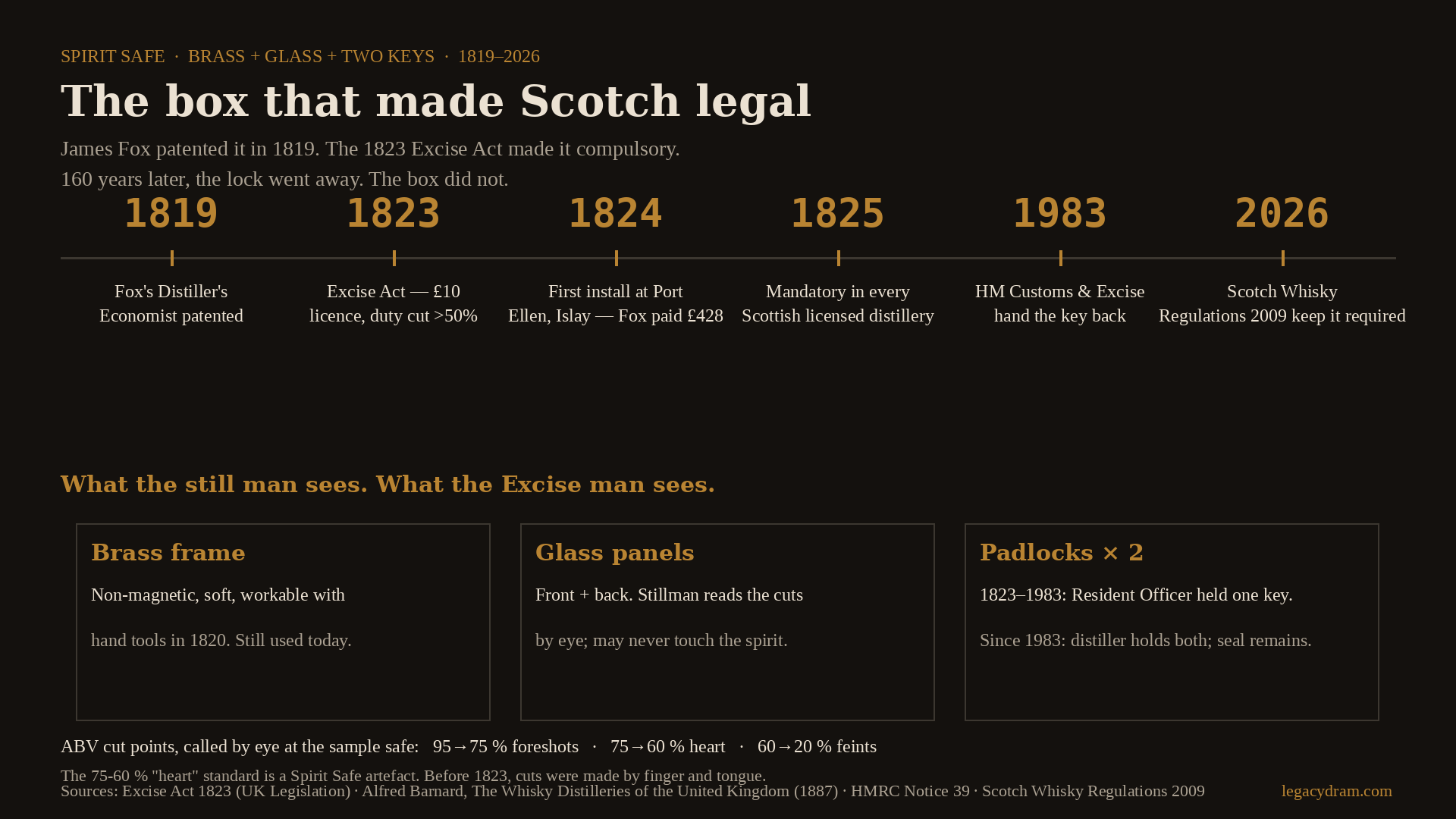
The 1823 Excise Act was the resulting bargain. The licence fee was set at £10 a year — within reach of a serious farm distiller. The duty was cut by more than half, to 2s 5d per gallon of proof spirit. The minimum legal still size was pinned at 40 gallons, which killed the one-cottage-one-pot economics of the old smuggling trade. George Smith took out the first legal licence under the new Act at Upper Drumin in 1824 and became what the industry now calls Glenlivet. Within three or four years the illicit-still seizures had collapsed by an order of magnitude.
Parliament wanted something in return. If the state was going to cut the duty and legalise the trade, it needed to be able to tax the output precisely, in gauge-books, as it came off the still — not later, not on declaration, not on the honour of a trade that had spent the previous century outwitting excisemen for sport. The spirit safe is what Parliament asked for in exchange.
1819: the box already existed
The device the Act reached for was not new. Four years earlier, in 1819, a man named James Fox had patented a brass-framed glass box he called “Fox’s Distiller’s Economist.” The patent language is unfashionably direct: the box was marketed on the dual claim that the distiller would waste less spirit to evaporation during the cuts (because the distillate stayed enclosed) and could gauge strength more reliably (because an internal hydrometer sat in the flow, visible through the front pane). It was sold as a labour-saving instrument, not as an enforcement tool. Fox had no particular reason, in 1819, to think it would become compulsory kit.
Then the 1823 Act happened and his small invention acquired a captive national market. In the winter of 1823-24, Fox personally travelled to Port Ellen on Islay and installed the first production unit, testing it on-site before HM Customs & Excise rolled it out across the country. The Port Ellen distillery records show he was paid £428 for the installation, which in 1824 money was serious — a working man’s annual wage was perhaps £40 — and which is roughly what you would expect to pay a specialist contractor who had been handed a de-facto standard. By 1825, every licensed Scottish distillery had one of Fox’s boxes bolted into the spirit line. He had been in the right place with the right small invention at the moment the right law passed.
(This is a pattern that happens repeatedly in the industry. The engineering that gets installed everywhere is rarely the most sophisticated engineering available. It is the engineering that was ready and standardised when a regulation came looking for something to standardise on. Aeneas Coffey’s still a few years later followed the same curve: it beat Robert Stein’s slightly more elegant 1827 design not because it was cleverer, but because it was duller to maintain and the market had already turned up to buy.)
What is actually in the box
Inside the brass frame, three things sit in the path of the spirit:
A sample column. The distillate from the condenser is piped into a vertical glass tube inside the safe. A Sikes hydrometer — a brass float with interchangeable brass weights, standardised as the UK’s legal strength measure by the Hydrometer Act 1816 — sits in the column. The float sinks to a depth that depends on the specific gravity of the liquid, which depends on its ethanol content; swap the weights to bring the float into the readable section of the stem, read the value off the scale, correct for temperature using the thermometer next to it. That number went into the Excise Officer’s gauge-book and was literally what the Crown taxed on. Modern distilleries still have a Sikes hydrometer in the safe out of habit; most also feed the stream through an electronic flow meter upstream for the number that actually goes to HMRC.
A set of external valves. The stillman reaches around the outside of the box, not into it, and operates brass taps that steer the flow between three destinations: the feints receiver (where foreshots and feints both go, to be redistilled in the next batch) and the spirit receiver (where only the heart cut goes, bound for cask). Those taps are the stillman’s only interface with the run. He can look through the front glass, see the hydrometer reading, watch the colour of the distillate shift from the cloudy foreshots to the clear heart to the waxier feints — and divert accordingly, from the outside, without the spirit ever leaving the sealed path.
Two padlocks on one hasp. The side of the safe has a hinged brass door and a hasp that takes two padlocks. From 1823 until 1983, one of those padlocks was keyed to the distillery and one to HM Customs & Excise, and the door could only be opened when both the distiller’s man and the Crown’s man were standing in front of it. You could not change the Sikes weights, calibrate the hydrometer, or get at the internal pipework without the Excise Officer present. The arithmetic in the gauge-book was, by regulation, a joint signature.
That last part is what everybody actually remembers about the spirit safe: that for a hundred and sixty years, the key to the box lived on the belt of a man who did not work for the distillery.
The 1823-1983 compact
The 1823 Act did not just require the box. It required the officer. Every licensed Scottish distillery was obliged to provide accommodation on-site for a Resident Excise Officer, whose role was explicitly to measure spirit production, hold one of the two keys, countersign the gauge-books, and generally be the Crown’s eyes inside a trade that the Crown had every historical reason not to trust.
For most of the next century and a half, that officer was a fixture of distillery life — a Civil Service posting with its own small folklore. Scotchwhisky.com’s history of the excisemen describes the role as part accountant, part watchman, and part village notable; many Highland parishes had an Excise cottage next to the distillery that was better built than most of the private houses. The best-known literary one is Robert Burns, who was an Excise Officer in Dumfries from 1789. The best-known industrial alumnus of the service is Aeneas Coffey, who spent roughly twenty-four years in the Irish Excise Service and held the Inspector General post for the last few of those years before resigning in 1824 to pursue the continuous still that would carry his name — meaning the man who would redesign grain whisky distillation had, among his previous occupations, spent his career on the Crown’s side of exactly this kind of locked box.
The compact worked. Illicit distillation did not vanish — it never does — but it ceased to be the main channel for Scottish spirit, and the gauge-book-at-the-safe system produced a tax base and a public record that the industry could be audited against. If you want a case study in a regulator and a regulated industry co-habiting a shared instrument for a century and a half without blowing it up, this is one. Nobody loved the Resident Officer — distillers resented him on principle, the way engineers always resent somebody who has to co-sign the measurement — but the system was legible, cheap to run, and sufficient.
In 1983, HM Customs & Excise withdrew the Resident Officer from Scottish distilleries. The reasoning was pragmatic rather than ideological: modern flow meters at the receiver, declared-grain reconciliation, and spot inspections could do the gauging job without a man living on-site. The Crown handed its padlock keys back to the distillery managers. The second padlock mostly came off. The brass seal remained compulsory; HMRC inspectors still visit; the gauge comparison still happens on a monthly cadence rather than an hourly one. But after a hundred and sixty years, nobody at the distillery is on the Crown’s payroll any more.
What is interesting is what did not change. The brass-and-glass box did not come out. Nobody replaced it with a different design, because the regulatory stack still required a secured, sealed, gauged point in the spirit flow, and Fox’s 1819 design was already the thing everybody knew how to build and inspect. The lock went away; the box stayed.
The accidental standardisation of the cut
The second-order consequence of forcing every Scottish distillery to install a spirit safe was not the one Parliament was thinking about in 1823, but it has outlasted the tax reason entirely.
Before the box, the cut was tactile. A pre-1823 distiller judged where to divert the flow using his finger, his tongue, and his nose: the demisting of water added to a sample, the “feel” of the oil, the specific taste of fusel notes coming through at the tail. Those judgements were real engineering judgements and they produced perfectly good spirit, but they were not transferable. Every house had its own gestures; the knowledge lived in the stillman and died with him; a measurement in one distillery was not comparable to a measurement at the next one.
After the box, the cut had to be made with the hydrometer visible through the pane and the ethanol number in the gauge-book. The 75% ABV demisting point became the de facto start of the heart cut because that was where the Sikes reading showed clean. The 60% ABV end became the typical close of the heart because that was where the hydrometer passed through the readable range on the standard weights and the gauge-book stopped making sense. Those numbers are not physical constants; they are the artefacts of what the Spirit Safe lets a stillman see and record. A modern Highland distillery that still cuts at “75 and 60” is honouring a convention that only exists because Parliament, in 1823, put a hydrometer in a brass box and told everyone to use it.
This is where the engineering reader will want to protest — “but surely they would have standardised anyway, through sheer trade exchange” — and the answer is: possibly, eventually, less sharply. The box collapsed what would have been a messy century of pre-industrial convergence into about a decade. By 1835 Scottish malt distillers were trading comparable ABV figures the way Victorian engineers would trade stress numbers once the standard testing machine arrived. The regulation forced the measurement; the measurement forced the standard.
(This is also the point at which the romantic view of malt whisky as a pre-industrial craft tradition starts to look a little threadbare. Much of what we admire today as “traditional Highland cut points” is a nineteenth-century regulatory artefact. Nothing wrong with that — a lot of what we admire as traditional anything turns out to be a nineteenth-century regulatory artefact — but it is worth noticing which part of the tradition is actually the romance and which part is actually the Crown.)
Scotland only, essentially
The Scotch Whisky Regulations 2009 (SI 2009/2890) do not literally include the sentence “there shall be a spirit safe.” They do require Scotch to be distilled in Scotland, matured in Scotland, bottled in compliance with the regulations, and — critically for our purposes — produced in a facility that complies with UK excise rules. The UK excise rules in turn require the spirit flow to be gauged for duty and the gauging point to be secured. In practice, every operating Scotch malt distillery meets that requirement with a brass-and-glass spirit safe of recognisably Fox-era design, and the Scotch Whisky Association’s producer guidance treats the safe as expected kit.
Elsewhere in the world the device is optional. Irish distillers may use one or not; American bourbon has its own tax measurement regime (parallel traditions, different kit); Japanese whisky — famously modelled on the Scotch workflow by Masataka Taketsuru’s 1920 Hazelburn apprenticeship — adopted the spirit safe as a matter of imitation rather than law, which is why you will find one at Yamazaki but may not find one at a comparable Kentucky operation. The spirit safe is one of the few pieces of distillery kit that, in regulatory terms, actually marks the Scotch–not-Scotch boundary.
A reader asking “is this arbitrary — would the whisky be different if the box had never been required?” is asking exactly the right question. I think the answer is probably yes, in small ways. A world in which Scottish malt cuts never standardised around hydrometer-visible ABV thresholds is a world in which Highland spirit characters diverged further by house rather than converging onto a common cut-point language. We will never know what that counterfactual single malt tastes like. We know only that the one in the glass has been shaped, at the margin, by a brass box an inspector could put a padlock on.
What the box is now
Walk the distillery tour today and the guide may or may not know the James Fox story, may or may not mention the 1983 withdrawal of the Resident Officer, will almost certainly point at the padlock holes on the side of the safe and say “and until 1983, only the exciseman had the key.” This is the vestigial fact that always survives — because it is a good story — long after most tour visitors have stopped understanding why the box was there in the first place.
The box is there because, two hundred and three years ago, Parliament made a deal with Scottish distillers: lower duty in exchange for sealed measurement. The sealed-measurement half of that deal lives inside the brass-and-glass box. The seal is still on it. The measurement is still happening. The Resident Officer is at home with his family in Perth; HMRC visits on a schedule. And the next time you taste a Highland malt that cuts clean at 75 and runs out at 60, you are tasting a convention that only exists because James Fox had a patent in 1819 and the Fourth Duke of Gordon wanted his tenants to pay rent in money.
Related reading on legacydram
- Whisky Spirit Cut: 75-60% ABV Heart, Explained at Glenturret — the modern-day practice of the cut, called by eye at the same brass-and-glass box, at Scotland’s oldest working distillery.
- Coffey Still vs Pot Still: 94% Grain, 65% Malt — Aeneas Coffey went from Inspector General of Excise to patent-holding still designer in the same decade that Fox’s safe was being rolled out. Same regulatory climate; different side of the padlock.
- Robert Stein’s Kilbagie Continuous Still — the other great post-1823 Act engineering story. Stein patented first; Coffey built the plainer version; the plainer version won. The Spirit Safe story has the same shape.
- Loch Lomond’s Straight-Neck Rectifying Still — a modern still that puts the cut selection inside the rectifier instead of leaving it to the spirit safe downstream. One of the few radical breaks from the Fox-era workflow.
Primary sources: Excise Act 1823 (6 Geo. IV) via the Scotch Whisky Association’s bicentennial note; Alfred Barnard, The Whisky Distilleries of the United Kingdom (1887), Spirit Safe illustrations and distillery-by-distillery descriptions; Scotchwhisky.com, “Remembering the age of the excisemen” on the 1823-1983 Resident Officer regime; Whiskipedia, “The spirit safe” for the Fox patent chronology; Mark Littler, “The History of Port Ellen” for the £428 installation record; Scotch Whisky Regulations 2009 (SI 2009/2890) via legislation.gov.uk; Dave Broom, The World Atlas of Whisky (Mitchell Beazley, 2nd ed. 2014); Charles MacLean, Whiskypedia (2016).