Sikes Hydrometer 1802: Inside the Spirit Safe
Open any Victorian spirit safe still in service — the one at Glenturret, the one at The Dalmore, the one at Strathisla — and you will see the same thing suspended inside the glass column: a hollow brass float with a thin graduated stem, and a flat lacquered wooden box next to it containing nine small brass weights laid out in a line. The box is usually labelled, in slightly faded Victorian lettering, “Sikes Hydrometer. Made for HM Excise.” Most tour guides do not read out the lettering. Most readers of this site, I suspect, will want to know whose name is on it, and why it is still there in 2026 when the instrument lost its legal standing almost half a century ago.
This is a piece about that brass float. About the engineer who built it in 1802, the son-in-law who built the company that sold it for forty years after he died, and the 180-year run during which Parliament taxed British whisky on the reading of one mechanical device. If you have ever shipped a reference implementation — the one that outlives its spec because nobody can face replacing the installed base — you already know the shape of this. I keep coming back to the Sikes hydrometer for the same reason I keep coming back to the Spirit Safe. The regulation that specified the instrument is gone; the instrument is still in the box.
The 1802 competition
Bartholomew Sikes was not an inventor by trade. He was an officer of HM Excise, and he spent his working life doing what every excise officer of his generation did in Britain — measuring spirit, keeping a gauge-book, and filing reports to a Board in London that, by the late eighteenth century, had become increasingly unhappy with the instrument it was using. The incumbent device was Clarke’s hydrometer, designed in the 1740s and no longer trusted by its own inspectors. Clarke’s readings drifted with temperature in ways nobody had bothered to correct properly. Different officers got different numbers off the same spirit. The Board wanted something better.
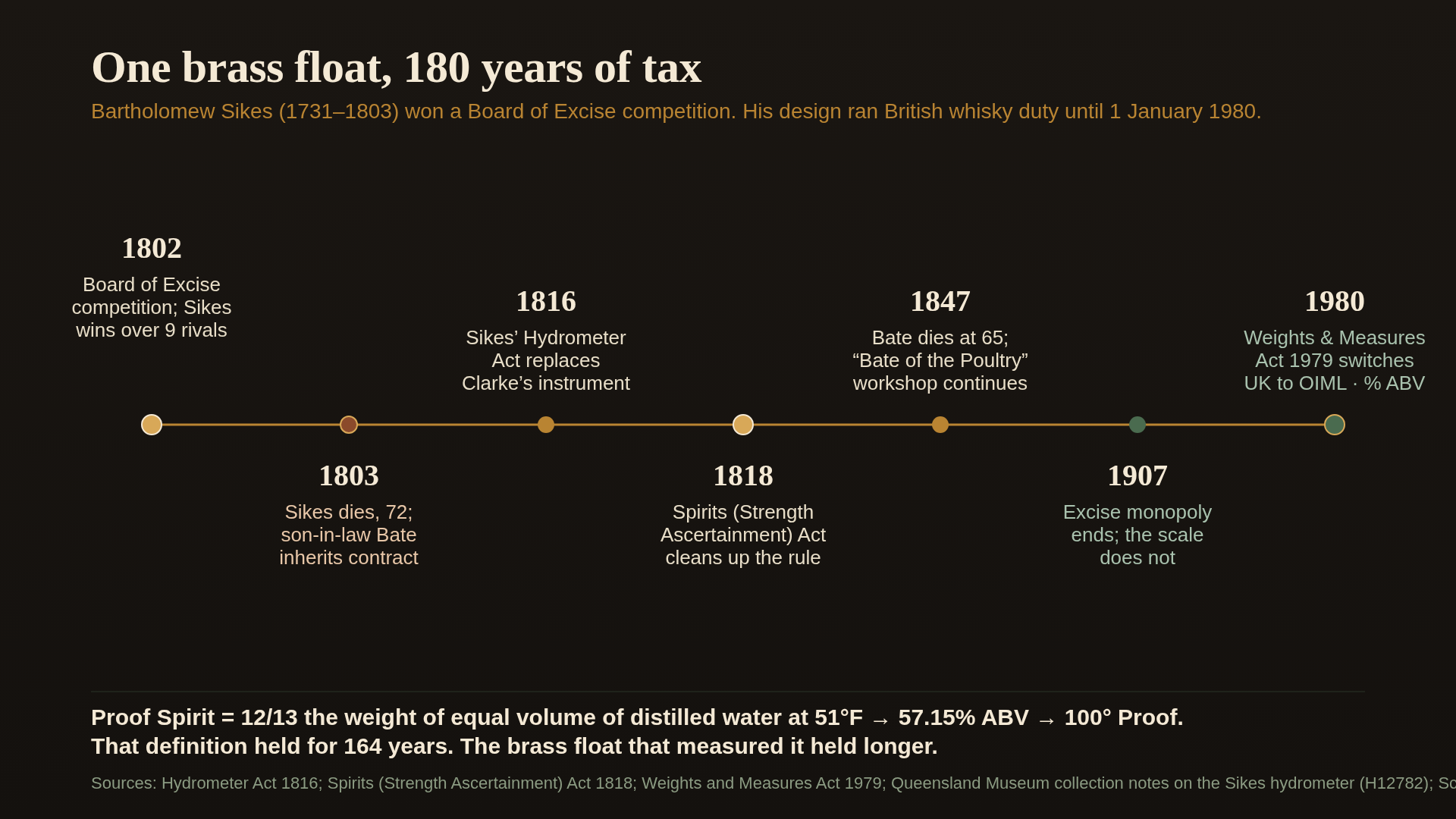
In 1802 it ran a competition. The call went out for a replacement hydrometer suitable for excise use; ten designs were submitted. The field was serious. Mary Dicas of Liverpool, whose hydrometer was already the approved federal instrument of the United States, submitted hers. So did several of the London instrument makers. The Board of Excise sat in formal session, ran the candidates through comparative testing on reference spirits, and awarded the commission to Sikes — one of their own officers, who had designed, around his day job, a hollow brass float with an interchangeable-weight system that produced consistent readings across the full strength range from feints to high wines.
Sikes was seventy-one years old when he won. He died the following year, in 1803, before the production contract had been fully executed. He had worked for the Board of Excise for his entire adult life and he had, at the very end of it, invented the instrument that the Board would use for the next hundred and seventy-eight years.
What is in the instrument
Three things sit in the box, and all three are the engineering:
The float. A hollow brass spindle, roughly the size of a small cigar, with a thin graduated stem rising from one end. In spirit, it sinks to a depth that is a function of the liquid’s specific gravity, which is in turn a function of its ethanol content at a known temperature. In isolation, a single float can read only a narrow band of strengths before the stem runs out of scale — a problem Sikes solved with his second innovation.
The nine weights. A row of small brass discs, labelled zero through H, each with a central hole that lets it slide onto the base of the stem. Each weight corresponds to roughly ten degrees Proof of strength range. You pick the weight that brings the meniscus into the engraved section of the stem, make the reading, and write both the weight letter and the stem number into the gauge-book. The eight extra weights are the whole reason the instrument works across the full range from neutral grain spirit to heavy feints without ever being out of scale. This is where Sikes beat the field. It is not a clever float; a clever float had been tried before. It is a modular float, which is the first thing you reach for when you understand that one component cannot span the range you need.
The thermometer and the tables. The reading only tells you the specific gravity, and the specific gravity of a water-ethanol mixture depends sharply on its temperature. Each instrument shipped with a mercury thermometer and a printed book of correction tables that converted a raw hydrometer reading at an observed temperature into degrees Proof at the 51°F reference. The Excise Officer did the arithmetic by hand, in the gauge-book, in front of the distiller. Modern distillery displays of Sikes hydrometers usually include the tables; they are not optional parts of the instrument but constitutive of it.
Nominal accuracy was about ±0.1 degree Proof, which is roughly ±0.057% ABV. For comparison, a modern laboratory oscillating-U-tube densitometer will give you ±0.02% ABV or better, so Sikes was within a factor of three of a 21st-century reference instrument, using nothing but brass and a mercury column and some tables you could print on a few folded sheets. Victorian engineering is never entirely primitive once you look at it carefully.
The son-in-law takes the business
Sikes’s death in 1803 would have ended the story if it were only about him. It was not. The following year, in 1804, his daughter Anna Maria married a young man called Robert Brettell Bate — her first cousin on the maternal side, several years her junior, an instrument-maker in London not yet famous. When Sikes died with the contract unexecuted, Bate was still finding his trade. The Excise Office technically had no obligation to the family. According to the Science Museum’s biographical notes on Bate, Sikes’s widow lobbied the Board to honour the contract through her nephew-and-son-in-law; by 1807 the Board had agreed.
That decision diverted Bate’s working life. He never became an exciseman. He became an instrument maker, set up at 17 Poultry in the City of London, and spent the next forty-four years supplying brass hydrometers to HM Customs & Excise under what was functionally a Crown monopoly. The stamp on the instruments was not “Sikes & Co.” It was “Bate of the Poultry.” By the 1830s he was supplying hydrometers across the Empire, from Scotch distilleries in Speyside to Irish grain plants Aeneas Coffey had helped design to Jamaican rum houses. The design was Sikes’s, from 1802. The production was Bate’s, from 1803 onward, and overwhelmingly from the Poultry workshop until his death in 1847.
I find this part of the record quietly instructive. The clever thing an engineer makes in the last year of his working life is rarely the thing his family profits from. In Sikes’s case the family did profit, because his widow was tactical about who the Board owed and because the man she married her daughter to was the right kind of craftsman to carry the thing forward. Some of the longest-running engineering companies in Britain began as a widow writing a letter.
Why 180 years
The Sikes’ Hydrometer Act of 1816 formally replaced Clarke’s instrument with Sikes’s for all British excise purposes. Two years later, the Spirits (Strength Ascertainment) Act 1818, passed on 23 May, repealed and restated the 1816 Act in cleaner language. From that moment, every drop of licit British spirit was measured on a Sikes hydrometer. The definition it carried — Proof Spirit as twelve-thirteenths of the weight of an equal measure of distilled water at 51°F, which maps to 57.15% ABV in modern units — was a legal constant, unchanged, for the next 164 years.
That stability is the second thing worth noticing. When James Fox got his spirit safe installed at Port Ellen in 1823-24, the brass float inside it was reading on the 1818 scale. When the two-key padlock was retired in 1983 and the Resident Excise Officer went home, the hydrometer was reading on the 1818 scale. When Bob Dalgarno takes up the Glenturret cut today, the brass float next to him is still ghosting the 1818 scale even though the paperwork has sat on OIML since 1980. Three engineering generations of Scotch whisky were measured on the same reference, which is remarkable for an industry in which almost nothing else stayed constant.
The Sikes hydrometer lost its exclusive legal standing for excise work in 1907, after which other certified instruments could be used, but the Sikes degree of Proof remained the official unit of strength in British duty law until 1 January 1980. On that date, the Weights and Measures Act 1979 took effect and the UK moved to the OIML scale — alcohol expressed as percentage by volume at 20°C, the same unit the rest of Europe already used. The Sikes brass float went, overnight, from being the law to being a museum piece and a distillery ornament. Most spirit safes kept theirs in place anyway, because the box they live in is still compulsory, the modern flow meters sit upstream rather than inside it, and nobody saw any reason to pull a working brass instrument out of a glass column it had lived in for a hundred and fifty years.
What the 46% distillers actually measure
The scale that modern Scotch bottlers talk about — the 46% ABV threshold below which chill-filtration becomes necessary, the cask strength numbers that run 58 to 62, the bottling strengths that vary with the age statement — is OIML, and it has been since 1980. But the physical measurement, if you walk into any modern distillery and ask the stillman what instrument is in the safe, is still the same. A Sikes hydrometer, or an instrument of identical geometry labelled in OIML units, suspended in the brass column, read against a thermometer, corrected against a printed table. The scale changed. The physics did not, and neither did the instrument.
I think about this when I see the romantic prose on cask-strength labels — the “unadulterated expression” and the “traditional measurement” claims. The measurement is traditional in exactly the sense this article has been describing. It was traditional in 1830 because an exciseman built it in 1802 and his son-in-law sold it from the Poultry; it is traditional in 2026 because an industry that likes brass has kept the instrument around in physical form long after the regulation that required it. There is nothing dishonest about any of this. The scale was accurate enough, and stable enough, and cheap enough to produce, that an industry built around it did not need to change it. But “traditional” here means, concretely, one man’s 1802 design, held in production by his widow’s letter, and left in place by a succession of Boards and Acts that could never find a reason to replace a brass float that worked.
The box is still there
The next time you stand in front of a spirit safe on a distillery tour and the guide points at the padlock holes on the brass door, look at the thin graduated spindle suspended inside the glass column and the small wooden box of weights beside it. If the box has a maker’s mark you can read, you will usually find a London address, sometimes still “Bate of the Poultry” on a Victorian survival, more often a successor firm like Loftus of London or Joseph Long. The design is Sikes’s from 1802. The business was Bate’s from 1803. The law was the 1816 Act and then the 1818 Act. The scale ran until 1980. The brass is still in the glass.
One Excise Officer, late in his career, designed a modular float. The modular float taxed British whisky for 180 years. That is, improbably, the correct length of the sentence.
Related reading on legacydram
- Spirit Safe Whisky: 1823 Excise Act Brass Lock — the brass-and-glass box that held the Sikes hydrometer in every licensed British distillery from 1823 to the present. Different inventor, same regulatory climate, overlapping instruments.
- Robert Stein 1827 Continuous Still: Before Coffey — Kilbagie, 1827. The Sikes hydrometer at the Stein works was already five years into mandatory service when Stein filed Patent 5583.
- Coffey Still vs Pot Still: 94% Grain, 65% Malt — Aeneas Coffey ran stills whose output was measured on Sikes hydrometers. He had, before the 1830 patent, been Inspector General of Excise in Ireland, which means he had used the Sikes instrument professionally for years.
- Whisky Spirit Cut: 75-60% ABV Heart, Explained at Glenturret — where the Sikes reading actually happens, in the moment, with the stillman watching the meniscus and deciding whether the heart cut is still clean.
- Why 46% Ester-Haze: Non-Chill-Filtered Whisky — the modern ABV threshold that governs bottling policy. OIML units, post-1980 measurement, but the same brass column downstream.
Primary sources: Wikipedia, “Bartholomew Sikes” for the 1802 Board of Excise competition and the ten-design shortlist including Mary Dicas; Queensland Museum, “Sikes Hydrometer; H12782” for the instrument’s physical description and the nine-weight system; Science Museum Group collection notes on Robert Brettell Bate for the Sikes-Bate marriage and the inheritance of the Excise contract; Spirits (Strength Ascertainment) Act 1818 (58 Geo. III c. 28) via legislation.gov.uk; Weights and Measures Act 1979 for the 1 January 1980 OIML transition; Science Museum Group, Loftus of London Sikes hydrometer for later-production instruments; Alfred Barnard, The Whisky Distilleries of the United Kingdom (1887) for spirit-safe illustrations showing Sikes hydrometers in situ; HM Customs & Excise Notice 39 for the modern descendant of the 1818 Act’s duty rules.