Suntory 1929 Shirofuda: Japan's First Whisky
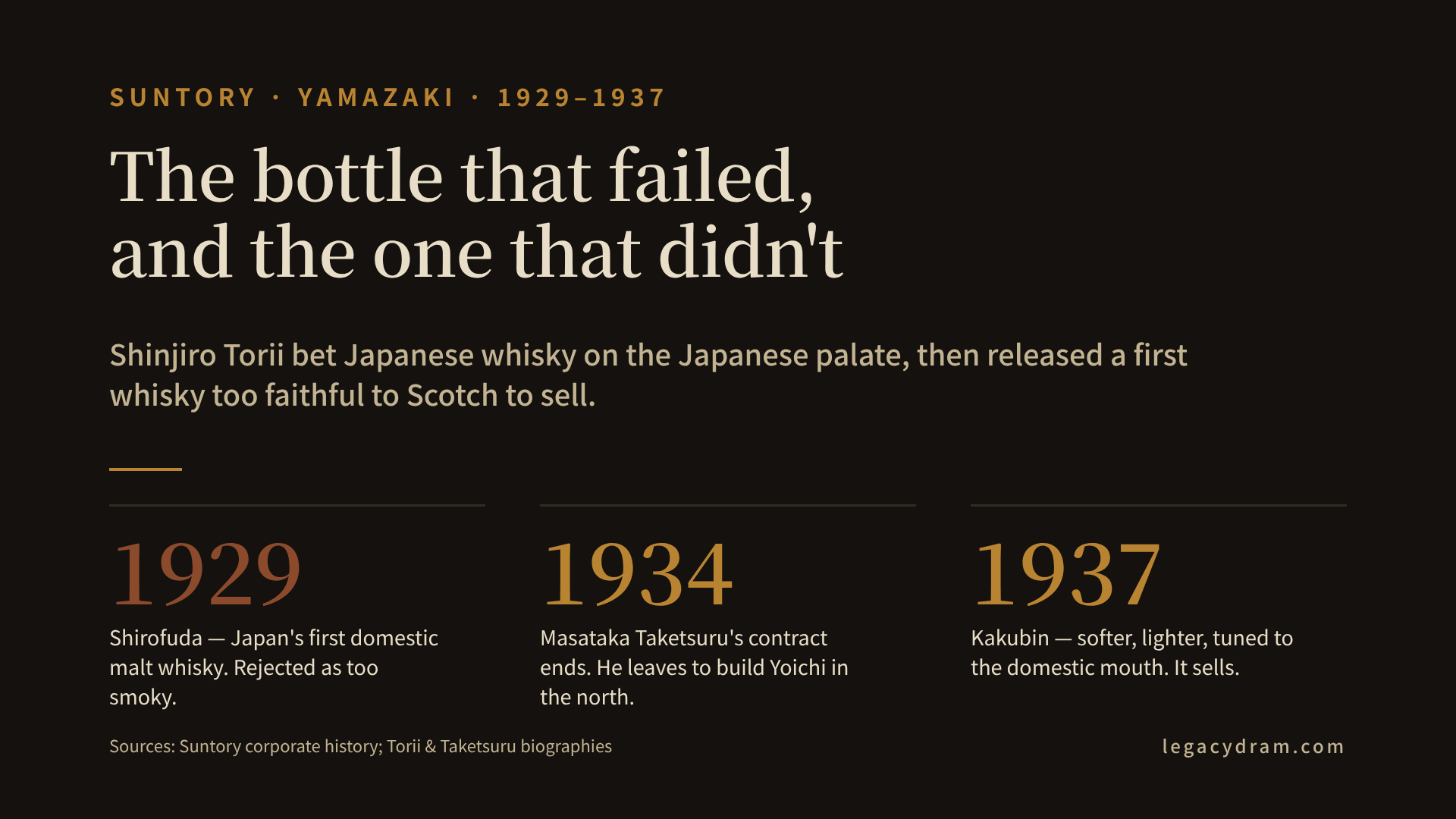
In 1929 the first whisky distilled in Japan from a Japanese still went on sale, in a white-labelled bottle, made by a company in Osaka that had until then been known mainly for sweet fortified wine. It was called Suntory Whisky Shirofuda, which means white label, and it was the product of six years of construction, a Scotland-trained distiller, and the largest single bet anyone in the country had made on the idea that Japanese people would one day drink whisky. It did not sell. The reason it did not sell is the part most accounts skip past on the way to the triumphant 1937 bottle that did, and it is the reason I wanted to write about Shinjiro Torii rather than about Suntory. Shirofuda failed because it was too good an imitation of Scotch. The man who had spent his whole career adjusting foreign tastes to fit Japanese mouths had, on his most important product, forgotten to do it.
I want to be careful with the word failed, because the company that descends from this one is now one of the largest spirits businesses on earth and the temptation to read the failure as a clever setup for the eventual win is strong. It was not a setup. It was a genuine commercial misjudgement by a man who was usually very hard to fool on questions of taste, and the eight years he spent recovering from it are more interesting than any origin myth, because they are where the actual character of Japanese blended whisky was decided. They also cost him the better distiller of the two who built that first bottle, and he never got him back.
The man who sold sweet wine first
Torii was born in Osaka in 1879 and went to work at thirteen as an apprentice at the Konishi Gisuke house, a wholesaler that dealt in pharmaceuticals and, increasingly, imported Western drinks. This is the detail that explains him. He did not learn whisky, or wine, or even spirits as such. He learned blending as a commercial discipline, in the back room of a trading house, where the job was to take a foreign product that Japanese customers found strange and adjust it until they would pay for it. He learned it on medicines and on wine. The whisky came thirty years later, and he approached it with exactly the same instinct: the product is not finished until the local customer likes it.
He opened his own shop, Torii Shoten, in 1899, importing and selling wine. The wine did not move. Western dry wine was, to the Japanese palate of 1900, sour and thin and faintly medicinal, and Torii’s response was not to lecture the customer about acquired taste. It was to sweeten it. In 1907 he released Akadama Port Wine, a fortified, sweetened, deeply un-European thing that was to authentic Portuguese port roughly what a melon soda is to a dry Riesling, and it sold enormously. Akadama is the bit of the story that the whisky histories tend to mention in a sentence and move past, because it is unglamorous, but it is the financial and intellectual foundation of everything else. Akadama made Torii rich, and it taught him, with a very large cash reward attached, that the correct move with a foreign drink was to bend it toward the domestic mouth rather than to bend the mouth toward the drink. He incorporated the business as Kotobukiya in 1921 on the back of that lesson.
So when he turned to whisky, he turned to it as a man who had made his fortune on precisely one principle, and who was about to violate it.
Why he hired the man who would prove him wrong
In 1923 Torii began building a distillery at Yamazaki, on the southern edge of Kyoto, at a confluence of rivers chosen for its water and its damp air. This was not a cautious move. No one in Japan had made malt whisky before; the technology was Scottish, the climate was wrong in ways no one yet understood, and the capital required was enough to frighten his own board. To run it he hired Masataka Taketsuru, a young man from a sake-brewing family in Hiroshima who had gone to Scotland, studied chemistry at the University of Glasgow, apprenticed at Longmorn and Hazelburn, married a Scotswoman, and come home with notebooks full of the actual working practice of Speyside and Campbeltown distilleries. Torii reportedly offered him a salary that was, for the time, extraordinary. He was buying the one thing he did not have, which was a man who knew how Scotch was really made.
And here is where the two of them diverged, quietly, in a way that would not become visible until the bottle reached the shelf. Taketsuru’s whole project, the thing he had crossed the world for, was fidelity. He wanted to make Scotch in Japan, correctly, with the peat and the heavy smoke and the structure he had learned to respect in Scotland. Torii’s whole project, the thing that had made him rich, was adjustment. He wanted to make a whisky Japanese people would drink. For the first six years these two aims pointed roughly the same direction, because nobody had a finished product yet and the argument was theoretical. In 1929 it stopped being theoretical.
Shirofuda was, by the accounts that survive, an honest attempt at a properly made Scotch-style whisky: smoky, peat-influenced, structurally faithful to the thing Taketsuru had learned to make. It was, in other words, Taketsuru’s whisky more than Torii’s. And Japanese drinkers, in 1929, did not want it. The smoke that read as authenticity and depth to a Scottish or a trained palate read as medicinal and harsh to a domestic market that had been raised on sake, on sweetened Akadama, on nothing remotely like a peated Islay-leaning dram. The bottle that was meant to announce Japanese whisky to Japan announced instead that the founders had, for once, built the product for themselves rather than for the customer.
The correction, and what it cost
This is the place in the piece where I would like to tell you that Torii then displayed his genius and engineered the perfect Japanese whisky. I am not going to, because what he actually did was more ordinary and more instructive. He went back to the principle he had abandoned. He pulled the style toward lighter, softer, less smoky, more rounded (toward the mouth that had bought Akadama by the case), and he spent the next eight years getting there. The whisky that resulted, Kakubin, released in 1937 in the squat faceted bottle it is still sold in, was the first one that worked. It is no one’s idea of a faithful Scotch; it was built, deliberately and commercially, to be drinkable by people who did not already like whisky, and its softness owes nothing to an accident of climate or cask. It is the founder correcting his single largest mistake by reverting to the only thing he had ever been sure of.
The cost is the part that keeps this from being a tidy success story. Taketsuru’s contract was for ten years, signed in 1923 and therefore expiring in 1934, three years before Kakubin. He did not renew. The standard telling is that the contract simply ran its course, and that is true as far as it goes, but it is also true that the two men wanted different whiskies and that the 1929 failure had handed the argument, decisively, to Torii. The company was going to move toward the softer, blended, domestically-tuned style, and Taketsuru, who had crossed the world to make the faithful thing, went north to Hokkaido, to a cold wet site near the sea that reminded him of Scotland, and built Yoichi to make the whisky he had wanted to make all along. The two founders of Japanese whisky split over the exact question Shirofuda had raised, and each spent the rest of his life proving the other half of the answer.
I find it hard to call either of them wrong. Torii was right about the market: Kakubin and then the postwar Tory’s whisky of 1946 and Suntory Old of 1950 built the entire category, put whisky in front of ordinary Japanese drinkers in their millions, and funded the long patient development that eventually produced malts the rest of the world takes seriously. There is no Japanese whisky industry without the commercial bet he won. But Taketsuru was right about the whisky. The reason a Japanese single malt can now stand on a shelf next to a Speyside and ask the same price is the seriousness of the faithful, purist, Scotch-respecting tradition he carried to Yoichi: the tradition Torii had to set aside in 1934 to keep his company alive. Torii’s softness sold the category. Taketsuru’s rigour earned it the prestige. Neither could have done the other’s job, and they could not, it turned out, work in the same building.
What the bet left in the bottle
There is a technical afterlife to all of this, and it is worth one paragraph because it is where the decision still physically lives. Yamazaki under Suntory became a distillery built for blending rather than for a single signature: an unusual variety of still shapes and sizes, fermentation regimes, and cask types (including the Japanese oak, mizunara, and the wine casks the company had on hand from its Akadama days), all of it producing a wide palette of component spirits that a blender can assemble into a controlled, rounded house style. That breadth was a deliberate choice, the engineering expression of Torii’s principle: keep enough different parts on the shelf that you can always tune the final liquid toward the drinker. A purist building Taketsuru’s distillery wants a narrow, consistent, characterful spirit. A blender building Torii’s wants range — the same working necessity that keeps a Scottish master blender like Sandy Hyslop at Chivas Brothers protecting a wide component palette decades later, though there the job is holding a fixed house style rather than building one. The shape of Yamazaki is the 1929 lesson cast in copper.
For readers who came to my work through the Kindle on cost-performance whisky, this is the missing layer under the familiar Suntory bottles. The reason a Kakubin highball is so frictionless, so easy, so engineered to disappear into a meal, is not blandness. It is a hundred years of a single commercial instinct, first proven on sweet wine, briefly forgotten in 1929, and then never abandoned again. The softness is the strategy.
Torii died in 1962, eighty-two years old, having lived to see the category he built become ordinary, living to see whisky on the table in houses that would have found Shirofuda undrinkable thirty years earlier. He had won his argument so completely that the failure that started it is now a footnote. What he did not live to see, and what I suspect would have complicated his satisfaction, is the later turn in which the world came to prize exactly the faithful, uncompromising style he had let walk out the door in 1934. The bottles that now command the highest respect for Japanese whisky owe their license to the man Torii hired and lost, and the bottles that made Japanese whisky a business anyone drank owe everything to the man who hired him. The same 1929 mistake set both halves in motion. Torii spent eight years fixing it and the rest of his life being right about the market, and he was buried, I think, without ever quite being told that the part of the answer he gave away was the part that would make his industry famous.
Related reading on the engineering of taste-by-design: I have written on John Haig and the continuous still that made cheap blended Scotch possible, and on Benromach, a Speyside whose owners reverse-engineered a vanished house style. The wider argument about who decides what is in the bottle is at kenimoto.dev.