Helen Mulholland: Bushmills' First Woman Master Blender
The Old Bushmills Distillery sits on the north coast of County Antrim, in Northern Ireland, and holds a royal licence to distil that is dated 1608. The licence is older than the building. It is older than Northern Ireland as a political entity. It is older than the United States, older than Isaac Newton, and within months of the first optical telescope. The village of Bushmills grew up around it, not the other way around. When I think about what it means to be the person who decides what goes in a bottle marked 1608, I keep coming back to the arithmetic: Helen Mulholland walked into the Bushmills laboratory as a food-technology student in 1993, which was the distillery’s 385th year of operation, and walked out as master blender emerita in 2021, which was the 413th. She held the blending bench for sixteen of those years. That is less than four percent of the licence’s history. She is in every bottle currently on the shelf.
The path was the lab, not the floor
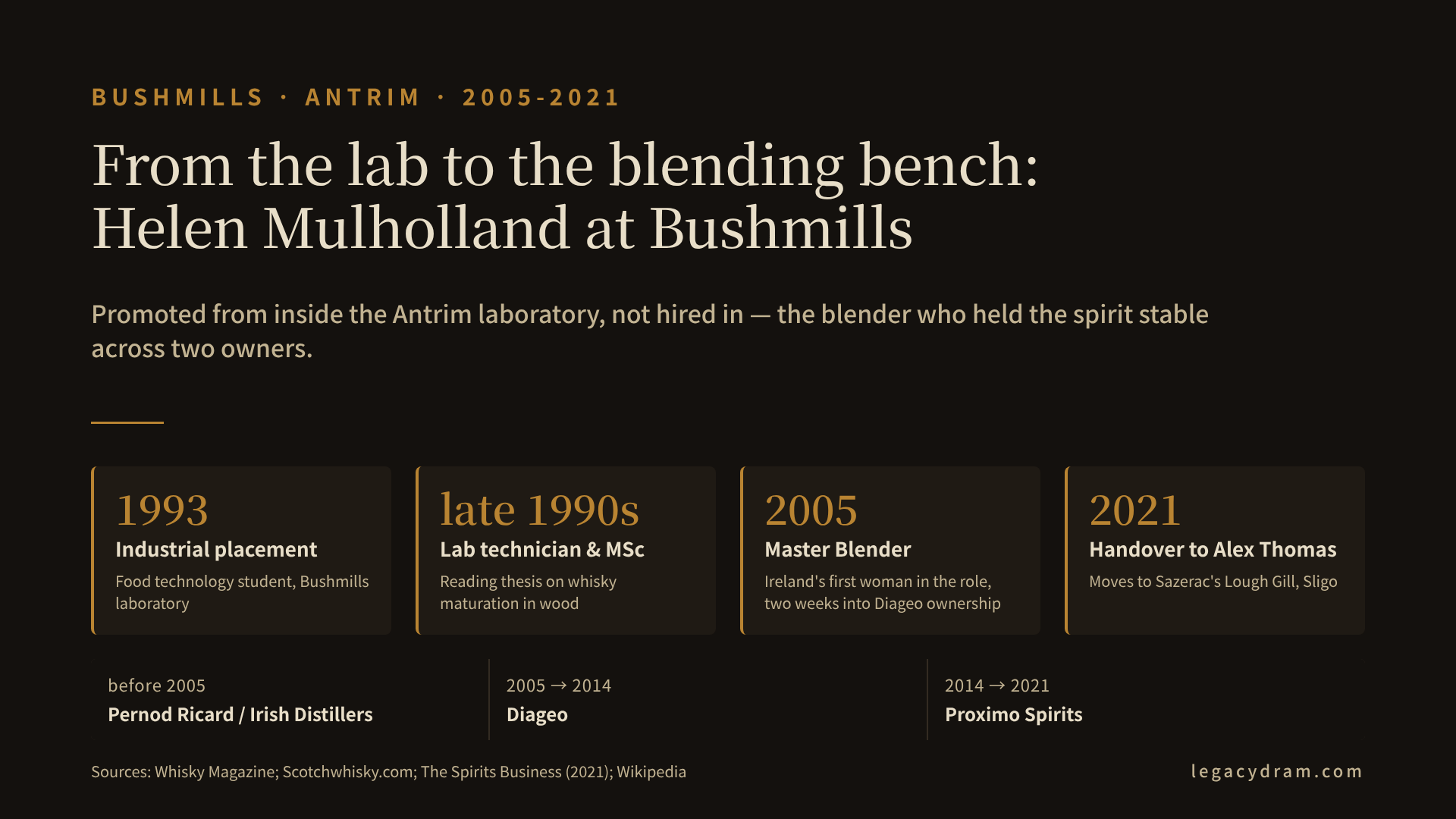
Mulholland was born in Portstewart, a small coastal town in County Londonderry, fifteen miles from Bushmills along the Causeway Coast. She studied food technology at Northern Ireland’s College of Agriculture, Food and Rural Enterprise, which is not a distilling school. It is a vocational college whose graduates generally go to dairies, bakeries, abattoirs and Northern Ireland’s food-manufacturing sector. She arrived at Bushmills in 1993 as a student industrial placement, moved into the laboratory as a technician, and, while continuing to work full-time at the distillery, completed a master’s degree at the University of Reading. Her thesis was on whisky maturation in wood. That is the first fact about her career worth sitting with.
The master blender’s role, in the modern formally-titled sense that emerged across the Scotch and Irish industries in the 1990s, is not really a stillhouse job. It is an analytical-chemistry job that sits on top of a cask inventory. The spirit character is set by the distillation, which is someone else’s responsibility (at Bushmills, Master Distiller Colum Egan since 2002). What the blender does is select, from tens of thousands of casks ageing in warehouses, the ones that will go into next year’s bottling, and reproduce the specification year over year. The most useful place to learn how to do that is the lab, where every cask that has ever been sampled leaves a GC-MS trace and a sensory panel sheet.
Bushmills, in 2005, did something the industry has sometimes done and sometimes failed to do: it promoted the person inside the lab instead of hiring a blender from outside. The why matters. Diageo had just bought Bushmills from Pernod Ricard, as part of Pernod’s takeover deal for Allied Domecq — Bushmills was the quid pro quo for Diageo staying out of the counterbidding — and needed a master blender immediately. The external pool of blenders with experience of Bushmills’ particular spirit (triple-distilled, unpeated, aged almost entirely in ex-bourbon and Oloroso) was essentially empty. Mulholland had been sampling that spirit through every cask-pull for twelve years. The promotion was lower risk than a hire. The marketing that framed it as Ireland’s first female master blender is correct but does the thing marketing usually does, which is to narrate a staffing decision as a milestone.
The owner question
Between 2005 and 2021, Bushmills had two owners. Diageo held it until November 2014, when it was traded to Proximo Spirits, the holding company better known for Jose Cuervo, in exchange for the fifty percent of Don Julio that Diageo did not already own. Proximo kept Bushmills as a standalone brand. Mulholland remained master blender through both.
This is the structural context in which to read her sixteen years. Each ownership change rewrote the marketing deck. Diageo had positioned Bushmills next to Johnnie Walker and talked about it as a route into the premiumising Irish-whiskey category. Proximo had no comparable scotch line and positioned Bushmills as its anchor malt brand, next to tequila. The strategic framing went from one blend among many to the one that matters. The spirit coming off the stills did not change, because the stills did not change, and the casks ageing in the warehouses were committed to the specifications Mulholland had locked in four, seven, ten, twenty-one years earlier. What the owner change could rewrite was which bottlings got investment, which got new packaging, and which got exported where. The underlying chemistry could not be rewritten on that timescale.
The release that is most clearly hers is Bushmills 1608 Anniversary Edition, launched in 2008 for the quatercentenary of the distillery’s licence. The 1608 is a blended whiskey built on malt that had been distilled from crystal malt: barley that is wetted, germinated, and then kilned at higher heat than standard distilling malt, which caramelises the sugars inside each grain before the mash stage. Crystal malt is a brewing ingredient. Its use in whisky is unusual, and the casks in the 1608 release had been maturing experimental crystal-malt spirit for more than a decade by the time she assembled the blend. The bottle is Mulholland’s specifically in a way most of her other work is not, because the Original and Black Bush cores existed before her and will exist after her, and what she contributed to them was consistency rather than invention. The 1608 was invention.
The other place to look for her signature is the cask-sourcing programme. Bushmills under her tenure bought casks directly from bodegas in Jerez, port houses in Portugal, and madeiras from Funchal: not refills traded through brokers, but pre-seasoned fresh casks whose first liquid was sherry, port or madeira chosen by Bushmills for how it would prime the oak. That procurement pipeline requires the blender to taste, in advance, the wine being used to season the empty staves, and to decide which style of oxidative sherry or port is going to shape the wood for the ten or fifteen years after. It is slow, expensive work. Mulholland also experimented with woods beyond oak, including an acacia-finished expression. Acacia gives a warmer, more spiced extraction profile than oak and is almost unused in the Irish category. None of that experimentation ended up redefining the house style. But the fact that she had the authority to try it, inside a corporate owner’s portfolio, is itself a measure of what she was trusted with.
The first-woman question, carefully
Mulholland is routinely described as Ireland’s first female master blender or the first woman master blender in Irish whiskey, and in 2018 she was inducted into the Whisky Magazine Hall of Fame as the first woman since the Hall was established in 2004. I want to put those claims in a ledger rather than wave them past.
She was first in Irish whiskey. That is not in dispute. In 2005, when she was appointed, the Irish industry was tiny: Midleton, Bushmills, and Cooley were the three production sites, with Midleton’s spirit overseen by master distiller Barry Crockett (see Redbreast 12 and Single Pot Still) and master blender Billy Leighton, and Cooley’s then-owner John Teeling and his master blender Noel Sweeney holding the third. Mulholland walked into a room of two other blenders, both men, in a category that had maybe ten percent of Scotch’s production volume. The first is accurate.
What the headline flattens is the broader lineage. Bessie Williamson ran Laphroaig from 1954 to 1972, though as managing director and owner, in a role that predates the formally-titled master-blender position standardised across the industry in the 1990s. Rachel Barrie became group master blender for BenRiach, GlenDronach and Glenglassaugh in February 2017, twelve years after Mulholland, but in Scotch, which has thirty times as many distilleries and a much deeper blending bench. The sentence Helen Mulholland was the first woman master blender in Ireland is simultaneously true, chronologically later than Williamson’s Laphroaig role, and chronologically earlier than Barrie’s Scotch one. The gendered superlative is category-dependent, and the categories are small enough that the superlative is mostly a statement about how the categories are drawn.
The more useful fact, I think, is the path. Williamson inherited Laphroaig from her employer after twenty years as his secretary and de facto manager. Barrie came through the Scotch Whisky Research Institute, then Glenmorangie, then Morrison Bowmore, and was hired into the BenRiach job as an external replacement for Billy Walker. Mulholland neither inherited nor was hired in. She was promoted from the laboratory of a company she had worked at since she was a student, into the senior technical role at that same company, by an owner who had bought the company two weeks earlier. That is the rarer path, and it is the one that the first-woman framing obscures.
The handover that repeated the pattern
Mulholland retired from Bushmills in November 2021, after sixteen years as master blender and twenty-eight years total at the distillery. Her successor is Alex Thomas, born in Ballymoney, fifteen minutes’ drive from the distillery, who had spent over a decade as a timber merchant before joining Bushmills in 2004, qualified as a distiller and blender in 2012, and had been master blender for Proximo’s Sexton single malt since 2017. Thomas’s path is not identical to Mulholland’s — she came in from timber rather than food technology — but the shape is familiar: a long apprenticeship inside Bushmills before the senior role. Bushmills has now promoted two consecutive master blenders from inside its own operations, both women. That is almost certainly not an intentional policy. It is what happens when the distillery itself becomes the apprenticeship, and the apprenticeship produces the only candidates the owner trusts with the sixteen-year commitments that a blender makes.
Mulholland did not stay in the Irish industry in a ceremonial role. She moved to Sligo and took the master-blender job at Lough Gill Distillery, owned by Sazerac, the American family company that also owns Paddy Irish Whiskey and Buffalo Trace. In 2022 she was named vice-chair of the Irish Whiskey Association, and in December 2024 its chair, the first woman in the position since the association was founded in 2014. That is a different job from the Bushmills one. It involves lobbying, geographical-indication defence, and export-market work, not cask selection. The move suggests, to me, that she had finished with Bushmills in the way a long engagement finishes, and wanted the next thing to be unambiguously her own.
What is in the bottle
The sentence I keep wanting to write about Helen Mulholland is that she was a custodian rather than a founder, and I keep crossing it out because custodian flatters the role and understates the chemistry. Custodians preserve. Mulholland selected, blended, and released hundreds of distinct cask vattings over sixteen years, inside a specification that had to be identical from year to year because that is what commercial single-brand whiskey is. The analogy that fits better is the one engineers already know: she was the long-serving on-call for a production system whose output had to be bitwise reproducible across sixteen years and two acquisitions, using inputs (oak, barley, time) that were themselves variable.
If you open Bushmills Black Bush in 2026, somewhere between a quarter and a third of what is inside the bottle is malt she selected. The Original is less of hers now than it was in 2021, because the youngest components have been vatted by Thomas. The 16-year-old is almost entirely hers, because the youngest oak it touched was already in the warehouse before 2010. The 21-year-old, which uses casks laid down in 2004 or earlier, is partly hers and partly Darryl McNally’s. The further back you go on the shelf, the more of her decisions you are drinking, and the less of her lab coat is in the Antrim building.
She retired four years ago. The spirit she chose is still working its way out of the warehouses. In 2032, the last of her 10-year-old releases will clear. The 1608, which she built out of experimental casks that were themselves fifteen years old in 2008, is already gone from most markets. What she decided in the Bushmills lab between 1993 and 2021 will outlive her retirement by roughly a decade, which is to say she will have shaped the inside of the bottle longer than she sat at the bench. That is the usual economics of a blender’s career, and it is why the first-woman line in the obituaries, when they come, will be the least interesting sentence about her.
If you want to read further on the people who shaped Bushmills and the Irish category around her: Colum Egan on Bushmills Black Bush is the Master Distiller whose spirit Mulholland worked with for sixteen years. Barry Crockett and Single Pot Still is the Midleton counterpart to Bushmills’ triple-distilled malt tradition. John Teeling at Cooley is the independent third pole of Irish whiskey in the 1990s and 2000s. For the female-master-blender lineage either side of her: Rachel Barrie’s blend matrix is the Scotch contemporary who came in twelve years later, and Bessie Williamson at Laphroaig is the Scotch antecedent half a century earlier, in a very different kind of role.