Redbreast 12 Review: Barry Crockett's Pot Still
Two glasses on the kitchen counter — a Glencairn on the left with Redbreast 12, a rocks glass on the right with Bushmills Black Bush. Both bottles are Irish. Both had been open a fortnight. I had promised myself I would try them side by side, on the theory that two Irish whiskeys from the same island but different mash bills would tell me more about each other than either would tell me alone. The Black Bush is all-malt, triple-distilled, blended with grain. The Redbreast is triple-distilled from a mash of malted and unmalted barley, which is what makes it “single pot still” rather than “single malt.”
I nosed the Redbreast first. There is no smoke. Instead: warmed honey, toasted walnut, a piece of orange peel that has been sitting on a warm hob for a minute. Then I sipped, and the first thing that reached me was not a flavour but a texture. The liquid coated the tongue like cream that had been stirred a beat too long. A 40% bottle should not feel like this. It does anyway, and the reason has a name on the label and a tax date on the archive shelf.
Redbreast 12 — 40% ABV, around £52 in the UK or $60–75 in the US
The person. Barry Crockett was born in the Distiller’s Cottage on the Midleton site, in the small stone house tucked inside the distillery walls where his father Max Crockett was the sitting Master Distiller. Barry apprenticed to his father from age seventeen, and in 1981 he took over the desk himself — six years after the commissioning of the New Midleton complex in July 1975, the industrial-scale plant that Irish Distillers had built next to the old distillery to consolidate what was left of Irish whiskey after the industry’s near-death in the mid-twentieth century. Barry held the role until March 2013, when he handed it to Brian Nation. Nation, in turn, handed it to Kevin O’Gorman in 2020. Over the same period the blending desk was held by Billy Leighton, who joined Irish Distillers’ finance department before pivoting into whisky, became Master Blender in 2004, and stepped into a Master Blender Emeritus role in November 2023, passing the batches on to Dave McCabe.
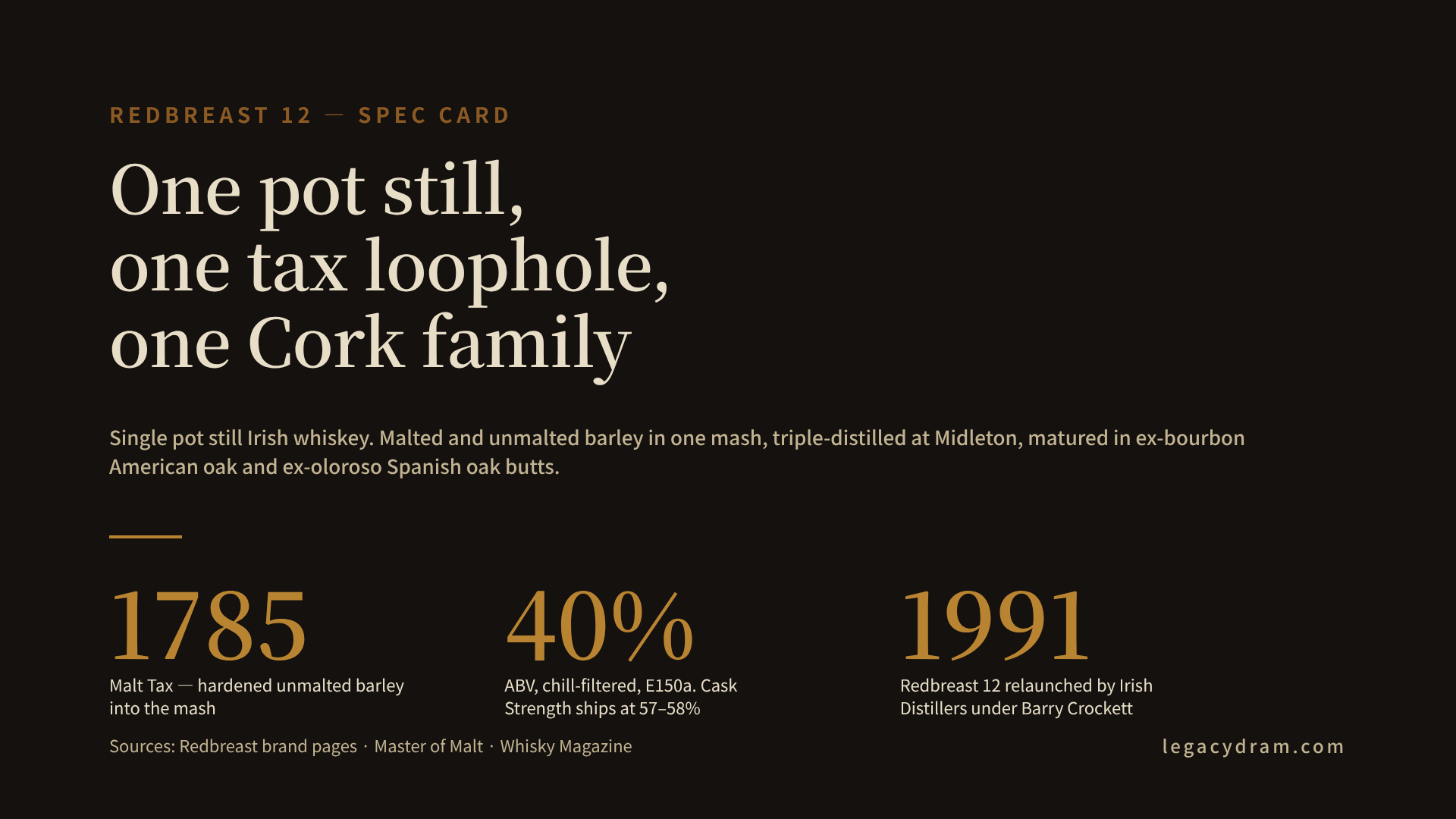
I include the family history because Redbreast, as it sits in the glass, is a decision-chain rather than a single hand. The brand itself was born as a bonder’s label: from 1912 W&A Gilbey bottled distillate from Dublin’s Bow Street Distillery and sold it as Redbreast J.J. Liqueur Whiskey 12 Years Old. Irish Distillers ended the bonder trade in the early 1970s and closed Bow Street in 1971. Gilbey’s kept releasing what stock they had until 1985, sold the brand name to Irish Distillers in 1986, and in December 1991 Irish Distillers relaunched Redbreast 12 as a Cork-made pot still whiskey rebuilt on top of their reformed wood programme. Barry Crockett was the sitting Master Distiller through the entire relaunch. If you buy a bottle today, the specification that got the label back on the shelf in 1991 is the one you are drinking.
The engineering. Three specifications are load-bearing on what is in the Glencairn.
The mash bill — malted and unmalted barley, in an Irish pot still. The Redbreast wash is made from a mash of malted barley and unmalted barley — sometimes called “green” barley — mixed in a single mash tun at Midleton. This is the definition of Irish single pot still whiskey. It is not blended after the fact; the two grains ferment together, distill together, and mature together. The unmalted grain is what gives the finished whiskey its characteristic weight on the tongue. Unmalted barley retains β-glucans and other soluble non-fermentable sugars that a fully germinated malt would have broken down during malting, and those compounds carry through fermentation and distillation into the final spirit as viscosity. That is the “creamy” mouthfeel you read about in every Redbreast review. It is a fluid-mechanics fact, not a poetic one.
The Malt Tax, 1785 — origin story with an asterisk. The received origin story is that Irish distillers began mixing unmalted grain into the mash to dodge the tax the British government levied on malted barley in 1785. That is not wrong, but it is not complete. Records from Irish distilling before 1785 show unmalted barley was already used in many mash bills — one estimate puts around a third of the average Irish mash as unmalted before the tax existed. What 1785 did was harden a technique that was already local practice into a survival strategy. The tax made unmalted grain the dominant choice for anyone shipping in commercial volume, and by the mid-nineteenth century “pot still” was a category name rather than a style. Two centuries later the tax is gone, the malting equipment is cheap, and Redbreast still uses unmalted barley because the mouthfeel it produces is what buyers of the bottle are paying for. A tax law survived as a texture.
Triple distillation and the two-cask maturation. The wash is triple-distilled in copper pot stills at Midleton — three passes rather than the standard Scottish two — which cuts the spirit down to a higher strength off the still and strips out more of the heavier congeners than a double pass would. Triple distillation is often described as what makes Irish whiskey “smooth”; a more precise description is that it is what makes Irish whiskey lighter, because the third pass removes a fraction of the fusel oils and heavier esters that would otherwise carry through. That is why the unmalted-barley weight matters so much on Redbreast in particular: the pot-still design would otherwise ship a lean spirit. Then the whiskey is filled into a two-cask combination — ex-bourbon American oak barrels weighted more heavily than ex-oloroso sherry-seasoned Spanish oak butts, with the exact ratio moving batch by batch — and left for at least twelve years. The ex-bourbon casks contribute vanilla, coconut, and the pot still’s own honeyed cream; the oloroso butts contribute walnut skin, raisin, and the toasted-nut spine that reads as Redbreast on the palate.
The bottling — 40% ABV, chill-filtered, E150a. The standard 12 ships at 40% ABV, chill-filtered, and lightly coloured with E150a spirit caramel. This is the mainstream Irish convention for a core-range single pot still under £60. The Redbreast 12 Cask Strength expression, introduced in 2011 during Barry Crockett’s final years at the desk, is the same base whiskey pulled from first-fill oloroso butts, bottled batch by batch at 57–58% ABV, non-chill-filtered, without added colour. The two bottlings live on the same shelf at wildly different prices. The standard one is the one that established the modern shape of Irish single pot still on the world market; the cask-strength one is the one that convinced whisky critics the shape had teeth.
What it tastes like, in specifics.
- Colour. Amber, a little deeper than the Bushmills next to it. The oloroso butts are doing some of that work; the E150a is doing the rest.
- Nose. Warmed honey first, then a beat, then toasted walnut and a piece of orange peel that has been left on a warm hob for a minute. Behind the sweetness sits a green-apple note that reminds me the pot still is Irish and not Scottish. Not banana, not tropical fruit — a raw Bramley apple sliced thin.
- Palate. The texture arrives before the flavour. The liquid coats the tongue with an oiliness that a 40% bottle has no right to. Then the flavours land in order: vanilla and honey from the bourbon casks, then a beat, then the raisin and walnut skin from the oloroso, then a low tannin at the back of the tongue that reads as good black tea gone slightly cold in the cup.
- Finish. Medium-long. The nuttiness lingers into the walnut-skin bitter note, then decays over about forty seconds into a warm-honey memory at the back of the throat. Not a sherry monster. A quiet Cork pot still with a sherry overlay that stays polite.
When to drink it, and next to what
In a Glencairn or tulip at room temperature, roughly 18–20 °C, no water. Water at 40% ABV thins the mouthfeel that is the whole reason to buy this bottle. If you must add water, add three drops and stop; more than that and the honey moves further back and the pot-still weight collapses. It sits well after food, because the walnut-skin bitter note reads as savoury nuttiness once the tongue is coated with something rich. Do not put it over ice — the sherry finish is fragile enough that a cold pour loses the raisin-and-walnut spine and reads as generic sweet Irish whiskey.
The best pouring companion I have found is a plain single malt from the Speyside side of the sherry-cask school — a Glenlivet 12, a Glenfarclas 10, or if the shelf will stretch to it a Glendronach 12. Pour a half of each. The Speyside malt shows you what oloroso does to a mash of pure malted barley; the Redbreast shows you what oloroso does to a mash that also contains unmalted barley. The mouthfeel delta is the whole education.
The Bushmills next door — one island, two mash bills
Two Irish whiskeys, both triple-distilled, both partially matured in oloroso. The differences are not distillery folklore; they are the mash bill and the blending. Bushmills Black Bush is an all-malt whiskey blended after distillation with a lighter grain whiskey; Colum Egan’s specification leaves the sherry-cask malt at roughly 80% of the finished blend. Redbreast 12 is single pot still — malt and unmalted barley in the same mash, from the same stills at Midleton, with no grain component at all.
Pour them side by side and the Redbreast reads as thicker. The Bushmills is the more elegant of the two; the Redbreast is the more physical. Either bottle would happily sit as a Speyside 12’s Irish counterpart on a shelf; together they are the argument, still running, about what “Irish whiskey” is supposed to mean after the near-extinction of the industry in the mid-twentieth century. That argument is not academic. John Teeling started Cooley Distillery in 1987 partly because Irish Distillers had reduced Ireland to two distilleries and one house style, and the industry needed a third voice to prove the category could hold more than one answer. Redbreast is Irish Distillers’ answer. Bushmills is the northern-Ireland answer. Cooley, and everyone Cooley made possible, is the third.
What to check next time you pour one
Three tests will tell you whether the plant at Midleton is doing what it is supposed to.
First, the mouthfeel arrives before the flavour. Take a sip and pay attention to the first thing you notice. It should be a physical coating on the tongue, not a taste. If the taste arrives before the texture, the batch has been over-cut on the third distillation and the unmalted-barley weight has been stripped out. This is the single most important tell for a Redbreast batch that is working properly.
Second, the vanilla arrives before the raisin. After the texture, the flavours should land in bourbon-cask order — vanilla and honey first, then the oloroso’s walnut and raisin behind them. This tells you the batch is still weighted toward the bourbon-heavier spec rather than being pulled disproportionately from the sherry butts. If the raisin arrives first, either the batch was blended sherry-heavy that quarter, or the bourbon casks were more tired than usual. Both are possible.
Third, the walnut skin at the back of the palate. This is the tell for a genuine oloroso-seasoned Spanish oak butt, rather than a re-used or gently seasoned one. The sotolon and related rancio compounds build up during the long dry aging of oloroso in the butt before it is emptied for whiskey use, and they are what your tongue reads as walnut skin. If the finish tastes clean and generic-sweet with no bitter walnut note, the butt has probably given up most of its rancio to a previous whiskey and been re-used for economics.
Barry Crockett stepped away from the Midleton stillroom in 2013, but the specification he was sitting on when Irish Distillers put Redbreast 12 back on the shelf in 1991 has outlived his desk. Brian Nation kept it. Kevin O’Gorman is keeping it now. Billy Leighton did the blending revival that made it recognisable as this Redbreast; Dave McCabe is signing the batches today. That is the highest praise a bottle can get in this trade — three successors, decades apart, deciding the previous decision was worth keeping.
Try this bottle
Affiliate link below. If you buy through it, LegacyDram earns a small commission and the price you pay does not change. Alcohol-related links are intended for readers of legal drinking age (20+ in Japan, 21+ in the US, 18+ in the UK).
Related reading
- Bushmills Black Bush Review: Triple-Distilled Malt Meets Oloroso — the northern-Ireland answer to the same “Irish and sherried” brief, from a malt-only mash blended with grain
- John Teeling and Cooley: The Harvard PhD Who Broke Ireland’s 2-Distillery Whiskey Monopoly (1987) — the founder story of the third house that gave Irish whiskey back its plural voice
- Redbreast 12 と Barry Crockett — 麦芽税が生んだ『未発芽大麦の配合』 — the Japanese-language companion piece on the same bottle, written from the same kitchen
Sources
- Redbreast (whiskey) — Wikipedia
- Redbreast 12 Year Old — Redbreast brand page
- Redbreast 12 Year Old Whiskey — Master of Malt product page
- Jameson master distiller Barry Crockett retires after 47 years — The Spirits Business
- Midleton’s Barry Crockett Retiring After 47 Years — WhiskyCast
- Master distiller Brian Nation departs Irish Distillers — The Spirits Business
- Billy Leighton becomes Irish Distillers master blender emeritus — Whisky Magazine
- The 18th-Century Tax That Shaped the Future and Identity of Irish Whiskey — VinePair
- Irish Whiskey Explained: Single Pot Still Whiskey — Master of Malt blog
- Classic bottlings: Redbreast 12 Year Old — Master of Malt blog