Balvenie 12 DoubleWood Review: Stewart's 1993
The kitchen counter had a Glencairn on it and next to it a rocks glass — I had promised myself I would try the DoubleWood next to a Glenfiddich 12, on the theory that two Speyside malts from the same holding company would tell me more about each other than either would tell me alone. The Balvenie went into the Glencairn. The Glenfiddich went into the rocks glass because that was the last clean glass in the cupboard, and by the time I noticed it was too late to swap them. Both bottles had been open a fortnight.
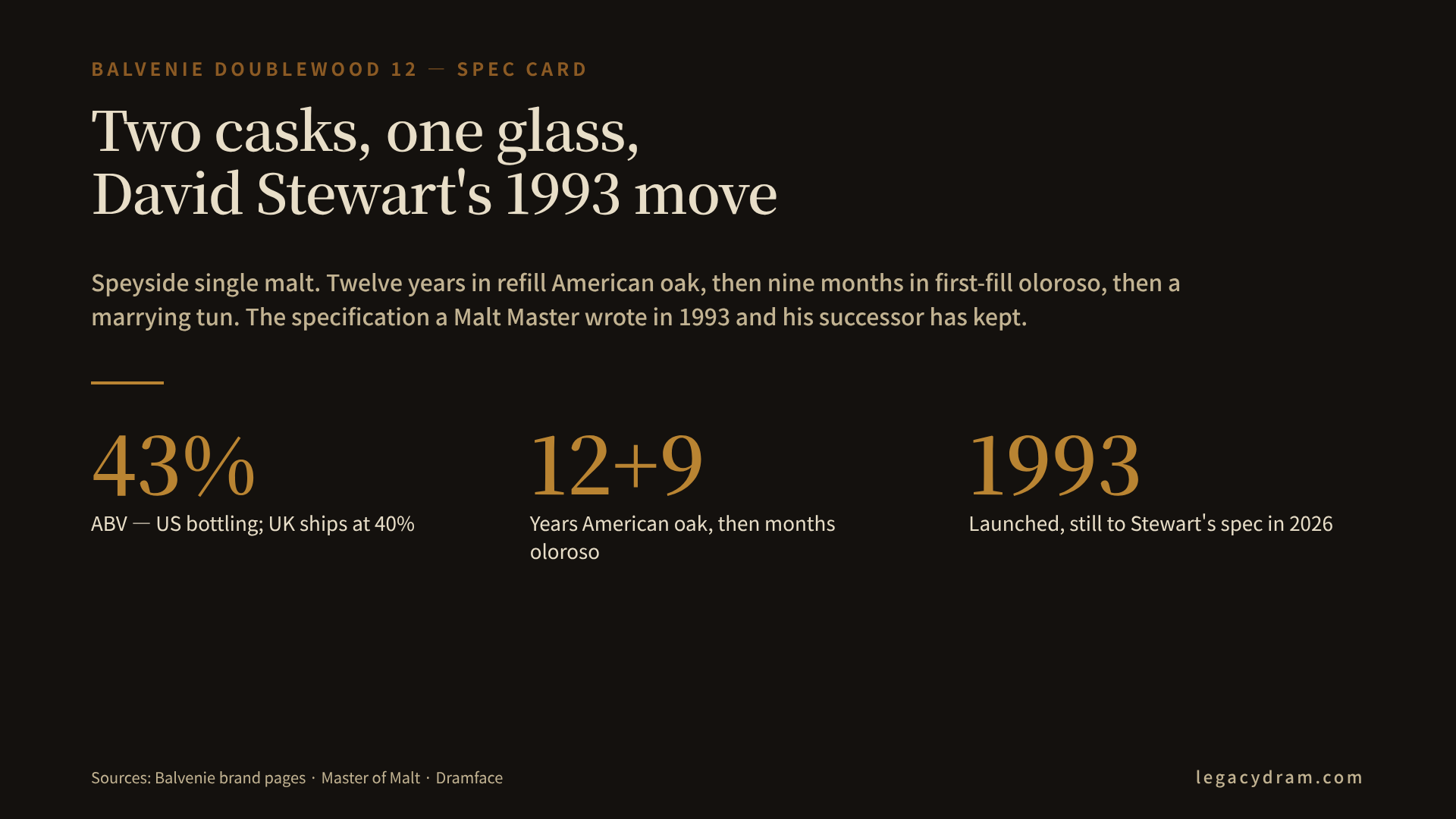
David Stewart launched the DoubleWood 12 in 1993, and in 2026 the pour still works as an argument. The Glenfiddich next to it was there to draw a line between two philosophies of the same company: the sister distillery that ships one specification and holds it steady, and the sister distillery that ships two casks reconciled into one glass. One decision-maker on each side of the line. The line has been drawn since 1993.
Balvenie DoubleWood 12 — 43% ABV in the US, 40% in the UK, around $55–70 or £45–55
The person. David Charles Stewart MBE was interviewed for a stocks-clerk role at William Grant & Sons in 1962 at age seventeen. He served a twelve-year apprenticeship under the previous Malt Master, Hamish Robertson, and took over the desk in 1974 at twenty-nine. He held the Malt Master role for the entire William Grant portfolio — Glenfiddich, Balvenie, Kininvie, the Grant’s blends — until 2009, when he handed Glenfiddich and the blends to Brian Kinsman and narrowed his focus to Balvenie. In the 2016 New Year Honours he was made MBE. In 2018 he took on Kelsey McKechnie as apprentice; McKechnie now signs the Balvenie batches. As of September 2022 Stewart had been at the same distillery for sixty years, which the Balvenie marketing team commemorated with a very expensive whisky called The Balvenie Sixty. If you buy a DoubleWood 12 this year, the person who first put that liquid in a bottle in 1993 is retired, alive, and living the same day-to-day distance from the distillery he lived in 1961.
I include the biography because DoubleWood is the artefact of a career decision. Stewart began experimenting with wood finishing at Balvenie in 1982 — taking a fully matured whisky out of one cask and setting it in a second cask of a different kind for a short period. The technique appeared in the early Balvenie Classic (1982) but did not become a permanent product line until 1993, when Stewart released the DoubleWood 12. Most Scottish distilleries did not start experimenting with cask finishing at commercial scale until the mid-1990s, when Glenmorangie’s port-wood and sherry-wood editions arrived and the technique started to look like an industry.
The engineering. Three specifications are load-bearing on what is in the Glencairn.
First maturation — American oak, at least twelve years. The DoubleWood spends its first twelve years in ex-bourbon American oak, mostly refill barrels and hogsheads. American oak’s dominant flavour compound is vanillin, produced when the barrel’s inner surface is toasted or charred and the fresh oak lignin degrades. Ex-bourbon casks have already given up their most reactive layer to the previous American distiller, so the vanillin the Balvenie liquid draws out is subtler than what a virgin cask would deliver. Twelve years of this gives you a base whisky with vanilla, coconut, honey, and a light citrus edge — a proto-Balvenie that could ship on its own if Stewart had stopped here.
Second maturation — European (Spanish) oak ex-oloroso, nine months. The whisky is then decanted into first-fill oloroso sherry butts — Spanish oak (Quercus robur), previously seasoned with dry oloroso for two years by the cooperage before the barrels leave Jerez. Nine months is short. It is deliberately short. Spanish oak is denser and more tannic than American oak, and it also carries the residual sotolon and related rancio compounds from the oloroso seasoning, which is what your tongue later reads as walnut skin and raisin. Extraction happens fast. A full re-racking for another two or three years would rebuild the liquid as a sherried Balvenie; nine months leaves the sherry as an overlay on top of a still-recognisable bourbon-cask spine. The DoubleWood is engineered so you can still taste the first twelve years underneath.
Tun marrying — three to four months. After the sherry finish, the batch is transferred to a large oak tun and left to marry for three to four months before bottling. Cask-to-cask variation gets averaged out. The fatty-acid esters and heavier aromatics redistribute across the batch. This is the step that lets Balvenie ship a consistent bottle without hostile filtration — the marrying tun does the work the chill filter would otherwise be asked to do on its own.
The ABV split. The DoubleWood 12 ships at 43% in the United States and 40% in the United Kingdom and most of Europe. Same production, two conventions. The 3-point delta is audible in the glass: on the 40% bottling the sherry sits a beat further back on the palate and the vanilla is easier to isolate; on the 43% the two woods arrive closer together in time and the finish carries a fraction longer. Neither is wrong.
Everything downstream of the barrel — chill filtration, E150a caramel colouring — is standard for a bottle at this price. Stewart took the one 1993 fight he needed and left the other two for later.
What it tastes like, in specifics.
- Colour. Mid-amber, slightly deeper than the Glenfiddich 12 next to it. The E150a is doing some of that work; the sherry butt is doing the rest.
- Nose. Vanilla first — the American oak reads before the Spanish oak does, which is the whole point of a short finish. Behind it, raisins that have been warmed in a low oven, a walnut skin, a piece of honeycomb with the beeswax still on it, and a faint mineral note somewhere behind everything. Not a fresh candle. A candle that has been burning a while, set on top of a slice of Christmas cake.
- Palate. Honey and toasted almond arrive together, sitting on a base of soft butterscotch. Then a beat, and the raisin catches up — not a modern supermarket raisin but the kind soaked in warm brandy for a fruitcake. There is a low woody bitterness behind the sweetness that reads as walnut skin. At 43% the ABV is present but the mouthfeel is round; at 40% it goes a shade watery around the edges.
- Finish. Medium. Vanilla and dry sherry, in that order, decaying over about thirty seconds into a faint tannin at the back of the tongue. Not long. Not meant to be long. A DoubleWood that finished for two minutes would be a different whisky in a different price band.
Next to the Glenfiddich 12, the difference is a question about what a Speyside 12-year-old is supposed to do. The Glenfiddich is a single-specification liquid built by Brian Kinsman — ex-bourbon and ex-sherry casks married together in the vatting tank from the start, no separate finishing step, held identical from batch to batch across two decades. Its virtue is that it does not surprise you. The DoubleWood is Stewart’s answer to the same brief: build a Speyside 12 that reconciles two woods by moving the liquid, not by mixing it. The Glenfiddich is a photograph. The DoubleWood is a two-exposure double print.
When to drink it, and next to what
In a Glencairn or tulip glass at room temperature, roughly 18–20 °C. It does not need water. If you pour it after food, the walnut skin reads as more nutty and less bitter, which is why the bottle survives so well as a post-dinner malt. It does not do well over ice: the sherry finish is fragile enough that a cold whisky loses the raisin-fig axis and reads as generic bourbon-cask Speyside.
If you have both DoubleWood and a plain bourbon-cask Speyside on the shelf — an Aberlour 10, a Glenfiddich 12, an old Cragganmore 12 — pour a half of each and pass them back and forth. The nine-month oloroso finish is obvious in a way it is not on its own.
The Glenfiddich next door — consistency versus reconciliation
Two malt masters, two philosophies, one holding company. Stewart designed DoubleWood 12 as a two-cask reconciliation. Kinsman, who took over Stewart’s Glenfiddich desk in 2009, has held Glenfiddich 12 to a single-specification consistency doctrine — the same bourbon-and-sherry-cask marriage in the vatting tank, batch after batch. Both bottles ship in the same price band from the same corporate parent. The Balvenie’s argument is that you can taste a decision — the nine-month move — in the finished liquid. The Glenfiddich’s argument is that you should not have to.
Consistency is easier to build a globally distributed brand around; reconciliation is easier to build a career around. Both bottles have kept their specifications untouched for thirty-plus years. They are the same company disagreeing with itself in public, at the same price point, on the same shelf.
What to check next time you pour one
Three tests will tell you whether the plant is doing what it is supposed to.
First, the vanilla arrives before the raisin. Nose the whisky, sip it, and pay attention to which flavour reaches you first. The American oak has to arrive ahead of the Spanish oak — that is the whole point of a nine-month finish. If the sherry arrives first, either the batch spent longer than nine months in the butt or the cooperage has quietly increased the seasoning intensity; both are possible but neither is the DoubleWood you have been reading about.
Second, the walnut skin at the back of the palate. This is the tell for a genuine oloroso finish. The sotolon and related rancio compounds build up during the long dry aging of oloroso before it goes into the butt, and they are what your tongue reads as walnut skin. If the finish tastes clean and generic-sweet with no bitter note, the batch was finished in a re-used sherry cask that had given up most of its rancio to a previous whisky.
Third, the 43% versus 40% question. If you have a choice between the US bottling and the UK bottling — a duty-free shop, an internationally stocked bar, a friend who ships you a bottle — try both at once. The 3-point delta is a controlled experiment on what dilution costs the finish. The 43% keeps the two woods in conversation. The 40% pushes the sherry further back and lets the vanilla dominate. It is useful to know which bottling is on the shelf you are buying from.
David Stewart stepped back from day-to-day work at Balvenie in the years after 2018, but the DoubleWood specification he wrote in 1993 has outlived his desk. Kelsey McKechnie signs the batches now, and she has kept the two-cask move in place. That is the highest praise a bottle can get: a successor decided the previous decision was worth keeping.
Try this bottle
Affiliate link below. If you buy through it, LegacyDram earns a small commission and the price you pay does not change. Alcohol-related links are intended for readers of legal drinking age (20+ in Japan, 21+ in the US).
Related reading
- William Grant, Glenfiddich, and the 1886 Cardhu Stills — the founder story of the same holding company, whose consistency doctrine at Glenfiddich 12 Stewart’s DoubleWood is arguing against from inside the group
Sources
- David Stewart (master blender) — Wikipedia
- David Stewart MBE, Balvenie — Scotch Whisky Magazine
- The Balvenie names successor to David C. Stewart MBE — Master of Malt blog
- David Stewart celebrates 60 years at The Balvenie — Master of Malt blog
- The Balvenie DoubleWood 12 — Balvenie brand page
- Balvenie DoubleWood 12 Year Old — Master of Malt product page
- Whisky Review: Balvenie 12 Year Doublewood 40% vs. 43% — Chemistry of the Cocktail
- Balvenie 12yo Doublewood — Dramface