Bunnahabhain 12 Review: 2 ppm Unpeated Islay
I braced for Islay peat and got a raisin instead. Three glasses at my kitchen table on an April evening, twenty-one degrees inside, four degrees outside: Bunnahabhain 12 on the left, Laphroaig 10 in the middle, Aberlour A’Bunadh on the right. I opened the Bunnahabhain first, out of order, because I wanted to know whether my nose would find the island before it found the bottle. It did not. What came up from the glass was oven-warmed raisins, a distant pine-resin note, sea air but no smoke. I made the small deflated face you make when a prediction you had been quietly proud of falls apart, and then, on the second sniff, I decided that was actually the right result.
This is an Islay whisky. It was distilled at Bunnahabhain, on the north-east coast of the island, close enough to Caol Ila that you can see the neighbour’s chimneys on a clear day. But the malted barley is unpeated. The bottling strength is 46.3% ABV. The label says non-chill filtered and natural colour, and if you put the bottle in the fridge overnight it will go slightly cloudy. That cloudiness is not a defect. It is the physical evidence of a decision a master distiller named Ian MacMillan made in 2010, and it is the reason this bottle is the shape it is.
A career that began in 1973
MacMillan started at Glengoyne in 1973, worked through the seventies and eighties across a couple of Highland and grain distilleries, and in 1991 joined Burn Stewart Distillers to lead the refurbishment of Deanston in the southern Highlands. Burn Stewart later added Tobermory on Mull (with its peated line, Ledaig) in 1993, and Bunnahabhain on Islay in 2003. MacMillan ran the technical side of the group’s malt distilleries for twenty-four years, until he left in 2015.
You will not find him on a book cover. Whisky Magazine ran two decent interviews with him, Scotch Whisky’s Five Minutes With series ran a third, and that is roughly the extent of his English-language presence. He was not a marketing face. He was the person who wrote the production specifications and defended them in front of the board when the accountants asked why the flagship couldn’t be a couple of percentage points cheaper to make.
The decision that most defines the bottle in your glass is this one. He told the board, in 2010, that the standard range of all three distilleries would stop being pretty on the shelf.
What he decided to stop doing
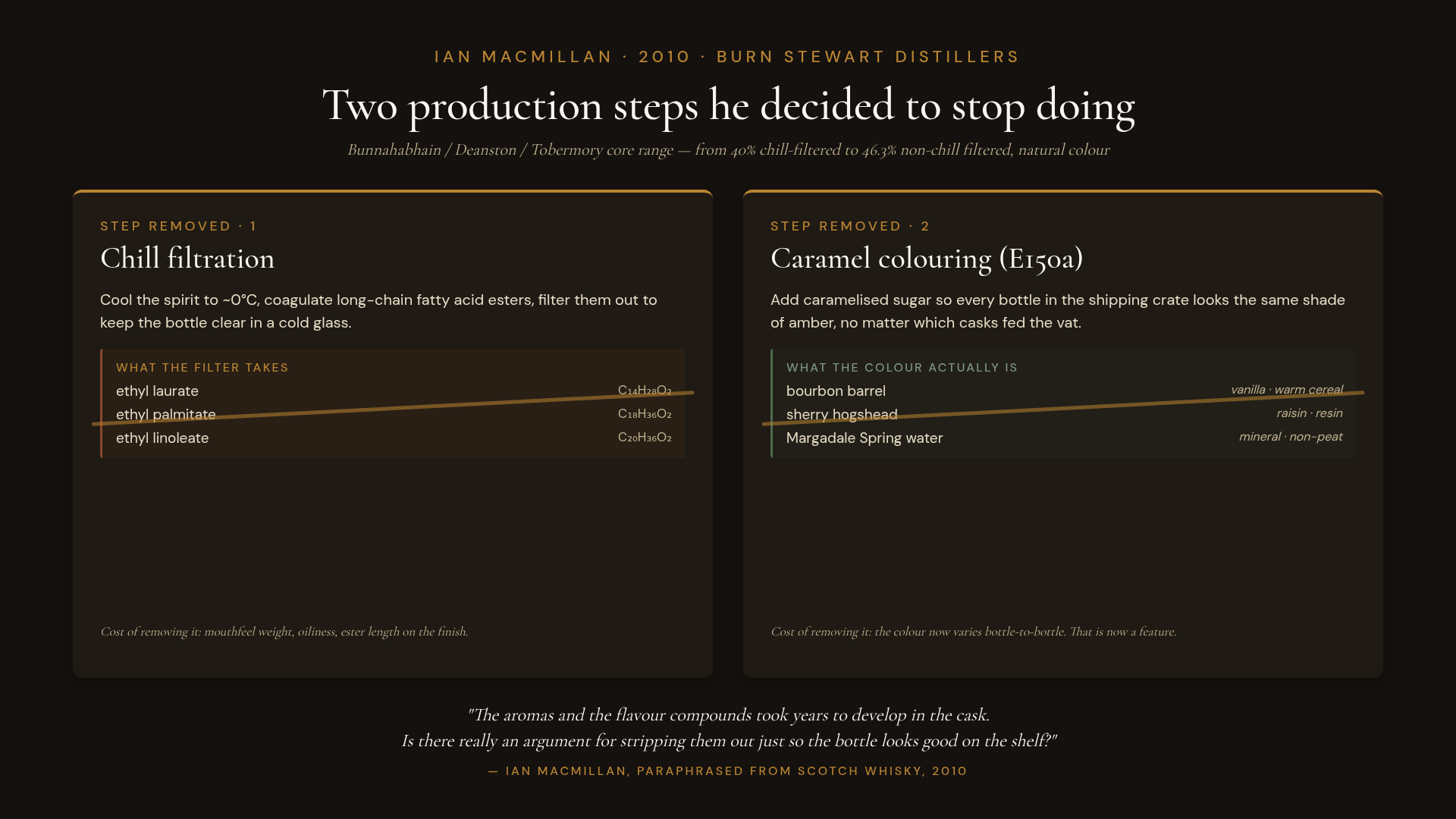
The 2010 specification change had three parts, all applied to the standard cores of Bunnahabhain, Deanston and Tobermory at once. Raise the ABV from 40% to 46.3%. Stop chill filtration. Stop adding E150a. Two of those are “stop doing something” — no new equipment needed, just a decision — but they went on a flagship line, which meant this was not a limited edition. Every bottle from that point on would look different from every bottle before it.
Chill filtration is the process of dropping the spirit to about zero Celsius before bottling, precipitating the long-chain fatty acid esters — ethyl laurate, ethyl palmitate, ethyl linoleate, the C12-and-above ester group — and filtering them out. These esters are soluble at room temperature but drop out when you refrigerate the bottle or pour it over ice, producing the visible haze the industry calls chill haze. Consumers, historically, do not like the haze; retailers, historically, do not like customer returns. So the industry chills, filters, and ships whisky that looks the same at every temperature.
There is a cost. Those same long-chain fatty acid esters carry weight in the mouth. They are what makes a spirit feel viscous, oily, mouth-coating. Strip them out and the liquid drinks thinner and flatter. MacMillan, in the trade press at the time, put it in the form of a question — his words to Scotch Whisky were: “The flavour and aroma compounds have taken years to develop, so why would we want to lose some of them just to make the whisky pretty?” Paraphrased: does the goal of looking clean in a shop window justify undoing what a decade in oak did?
E150a is industrial caramel colouring — sugar heated until it browns, added drop by drop to whisky at the vatting stage. It is legal under the Scotch Whisky Regulations 2009. Its job is to make every bottle in the shipping crate the same colour. Spirit from a bourbon barrel and spirit from a sherry hogshead do not naturally sit at the same shade of amber, and no matter how careful your vatting recipe, there is variance from batch to batch. E150a covers the variance. Take it away and the colour becomes an honest report of the cask mix and the warehouse.
46.3% is the number that lets the other two decisions physically work. Scotch’s legal floor is 40%. Non-chill-filtered whisky bottled below about 46% will haze at room temperature in a warm shipping container. 46.3% is not cask strength — it is a reduction number — but it is the highest ABV MacMillan could hold without the reduction water starting to erode mouthfeel. It clears the haze threshold by a whisker and no more. The same 46 percent floor shows up off Islay too: Arran 10 has been bottled at 46% non-chill filtered since the distillery’s core range settled its house style for exactly this physical reason — any distillery that refuses chill filtration ends up parked at or just above the haze threshold.
The distillery that chose not to burn peat
Now the distillery itself. Bunnahabhain was built in 1881 by William Robertson and the Greenlees brothers, on the shore of the Sound of Islay at the base of a cliff on the island’s north-east coast. Its water source is Margadale Spring, about a mile north of the site, running through rock rather than through peat bog. That geology — rock rather than peat in the water path — is the physical undercarriage of the whole “Islay distillery that doesn’t burn peat” argument.
Bunnahabhain has not always been unpeated, though. Until roughly the 1960s the distillery ran malt at 35–40 ppm phenol, and effectively all of it went into blends — Famous Grouse, Cutty Sark, the Islay component in a hundred bottled combinations. Then the blend market shifted, the industry rebalanced, and Bunnahabhain switched its standard production over to unpeated malt. In 1979 the distillery bottled its first single malt under its own name, and that first single malt was unpeated. The distillery had picked its identity years before the market went looking for one.
Peated Bunnahabhain has not disappeared entirely. The distillery now diverts roughly 20% of production to peated barley for its Toiteach / Toiteach A Dhà line (“Toiteach” is Gaelic for “smoky”), first bottled in 2008. But the 12, 18 and 25 that make up the flagship range remain unpeated, matured coastal, and bottled to the 2010 spec.
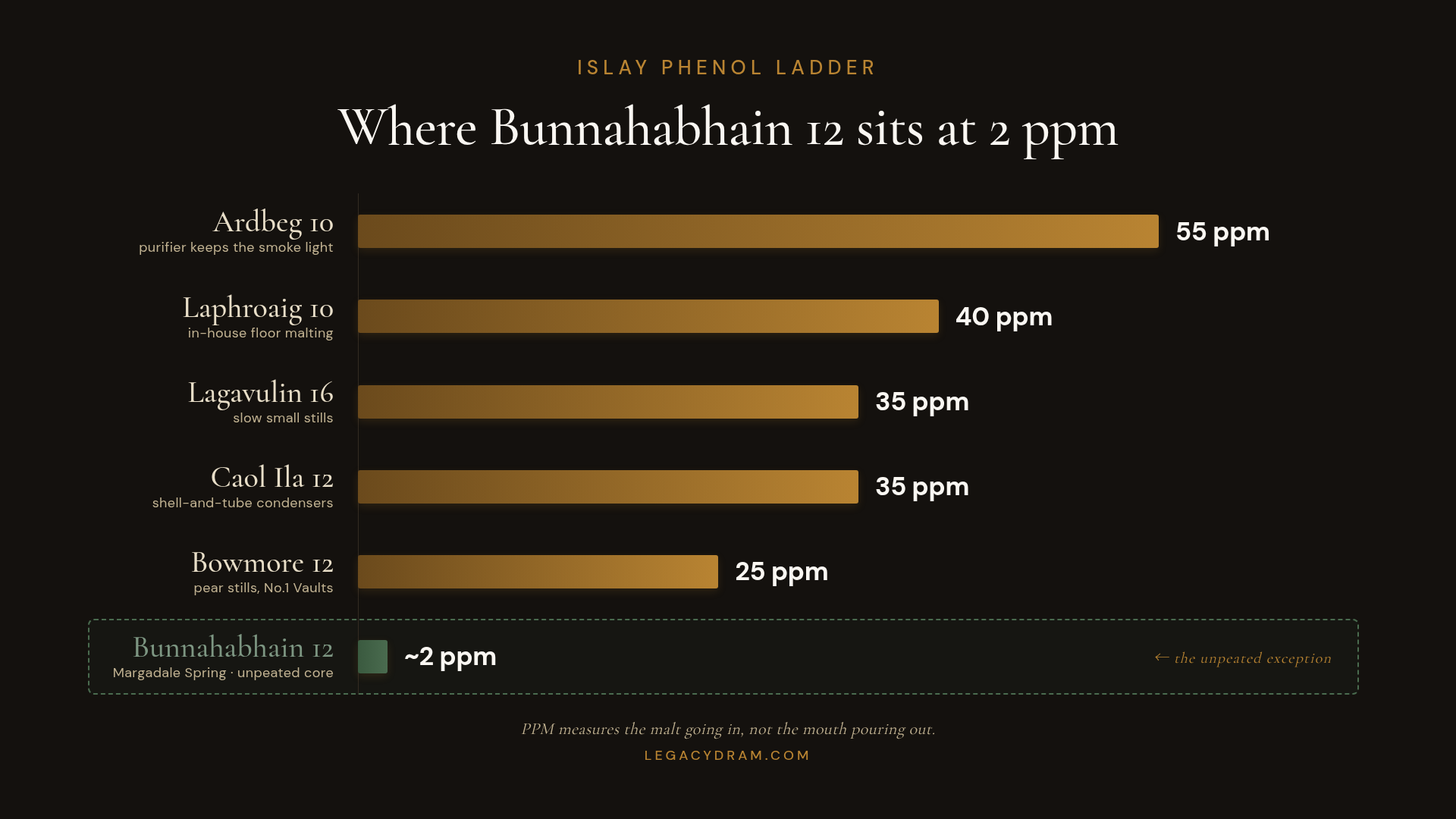
That ppm chart is where Bunnahabhain 12 sits inside the Lagavulin 16 / Bowmore 12 / Ardbeg 10 vs Laphroaig 10 triangle. Everyone else on the ladder is arguing about how much peat and how to hold or shed it in the still. Bunnahabhain is the bottom rung — the argument for whether the island’s identity is peat at all, or whether the sea and the rock and the water are enough.
What arrives on the tongue
Back to the three glasses.
Bunnahabhain 12. Left it in the glass for ten minutes at room temperature, then nosed. First arrival: raisins that have been briefly warmed in an oven, with a light pine-resin note behind them, as if you were smelling the edge of a pine forest after rain from about a hundred metres away. Sea in the background, but not smoke; no iodine, no creosote, no wet ash. On the palate the 46.3% carries real weight — thicker than the ABV number alone would suggest, which is the chill-filtration decision doing its promised job. Mid-palate: oven-warmed raisin sweetness, followed by a thin ribbon of salted butter. The finish is not the smoke curl of a peated Islay; it is a kelp-and-brine umami that sits at the back of the tongue, closing with a small note of old leather.
Pick up the Laphroaig 10 — 40 ppm, south coast of the island, all the peat you were expecting from an Islay — and the contrast writes itself. Antiseptic bandages, iodine, damp campfire from the morning after. The salt is still there but it arrives through a smoke filter. It is the same island salt as the Bunnahabhain, but it comes to you either straight or through a peat-and-medicine screen, and those two paths produce what feels like two different liquids. The Ardbeg-vs-Laphroaig comparison is the argument between two ways of doing peat; the Laphroaig-vs-Bunnahabhain comparison is the argument about whether to do peat at all.
Swing to the right: Aberlour A’Bunadh, 60%-ish Speyside cask-strength full sherry. That one plants itself in the middle of the tongue like a piece of furniture. Bunnahabhain 12, sitting between them, is a bourbon-barrel-led vatting with sherry hogshead in a supporting role — sherry as makeup, not as costume. It sits comfortably on nights that are too tired for A’Bunadh’s weight but too flat for Laphroaig’s medicine.
Price, availability, when to open it
In the UK you can find Bunnahabhain 12 for £40–50 in most independent whisky shops. In the US it runs $55–70 depending on state markup. It is stocked, not scarce; you will not chase this bottle.
The context I keep pouring it in is this. It is the second bottle for somebody who tried Laphroaig 10, wrote off Islay, and would benefit from being told that “Islay whisky” is not a synonym for “medicinal peat.” It is the palate cleanser on a night when a heavier bottle got there first. And it is the bottle to open when you want to argue — with yourself, with a guest, with a bartender — about what an island of eight active malt distilleries actually tastes like when you take away the one variable everyone assumes is the point.
“The bottle went cloudy in my fridge” is not a complaint about quality control. It is a report that the fatty acid esters that MacMillan refused to filter out are doing what they are supposed to do.
The next time you open this bottle
Unpeated Islay is not a bottle that hides its geography behind a label. What is inside is north-east-coast sea wind, water that came through rock rather than peat, and long-chain esters that someone chose not to filter out. Next time you open Bunnahabhain 12, put a Laphroaig 10 next to it, or an A’Bunadh if you have one on the shelf, and use the third glass to prove to yourself what an Islay distillery leaves in the bottle when it decides not to burn any peat under the malt. Salt, not iodine. Resin, not smoke. The warm dullness of a spirit that never went through a chill-filter.
MacMillan left Burn Stewart at the end of 2015, moved to Bladnoch for three years, then ran MacMillan Whisky Consulting Ltd, a one-man practice, until it was wound up in mid-2026. His name will never be on a Bunnahabhain label. But every time the cap comes off this bottle, the man who said stop making it look good on the shelf is still there, in the 46.3% on the label, and in the permission the fridge has to make the bottle cloudy. Worth remembering, once a month or so, while pouring.
Try this bottle
Affiliate link. LegacyDram may earn a commission on purchases made via the link. Prices to the reader are unchanged. Please drink responsibly.
Related reading
- Lagavulin 16 Review — Iain McArthur and the Islay Phenol Curve: the peated Islay flagship, 35 ppm malt, refill casks, and a warehouse manager who worked the same distillery for fifty-three years
- Caol Ila 12 Review — 35 ppm at Islay’s Largest Distillery: Bunnahabhain’s north-east coast neighbour, same ppm as Lagavulin but a lighter, cleaner smoke thanks to large stills and short runs
- Ardbeg 10 vs Laphroaig 10 — Purifier, 55/40 ppm, Which to Pick: the two most-argued peated Islays and the small piece of copper pipework that inverts the ppm chart on the tongue
- Bowmore 12 Review — Eddie MacAffer’s 25 ppm Islay Middle: Bunnahabhain’s opposite pole on the peat ladder — the same island, at 25 ppm phenol, matured in the No.1 Vaults below sea level
Primary sources
- Scotch Whisky — “Five Minutes With: Ian Macmillan, Bladnoch”: MacMillan’s career arc — 1973 Glengoyne, 1991 Burn Stewart, twenty-four years across Bunnahabhain / Deanston / Tobermory, 2015 move to Bladnoch
- Scotch Whisky — “Stop chill-filtering whisky”: MacMillan’s own account of the 2010 decision to move the Burn Stewart standard range (Bunnahabhain, Deanston, Tobermory and Ledaig) to 46.3% ABV, non-chill filtered, natural colour; source of the “flavour and aroma compounds have taken years to develop, so why would we want to lose some of them just to make the whisky pretty?” quote
- The Spirits Business — “Bladnoch master distiller Ian MacMillan departs”: late-2018 Bladnoch departure; MacMillan Whisky Consulting Ltd was incorporated at Companies House in July 2018 and dissolved in June 2026
- Bunnahabhain Distillery — “About Us”: 1881 founding, Margadale Spring water source about 1.6 km north of the distillery, unpeated core policy
- Whisky Magazine — “Bunnahabhain’s fruity, unpeated and sherry-cask-led style”: pre-1960s 35–40 ppm peated Bunnahabhain era, 1979 first own-name single malt bottling (unpeated), 2012 onwards ~20% Toiteach peated production split
- Diffords Guide — Bunnahabhain Distillery Co.: Margadale Spring geological route (rock rather than peat), pre-2012 water-source peat character, standard range specifications