Eddie MacAffer at Bowmore: Fifty Years on the Malt Floor
In 1966 the manager of Bowmore distillery, a man named James McColl, hired a nineteen-year-old off a merchant navy contract and put him to work digging drains. The nineteen-year-old was Eddie MacAffer, a Bowmore local, no formal training in anything to do with whisky, needing a job that was on the island. McColl offered him men’s wages if he worked hard. He stayed fifty years.
I want to be careful about the framing here, because the retirement press releases from 2016 were unusually generous about MacAffer’s foresight, and I think they slightly obscure what actually happened. MacAffer did not, in 1966, foresee that floor maltings would become a scarce production asset. He was not making a bet against industrialisation. He was digging drains for the summer, then he was in the warehouse, then he was on the malting floor, then he was at the wash stills, then he was managing the distillery, and by the time any of those decisions could be called strategic he had done the physical work for so long that leaving would have been stranger than staying. The bottle in front of you is the product of a career that accreted rather than a career that was designed.
The path from the drains to the stills
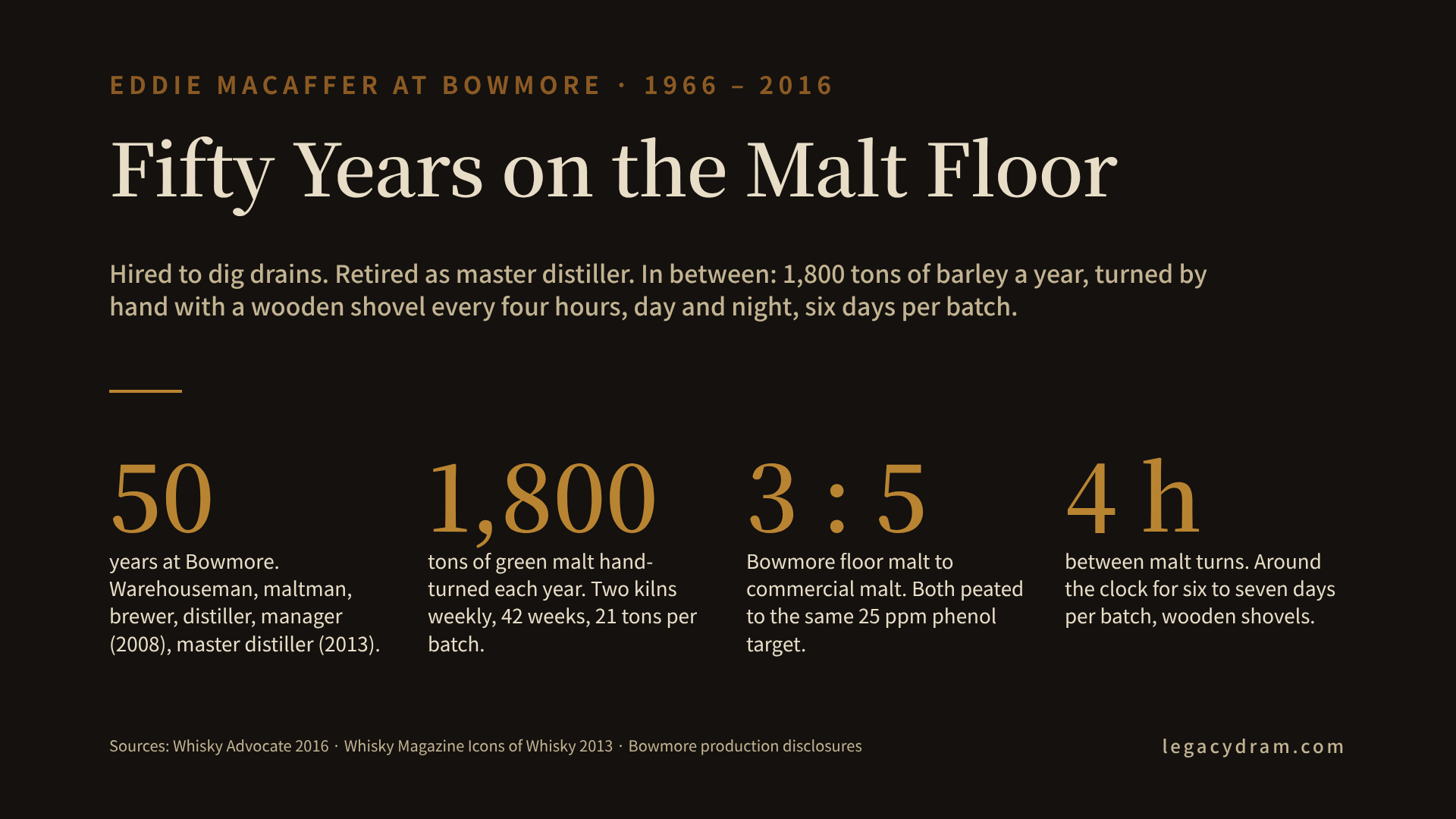
Bowmore was founded in 1779, which makes it the oldest distillery on Islay and, depending on how you count, the eighth oldest in Scotland. When MacAffer joined in 1966 the plant had been Morrison-owned for three years and was in the middle of a slow rebuild. Warehousing was the entry-level job on the island because everyone had to move casks and no one particularly wanted to. From warehousing MacAffer moved to the malt barn as a maltman, which meant he was one of the people turning damp barley every four hours with a wooden shovel, day and night, for six or seven days per batch. He worked as a brewer, then as a distiller running the wash and spirit stills. Bowmore promoted him to distillery manager in 2008 and to master distiller in 2013. Whisky Magazine gave him Distillery Manager of the Year at the 2013 Icons of Whisky Awards. Whisky Advocate gave him the Lifetime Achievement Award in 2016, the year he retired.
The chronology matters less than the shape of it. MacAffer worked the malting floor as a maltman for years before he did anything else, and he kept working closely with it as brewer and as distiller because Bowmore’s floor malting had never been decoupled from the rest of the production stack. He did not, from the outside, look like someone whose career was heading anywhere in particular until he was manager and then master distiller in his early sixties, having already announced he intended to retire. The retirement was the promotion. Bowmore was formally acknowledging what everyone at the plant had known for two decades, which was that MacAffer was the person who understood how the malt floor and the stills and the No.1 Vaults were talking to each other.
The decision that was not his to make
Here is where I want to be honest about the story the marketing has told. The publicity around MacAffer’s retirement leaned heavily on the idea that he had preserved Bowmore’s floor maltings against the industrial trend. That framing gives him more credit for the choice than the choice deserves. Bowmore was not going to close its floor maltings during MacAffer’s tenure for the same reason Laphroaig was not going to close its during Bessie Williamson’s tenure at Laphroaig from 1954 to 1972: the plant had been built around them, the peat and the coastal air were embedded in the resulting spirit, and the marketing department was, by the 1990s, actively selling the malting floor as brand.
What MacAffer did do, which is smaller and more interesting than the “he saved the maltings” version, was decline to let the standard get sloppy. Floor malting is a physically miserable job. It is heavy manual labour on a wet stone floor, on shifts that run around the clock because germinating barley has no consideration for the human diurnal cycle. Any distillery that continues to floor-malt has to keep re-recruiting maltmen who are willing to do that work, and the wages have to be competitive with easier jobs on Islay, and the standard has to be enforced, and none of that happens automatically. When a manager stops caring about the temperature of the piece or the depth of the bed or the timing of the turn, the malt drifts, and the drift shows up in the new-make eighteen months later and in the bottle ten years after that.
MacAffer had been a maltman. He knew what was hard about it and he knew what was easy to fake. This is, I think, the actual argument for a long-tenure manager: not that he had a vision that outsiders lacked, but that he could tell when a maltman was cutting corners because he had cut those corners himself in the 1970s.
What the arithmetic actually is
The publicly available numbers are these. Bowmore’s own floor maltings produce about 1,800 tons of malted barley per year, in two kilns a week for 42 weeks. Each batch is 21 tons of green malt spread eighteen inches deep on a perforated stone floor. The maltmen turn it every four hours for six or seven days. Bowmore fills that against a total malt requirement that is variously described as one-third or two-fifths of production, with the balance coming from commercial maltings. MacAffer himself is on record giving the ratio as three parts Bowmore malt to five parts commercial malt, which is thirty-seven and a half percent. Both the floor-malted and the bought-in malt are peated to a target of twenty-five parts per million phenol before kilning. The peat comes from Bowmore’s own workings on the Islay bog.
The reason both sides target the same twenty-five ppm is that the ratio is a cost-and-character compromise, not a chemistry one. A distillery that stopped floor-malting entirely could hit twenty-five ppm from a commercial maltings for less money per ton. What it would lose is not phenol level but phenol profile. Islay peat, cut from bogs saturated with marine plant residues, is chemically different from mainland Highland or Speyside peat. It carries higher levels of bromophenols, halogenated phenolic compounds that come from the algal biomass in the bog and that produce the iodine and sea-salt notes that people describe as medicinal. Commercial maltings that buy Islay peat can approximate the profile, but they cannot exactly replicate the phenolic mix that Bowmore’s own peat, kilned in Bowmore’s own kilns over Bowmore’s own malting floors, produces at the specific rate that Bowmore has always run.
The 3:5 ratio is a hedge. It preserves enough of the distillery’s own phenolic signature to matter, at a cost the current owner (Suntory Global Spirits, formerly Beam Suntory) is willing to keep paying. It also allows for a floor malting operation just large enough to be a real production input rather than a demonstration for visitors, which is what floor malting has become at some of Bowmore’s competitors. Nobody at the plant has to pretend the tour is doing anything but showing the tour what the actual production still does. The number that matters is the thirty-seven and a half percent that goes into the mash, not the two percent that would satisfy the tour bus.
No.1 Vaults, which he did not choose either
The other physical asset that shaped MacAffer’s later career is the No.1 Vaults, Bowmore’s oldest maturation warehouse. It was built in 1779, the same year as the distillery, which means it is one of the oldest maturation buildings in Scotland and the only Scottish warehouse whose floor sits below the high-tide line of the sea. The wall backs directly onto Loch Indaal, on the western side of Islay. The room stays cool and humid the way an ice house does, but with salt in the air. Casks in No.1 Vaults evaporate more of their alcohol than their water, which is the opposite of what happens in a dry inland warehouse. The result is a slower drop in cask strength and a slightly saltier bottle at ten or twelve years old than the same distillate would produce in a Speyside dunnage.
MacAffer did not build No.1 Vaults, obviously. He also did not decide to keep filling it, because it was already the reserve warehouse for the distillery’s best casks by the time he was warehouseman. What he did, in his later roles, was decide what went in and what came out. The Black Bowmore 1964, released in bottlings between 1993 and 2016, spent its fifty years in No.1 Vaults. So did the Bowmore 1966, released in 2017 as a fifty-year-old shortly after MacAffer’s retirement, in a manoeuvre that David Turner, MacAffer’s successor, described as “created the very year Eddie joined us”. The 1966 was, in an almost too-tidy way, a bottle whose distillate had been laid down the year MacAffer walked in the front door and whose bottling MacAffer signed off on the year he walked out. I do not think Turner was overselling it. The coincidence was real. But the coincidence is also what marketing departments are for, and it deserves a small deflation.
What is in the twenty-fifteen mash
The reason to care about all of this, if you are opening a Bowmore 12 in 2026, is that the malt on which the new-make was fermented in 2013 or 2014 was turned by MacAffer’s team on the floor of a stone building whose specifications have not meaningfully changed in a hundred years. Whether MacAffer personally turned any given kilo is not the interesting question. The interesting question is that the malting operation was, in his tenure, the way it had been in 1966, and the way it had been in 1900, and the way it will presumably be in 2036 unless Suntory changes its mind. He was one of the people who made the continuity boring enough not to break.
The bromophenol note that you can, if you concentrate, identify on the palate of a Bowmore 12 as the sea-salt taffy character is not a metaphor. It is a class of halogenated phenolic compounds, largely 4-bromophenol and 2,6-dibromophenol, adsorbed onto the barley during kilning over Islay peat and then partially volatilised through the stills. The compounds sit at a few parts per billion in the finished spirit and are close to the human olfactory detection threshold, which is what makes them noticeable rather than dominant. If Bowmore stopped floor-malting entirely, the bromophenol concentration would probably not change very much: commercial maltings can source Islay peat and hit similar numbers. What would change is a longer tail of minor phenolic compounds, harder to name and harder to measure, that come from Bowmore’s specific kilning regime. Whether that tail is worth the cost of two kilns a week for 42 weeks is a decision the accountants at Suntory make every year, and so far they have kept making it in favour of continuing. MacAffer’s argument, when he was still in the room, was that the decision had never been close.
Closing
MacAffer retired in October 2016 at the age of sixty-nine. Bowmore threw him a Golden Jubilee dinner at the Fèis Ìle festival that summer and released the 1966 fifty-year-old later in the year. He continued to live on Islay. David Turner, who took the master distiller title, had already been running the plant for years and made a point of saying, at the release, that MacAffer’s fingerprints were on the malting floor operation that Turner had inherited.
The malt Eddie turned in his last week on the floor came off the kiln in 2016 and went into a cask that will be bottled as Bowmore 12 around 2028, at ten years old. Someone will drink it in the mid-2030s at a bar in Tokyo or Chicago or Buenos Aires without knowing his name, and the sea-salt-taffy note will be, in a chemical sense, his labour. He may or may not be alive when the bottle is opened. Turner will still be signing them off. The malting floor will still be turning at the same eighteen-inch depth. This is, I think, the actual shape of continuity at a small distillery: not that any one person’s decisions survive, but that the physical routine survives the person, and the person survives just long enough to teach it to whoever comes next.
He was hired to dig drains. Fifty years later he was master distiller. In between he turned barley with a wooden shovel for weeks that added up to years, at four-hour intervals that added up to nothing anyone thought worth counting. The 3:5 ratio still holds. The 25 ppm still holds. The peat is still cut from the same bog. The maltmen are still working eight-hour shifts around the clock. The bottle on the shelf in 2026 is, in a literal sense, the residue of a job that nobody now living remembers signing up for.
If you want to read further on the adjacent decisions: I have written previously on Bessie Williamson’s inheritance of Laphroaig from Ian Hunter, the Islay counterpart to the MacAffer story where the continuity was contractual rather than routine. Adam Hannett’s three levels of peat at Bruichladdich and Octomore is the modern engineered-phenolics contrast to Bowmore’s inherited one. Billy Stitchell’s tenure at Caol Ila is the industrial-scale Islay counterpart, mostly a Diageo blending workhorse where a single manager still shaped what came off the stills. Frank McHardy’s stewardship of Springbank through the silent years is the Campbeltown case for the same argument about long tenure at a small distillery.