The Nose and the Ice: How Richard Paterson Reverse-Engineered a 1907 Whisky from Three Bottles Found Under a Hut
The most analysed old whisky in the world was distilled at a place you cannot visit, because it was knocked down to make room for a supermarket. That is the strange shape of this story, and it is worth holding in your head from the start: a team of chemists spent months establishing, to three decimal places, the recipe of a spirit whose birthplace had already been bulldozed.
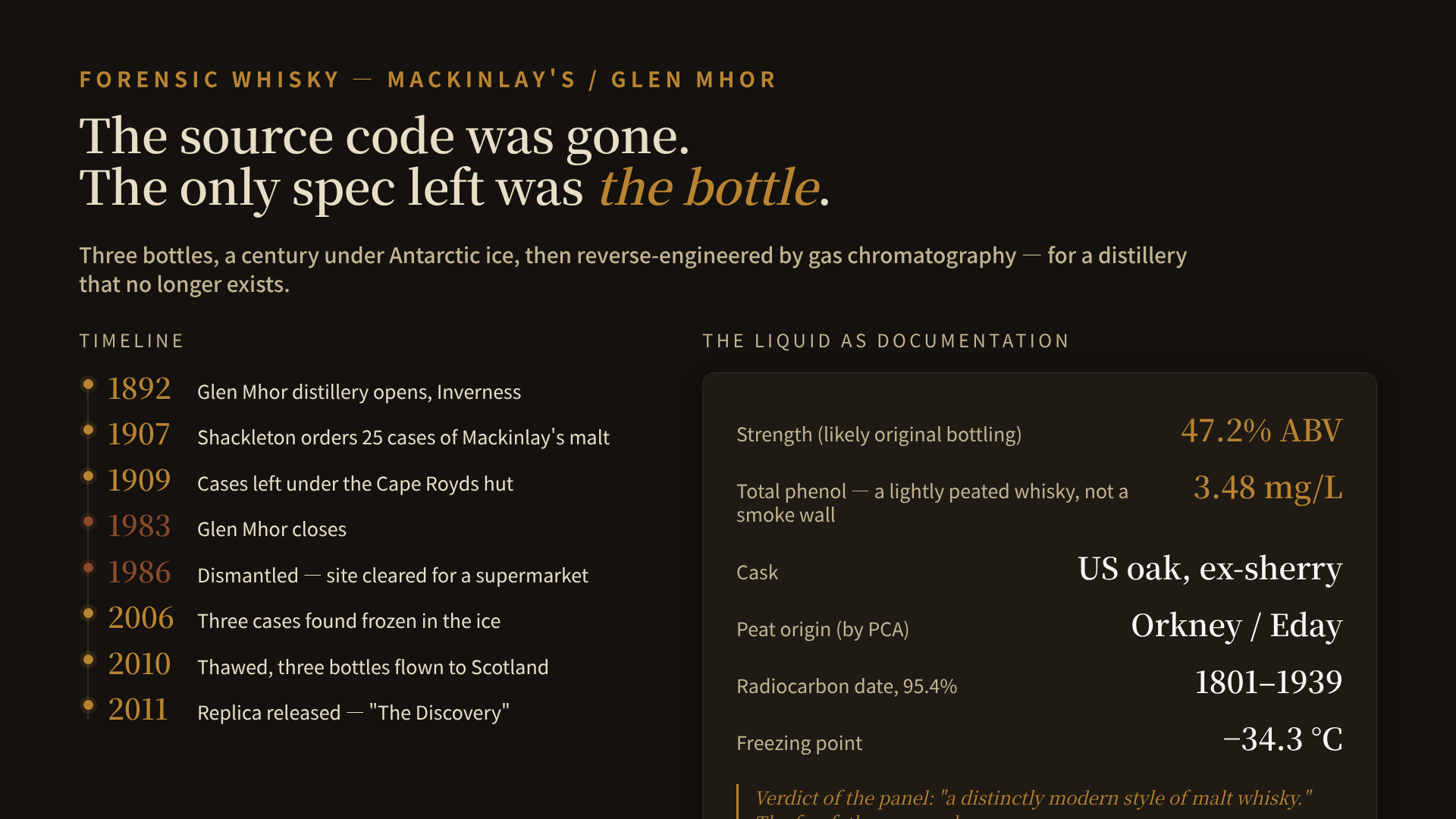
It begins with a crate in the ice. In 1907 Ernest Shackleton ordered twenty-five cases of Mackinlay’s “Rare Old Highland Malt Whisky” for his British Antarctic Expedition. Some of it travelled south to Cape Royds, was drunk or not drunk, and when the expedition packed up in 1909 a few cases were left behind under the floorboards of the base-camp hut. They stayed there. In 2006 a conservation team found three of them entombed in the ice beneath the floor, and in 2010 the bottles were chipped out, thawed in New Zealand, and three of them flown back to Scotland for the first proper chemical analysis of a malt whisky distilled in the 1890s.
What happened next is the part that interests me, because it is not a tasting note. It is reverse-engineering in the strictest sense: the kind any engineer recognises the moment they have to rebuild a system from a binary when the source code is gone. The original was no longer made. There was no recipe, no surviving distiller, no production record detailed enough to follow. The only documentation was the artefact itself: roughly seven hundred millilitres of amber liquid in a green conical bottle, and whatever a laboratory could pull out of it.
The spec was the liquid
The man given the liquid was Richard Paterson, the master blender at Whyte & Mackay, which owns the Mackinlay’s name. Paterson is a showman (a famous nose, a memoir literally titled Goodness Nose, a habit of theatrically throwing the first dram of any bottle on the floor), and it would be easy to write this as the story of a great palate working a miracle. It isn’t, quite, and the honest version is more interesting. Paterson’s nose got the headlines, but the actual reconstruction was done by instruments, by a fifteen-person sensory panel scoring against a fixed vocabulary, and by a paper with nine co-authors in the Journal of the Institute of Brewing. The romantic figure and the forensic process are both true at once, and the process is the one that did the work.
The laboratory ran the whisky through almost every analytical method the industry has. Gas chromatography with flame ionisation to separate the volatile congeners: the higher alcohols and esters that fermentation leaves behind, the compounds that constitute a spirit’s “fingerprint.” HPLC (high-performance liquid chromatography, a way of separating dissolved compounds by pushing them through a column under pressure) to count the phenols, the smoke-derived molecules that tell you how peated the malt was. GC-mass spectrometry and GC-olfactometry, a setup where the machine splits the column output between a detector and a literal sniffing port, so a human nose can name each compound as it comes off. Ion chromatography for the cations and sugars. Radiocarbon dating, of all things, to rule out fraud: the carbon put the date of manufacture between 1801 and 1939 at 95.4% probability, which is exactly the boring confirmation you want.
Out of all that came a number set. The whisky was 47.2% ABV. Because the cork had effectively annealed itself to the glass in the cold, that was very likely the original bottling strength, not a century of slow evaporation. It was matured in American white oak that had held sherry or wine. And the total phenol content was 3.48 mg/L.
The forefathers were shy
That phenol figure is where the story stops being an antiquarian curiosity and becomes mildly subversive.
If you ask most drinkers what a Highland malt from the 1890s would have tasted like, they will reach for the same picture: heavy, tarry, smoke-soaked, harsh. Peat as a wall, because surely they peated everything back then when peat was the fuel you had. That picture is in every potted history of Scotch. And 3.48 mg/L of phenol quietly demolishes it. That is the level of a lightly peated whisky by today’s standards. The smoke in Shackleton’s whisky was a thread, not a wall. The sensory panel found a balance of light peat, sherry-cask fruit, and spice, with no off-notes and nothing a modern drinker would find alien. The congener fingerprint (the amyl alcohols sitting at the low end of the modern range, the furfural near the modern average) read, in the words of the paper, as “a distinctly modern style of malt whisky.”
I find this genuinely funny in a quiet way. We assume the past was cruder than the present and that our forefathers drank rougher stuff. The chemistry says the opposite: Charles Mackinlay & Co. were making, in the 1890s, a subtle, lightly peated, well-made malt that you could pour today and nobody would blink. The distillery that made it, Glen Mhor near Inverness, took its water from Loch Ness, malted local barley on site, and dried it with peat shipped down from the Orkney island of Eday, which is why the phenol profile matches Orkney peat under principal-component analysis, neatly confirming a shipping record from a hundred years earlier. The forefathers were not brutes. They were, by the standards of the legend, almost shy.
What you can rebuild, and what you can’t
Here is the trade-off at the centre of the whole exercise, the one the marketing never quite says out loud.
You can measure a spirit to three decimals. You cannot un-demolish the distillery that made it. Glen Mhor closed in 1983 in a wave of shutdowns, was dismantled in 1986, and the ground it stood on near the Caledonian Canal was cleared for retail. The target profile that the chemistry had so precisely described belonged to a distillery that no longer existed and could not be run for one more day to make one more cask. So the “recreation” could never be a copy. It had to be an approximation, assembled from whatever living distilleries came closest.
What Paterson actually built was a blended malt: a small amount of genuinely old Glen Mhor stock that still survived in cask, propped up with spirit from Dalmore (conveniently, another Whyte & Mackay distillery and a near neighbour) and malts from Speyside and beyond, married to land near the measured target: a 47.3% bottling strength a hair above the original’s 47.2%, the light peat, the sherry-cask weight. The replica, Mackinlay’s Shackleton “The Discovery,” went on sale in 2011, with a portion of proceeds going to the Antarctic Heritage Trust that had dug the originals out of the ice. A second edition, “The Journey,” followed in 2013.
I want to be fair to it and also honest about it. This is a legitimate, careful piece of work, and the replica is by most accounts a pleasant, properly made dram. But it is not the thing in the ice, and it cannot be, because the thing in the ice was Glen Mhor and Glen Mhor is gone. The bottle on the shelf is the best approximation a master blender could reach toward a chemical target using the ingredients that still exist, which is a different and humbler thing than “the whisky Shackleton drank.” The analysis was forensic. The bottle is, unavoidably, a tribute.
This is the same shape I keep finding behind the bottles that hold my attention. When Gordon & MacPhail rebuilt the pre-1960s Speyside that the industry had thrown away, they were reverse-engineering a lost flavour spec too, but they had a working distillery to do it in. The Shackleton project had the opposite hand: a perfect spec and no distillery. You can have the blueprint and still not be able to build the building, if someone has already sold the land.
The taste came back; the place did not
So I keep returning to the asymmetry, because it is the truest thing in the story.
Three bottles spent a hundred years frozen under a hut at the bottom of the world, and against every reasonable expectation they survived: the cork held, the strength held, the volatiles that carry flavour were preserved by the very cold that should have destroyed the glass. A team of scientists pulled a complete flavour profile out of seven hundred millilitres of liquid and proved, along the way, that the whisky of the 1890s was lighter and more modern than the legend insists. Richard Paterson put his famous nose to a target the machines had drawn for him and reached, commendably close, toward a flavour nobody alive had tasted. All of that worked.
And none of it could touch Glen Mhor. The distillery that gave the whisky its character had been measured in minute detail and was, at the same time, a patch of ground under a supermarket in Inverness. You can recover the taste of a place. You cannot recover the place. The phenols, the esters, the 47.2%: all of it came back from the ice. The distillery that made them is still, and permanently, gone, and the most precise chemistry in the world cannot file the paperwork to reopen it. The liquid was documentation enough to rebuild a recipe. It was never going to be enough to rebuild a building someone had already agreed to forget.
Related reading
- Benromach 10: How Gordon & MacPhail Reverse-Engineered the Speyside the 1960s Threw Away: the same move (rebuilding a lost flavour spec from the output) but with a living distillery to do it in, where the Shackleton project had only a chemical target and a demolished site.
- Alfred Barnard’s 1887 Atlas: One Man, 162 Distilleries, and the Speyside Before It Got Efficient: Barnard walked the Highland distilleries a few years before Glen Mhor filled the casks Shackleton carried south: the documentary record of an industry that the chemistry later corrected.
Sources
- James Pryde, John Conner, Frances Jack, et al., “Sensory and Chemical Analysis of ‘Shackleton’s’ Mackinlay Scotch Whisky,” Journal of the Institute of Brewing 117(2), 156–165, 2011 — Wiley Online Library
- “Shackleton’s Whisky — Mackinlay’s Rare Old Highland Malt” — The Whisky Exchange feature
- Mackinlay’s — scotchwhisky.com Whiskypedia
- “How Scottish Scientists Re-Created a Hundred-Year-Old Whisky” — Popular Science
- Glen Mhor distillery — Wikipedia
- Richard Paterson, Goodness Nose: The Passionate Revelations of a Scotch Whisky Master Blender (Angels’ Share, 2008)