Jimmy Russell at Wild Turkey: The Entry Proof He Held to 2004
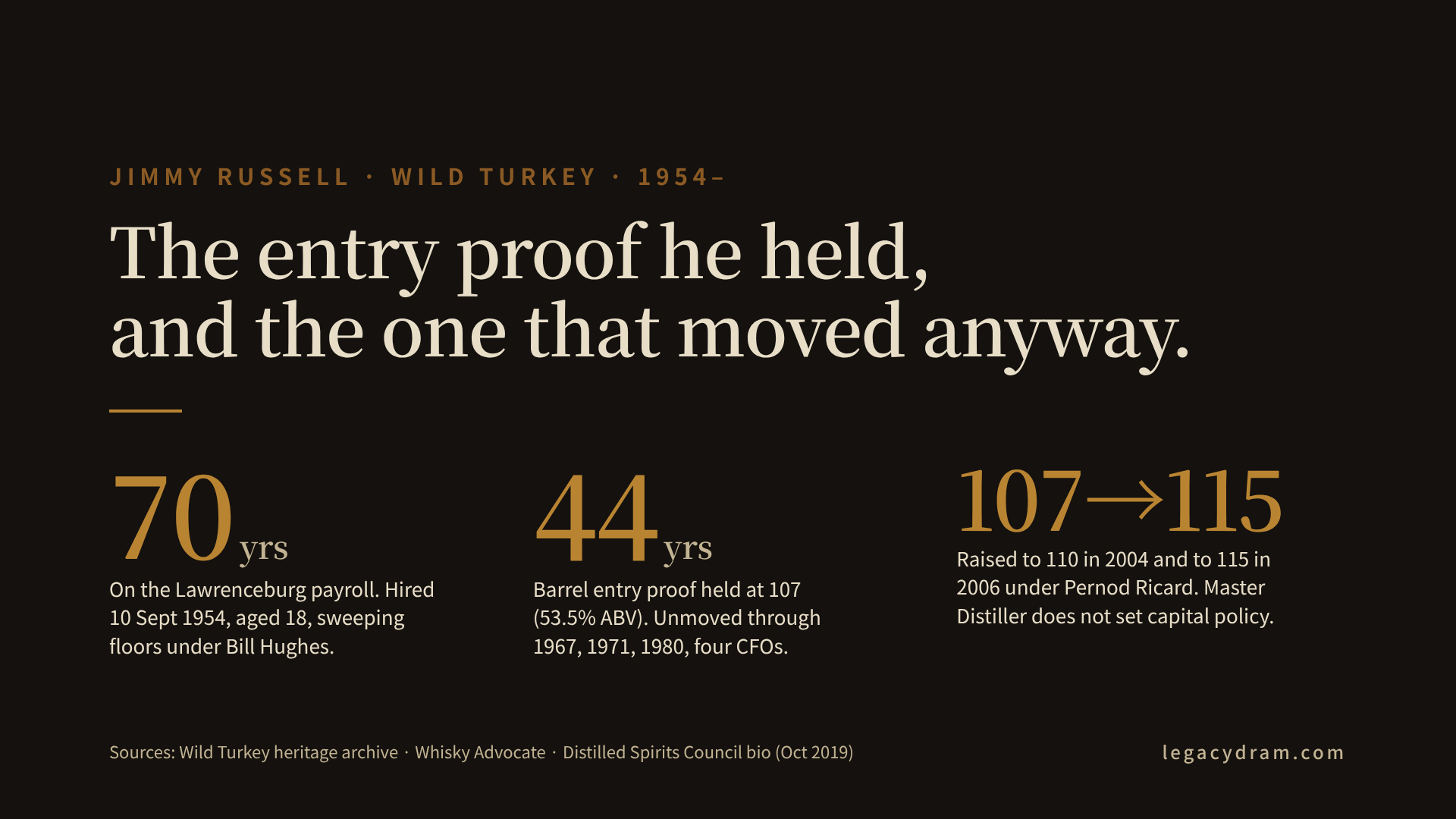
In 2004, Wild Turkey raised its barrel entry proof from 107 to 110. Two years later, in 2006, the number moved again, from 110 to 115, where it has stayed. Jimmy Russell was Master Distiller through both changes. He had, by the time of the first, been on the payroll of the distillery in Lawrenceburg, Kentucky for fifty years.
I want to open there rather than at the sweeping-the-floors story, because most of what has been written about Jimmy Russell for the last twenty years has been organised around the phrase he didn’t change a damn thing, and it is his own phrase, and it is not exactly true. The mash bill has not changed. The char has not changed. The yeast has not changed. The height and shape of the beer still have not changed. The proof at which new-make spirit is cut with water and put into a fresh charred barrel has changed twice, both times against what the production floor would have wanted, both times under a European corporate parent who was doing straightforward margin math. Russell was there. He signed the paperwork. He did not veto it, because a Master Distiller at a corporate house cannot veto capital policy, and he is honest about that in interviews if you read the ones that are not press-release copy.
I keep this framing at the top because the thing worth preserving about Jimmy Russell is not that he never changed anything. It is that he understood which knobs were his and which were not, and he protected the ones that were his for seventy years.
Sweeping the floors, September 1954
Jimmy Russell walked into the distillery for the first time on 10 September 1954. He was eighteen. The plant was then called the JTS Brown distillery, and the brand made there was still one of several that would eventually be consolidated under the Wild Turkey name. The buildings had been on a bluff over the Kentucky River since 1869, when James Ripy — an immigrant from County Tyrone, in the north of Ireland, who had settled in Lawrenceburg around 1830 — walked his sons upriver and picked the site.
Jimmy had grown up five miles from the door. His father worked at the plant. That is not romantic. Anderson County, Kentucky is thin on employers, and the distillery hired locally the way coal mines hire locally, which is to say without an interview, on the recommendation of a relative. Jimmy started with a push broom.
The man who would train him was Bill Hughes, the plant’s second Master Distiller, who had taken the role in 1950 after Ernest W. Ripy Jr. — great-grandson of James Ripy, the last of the founding family to hold the recipe. Hughes was a keeper. He had inherited the yeast, the mash bill, and the entry-proof number from Ripy, and he handed the same to Jimmy the way you hand a set of car keys to a child you already trust. Six years of that hand-off, and in 1960 Jimmy was promoted from floor worker to distiller in his own right. Seven more, and in 1967, at thirty-one, he was the third Master Distiller in the plant’s history.
The wit here is small but worth naming. Jimmy Russell is often written up as a self-made man. He is not, exactly. He is a middle link in a chain that started with a Tyrone immigrant in the 1830s, passed through the last of the founder’s great-grandchildren, went to a career distiller named Hughes, and then to a local kid who happened to be there when Hughes was looking for someone to teach. Wild Turkey is a preservation project. Jimmy is the longest-serving preserver.
What a Master Distiller at a big American house actually controls
The title sounds sovereign. In a small farm distillery it sometimes is. At an industrial-scale bourbon operation on a corporate balance sheet it is not.
At a house the size of Wild Turkey, the Master Distiller runs the production floor. He picks the yeast strain, sets the fermentation profile, calls the cut points on the doubler, tastes the daily distillate off both stills, signs off on which barrels get pulled for which product line. That is a real portfolio, and it accounts for most of what you can taste in the glass. What the Master Distiller does not do is set capital policy. Warehouses cost money. Barrels cost money. The new-charred-oak requirement in 27 CFR §5.143 means that every barrel a bourbon distillery uses is a barrel it will never use again, so barrel count is not a maintenance line — it is a recurring capital line. Anything that raises barrel count for the same output is a corporate decision, taken above the production floor.
Entry proof is exactly that kind of decision. It is a barrel-count decision, which is a warehouse-count decision, which is a corporate-margin decision. So when I say Jimmy Russell did not veto the 2004 raise from 107 to 110, I am not being uncharitable. I am describing the reporting line.
By 1971, the plant Jimmy was running had been sold to Austin, Nichols & Co., New York blenders who had been sourcing bourbon from the distillery since the 1940s under their Wild Turkey brand. Austin Nichols renamed the plant to match the brand. In 1980, Austin Nichols itself was sold to Pernod Ricard, the French drinks conglomerate. In 2009, Pernod Ricard sold the whole thing to Gruppo Campari, of Milan, for around $575 million.
Through those three ownership changes, Jimmy was on the floor. Through the first two, the entry proof was 107. Under the second, it moved to 110 and then to 115.
The 107 was the whole argument
Entry proof is the ABV at which new-make spirit is cut with water and put into the barrel. Federal law caps it at 62.5% ABV, which in American proof-speak is 125. From the 1980s on, the industry standard has drifted up to that ceiling. Buffalo Trace’s mash-bill #1, for instance, is filled at 125. Jim Beam is filled at 125. Most of the mass-market bourbon on any American shelf is filled at 125.
At Wild Turkey, under Ripy and Hughes and Russell, the number was 107 — 53.5% ABV. It cost more barrels per finished case. It cost more square feet of rickhouse, more warehouse insurance, more property tax on the barrelhouse acreage. Nothing in the corporate model rewarded it.
The reason nobody moved it, for forty-four years, is that lower entry proof pulls different congeners out of new white oak. Ethanol at higher concentration is a different solvent — it extracts more of the lignin-derived aromatics but does it faster and less selectively, so the aged bourbon can taste sharper and more astringent, with a thinner mid-palate. At 107, the barrel returned a bourbon that leaned heavier on the caramel-vanilla axis, with less of the woody edge, and — importantly for a distillery whose flagship was going to be bottled at 101 proof (50.5% ABV) — required only a modest amount of water to bring the barrel-strength spirit down to bottling strength. Less water in, less water out.
Every bourbon writer says less water in, less water out as if it were folk wisdom. It is arithmetic. But it was arithmetic that Bill Hughes taught to Jimmy Russell, and that Jimmy protected, without a formal mandate to do so, for four decades of quarterly reviews under two corporate owners.
Then, in 2004, it went to 110. In 2006, to 115.
I have looked at the interviews Jimmy Russell gave around 2005 and 2006 in Whisky Advocate and in trade press. He is careful. He talks about how the flavour is close enough. He does not talk about the raise as his decision. Read between those lines what you like.
What he did hold
Read the Wild Turkey production record from 1967 forward and list the things Jimmy actually controlled and did not change:
- The mash bill, roughly 75% corn, 13% rye, 12% malted barley — one of the most rye-forward workhorses in commercial bourbon. He refused, decade after decade, to lower the rye for cost. Rye is more expensive to source and slower to ferment than corn, and every time the input-price sheet came around the corporate side would ask about it. He kept it.
- The char level: #4, alligator char, about fifty-five seconds of open flame inside the barrel. Wild Turkey has been buying #4s from Independent Stave Company for as long as ISC has been the industry’s dominant cooperage. Chris Morris at Woodford Reserve, twenty miles up the road, chose to add a toast in front of a #3 for a broader aromatic palette; Jimmy chose not to. That decision is his and it is still in the glass. I wrote about the physics of it separately in Bourbon Cask Char Levels #1–#4.
- The distillation proof off the still. Wild Turkey exits the beer still around 60% ABV and the doubler around 65%, both notably low for a modern American distillery. Low still exit means more congeners survive into the barrel. This is Bill Hughes’s number and Jimmy kept it.
- The cut points. Jimmy calls them by nose, or he trained the people who still do. There is no computer on the doubler at Wild Turkey.
- The yeast strain, propagated on site, one of the older continuously maintained bourbon yeasts in Kentucky. He guards it in a way that is close to superstitious. Journalists who have asked to see the propagation room have been politely turned around.
Each of those is a real cost line. Each of those survived four ownership changes and eleven CFOs. That is what a career of preservation looks like, when you list it out.
The two lines everyone quotes, and what they hide
Jimmy Russell’s most-quoted line is: I’ve never worked a day in my life. His second-most-quoted is: I didn’t change a damn thing.
The first is charming. It is also performance. Seventy years of not working is still, as anniversary math, a shift pattern.
The second is not quite true. He did not change most of what he could see. He also inherited most of it, so the not-changing begins before him. And the thing he most publicly wanted to keep — the entry proof — did change on his watch, twice. If you write him as an inventor you have the wrong genre. He is a preserver. That is a different and, I would argue, harder virtue than invention, because invention gets you press releases and preservation gets you nothing but a bottle that still tastes the way your teacher said it should.
The corporate history is instructive here. Austin Nichols in New York was, in the 1970s, essentially uninterested in the distillery’s production choices; the brand they had bought was already selling. Pernod Ricard, from 1980 to 2009, was a global spirits operator running dozens of production lines and was margin-focused in the standard way. It is not a coincidence that both entry-proof raises happened under Pernod Ricard’s ownership. Under Campari from 2009 forward, the entry proof has held at 115. There is no evidence Jimmy pushed to bring it back down; it may be that at 89, and later at 90, he had decided which fights were still worth having and this one was no longer among them.
The son
Eddie Russell, Jimmy’s son, joined the distillery in 1981. He worked his way up the same ladder — warehouse, floor, distiller — and was named a Master Distiller in his own right in 2015, working alongside his father rather than replacing him. Eddie is the one who signs the newer expressions: Longbranch, Master’s Keep, the Rare Breed barrel-strength iterations, and the various single-barrel releases that would have been unthinkable in the 1970s. Eddie is more willing to try a cask. Eddie is who Campari sends to talk on stage.
Jimmy still comes in. In September 2024, the distillery released Jimmy Russell’s 70th, an 8-year 101-proof bourbon from barrels he had personally selected, to mark seventy years of employment. He was born in Kentucky in 1934, which makes him, at the time I am writing this in July 2026, ninety-two.
What is in your glass
If you pour a Wild Turkey 101 tonight — the workhorse, 50.5% ABV, on American shelves as a labelled brand since 1942 and as a recipe for considerably longer — the bourbon in the glass is somewhere between six and eight years old, blended from barrels entered at 115 proof, not 107. Jimmy did not distill this specific bourbon. Eddie signed off on it. The mash bill is Jimmy’s. The yeast is Jimmy’s. The #4 char is Jimmy’s. The stills are the ones he grew up next to.
The proof at which the water first met the new white oak in the barrel this came from is not his.
That is what a career at a corporate distillery actually looks like, once you stop writing it as hagiography. You inherit a recipe from a man who inherited it from a family that started distilling in Anderson County in the 1830s. You protect it for forty-four years. Corporate raises the entry proof anyway, twice. You keep going. You train your son. He becomes co-Master Distiller with you, which is a rare thing in this industry. You are still coming to work at ninety-two. But the entry-proof number has moved without you, and it will move again without you eventually, and both those facts are already true.
Pour it. The rye leans forward. The caramel is thicker than a 101-proof bourbon at this price point has any real right to be. The black pepper on the finish sits at the back of the palate the way it has sat, for anyone drinking from this recipe, since long before Jimmy walked in with a broom. Some of that is Jimmy. Some of it is a boardroom in Milan.
It is now impossible to tell them apart, which is exactly what a seventy-year career of preservation looks like when it succeeds.