Ichiro Akuto: Hanyu 400 Casks to Chichibu
In 2004 a man without a distillery owned four hundred casks of whisky he could not get to. The casks had been filled at the Hanyu distillery, in Saitama, between 1980 and 2000. The distillery that filled them had just been dismantled. The casks were sitting in a third-party warehouse owned by a bulk-liquor broker named Hinode Tsusho, who had bought the stock from the receivers of Ichiro Akuto’s family firm Toa Shuzo and was planning to dispose of it industrially. Akuto borrowed the money from relatives, bought the stock back, and then had to find somewhere to put it, somewhere to bottle it from, and some way to pay for both.
What makes this a different kind of founder story is the order of operations. Most Japanese whisky origin stories begin with a distillery. Taketsuru’s begins with three notebooks and sixteen years of waiting to build the still house they described. Torii’s begins with a wine merchant deciding, in 1923, to put up a Scottish-style malt distillery at Yamazaki. Both those founders drew up the pipework first and committed to filling it later. Akuto did the opposite. He bought the whisky first, before he owned a single length of pipe. The casks were already full. The problem was that the only person legally entitled to care about them was the person who had just bought them with money he did not have.
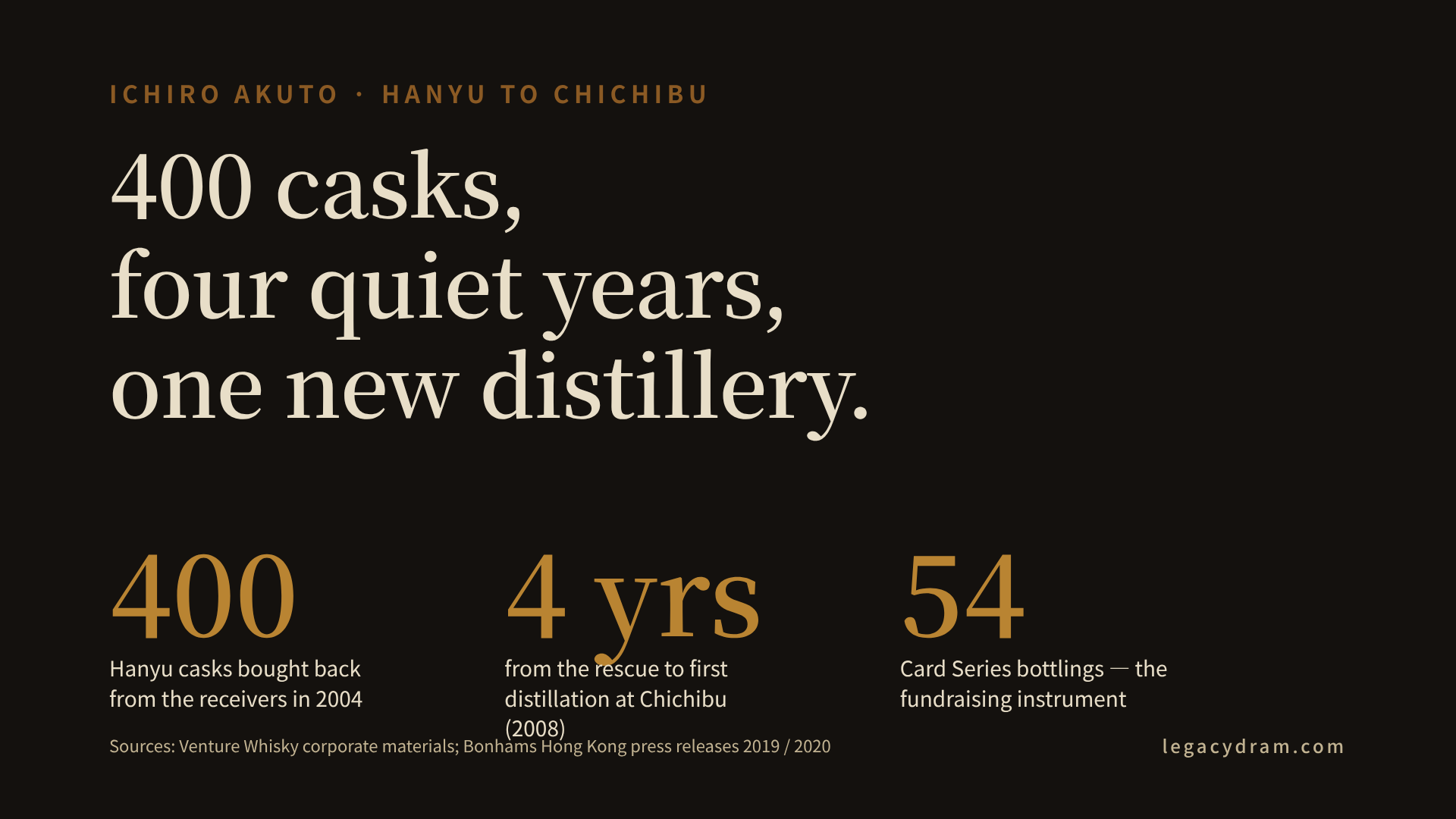
The 400 casks and the 4 years
The grandfather, Isouji Akuto, had moved the family sake business Toa Shuzo into whisky at Hanyu in 1941 and obtained a formal distilling licence in 1946. Real pot-still malt production did not begin until 1980, which gives the Hanyu bottlings a startlingly narrow window: between the first distillation in 1980 and the last in 2000, there were only twenty years’ worth of casks in the warehouse. Ichiro Akuto was in his mid-thirties when his father’s generation of the family lost the business. The post-war whisky collapse that followed the Japanese bubble economy had made malt distilleries uneconomic across the country. Karuizawa went silent in 2000, Hakushu halted a line, and the industry retreated into blends. Toa Shuzo entered rehabilitation proceedings in 2000, Hanyu stopped distilling, and over the next four years the physical plant was taken apart. The stock was sold as a bulk commodity. The buyer, Hinode Tsusho, planned to vat and dilute it and sell it on as a generic whisky base. The grandfather’s inheritance was going to be used to top up canned highballs.
I want to resist writing this as a hero narrative because it was not, at the time, obviously going to work. Akuto was not a famous blender. He had trained in Suntory’s sales division after university and left in 1995 to help run the family’s Hanyu operation, so he was personally present through Toa Shuzo’s 2000 collapse. He had the right surname and a trained palate, but he had no distillery, no brand, no retail footprint and, by his own later accounts, no money. What he had was a father who had just lost the family firm, a grandfather’s warehouse worth of maturing stock being treated as a disposal problem, and the specific intuition that the Hanyu spirit was unusually good. The intuition turned out to be correct, but it would not have mattered if the warehouse rent had come due in month three. Four hundred casks will sit for a long time without anyone caring about them, until suddenly the person who legally owns them has to pay the storage bill. The four years between buying the casks and opening Chichibu were spent, in large part, keeping the warehouse paid.
The Card Series was fundraising
The way he paid for it was the Card Series. Between 2005 and 2014 Venture Whisky released fifty-four single-cask bottlings of Hanyu malt, one for each card in a full pack, jokers included. In retrospect (the retrospect written by auction houses) the series looks like a self-conscious art project with built-in collectibility. From inside the business, in 2005, it looked like something simpler: a way to turn one cask at a time into enough cash to pay for the next six months of warehouse rent while a distillery was being drawn on the back of an envelope. The reason the releases were single-cask was not primarily aesthetic. It was that single-cask bottlings allow pricing well above standard-batch malts, and Akuto needed every yen that a label and a bar of narrative premium could extract from a cask he could not replace.
What is counter-intuitive about the Card Series is that most of its collectible value was created after Chichibu opened, not before. The first few cards sold respectably to Japanese bar owners and a small foreign following. By about 2015, four years after the first Chichibu single malts hit the market and reviewers like Serge Valentin on whiskyfun.com had begun treating Chichibu as a serious craft distillery, the market retrospectively decided that the Card Series was a monument. Full sets started appearing at Bonhams. The August 2019 Hong Kong sale took a complete fifty-four-bottle run to HK$7.19 million, about US$917,000, which Bonhams called a world record for a Japanese whisky collection at the time. In November 2020 a second set from the Club Qing collection reached HK$11,890,360 (about US$1,520,000), which Bonhams called a world auction record for a whisky series. In 2024 another set went to Bonhams Paris carrying a seven-figure estimate.
Those are the famous numbers, and I have to be honest about what they do and do not mean. They are a verdict on scarcity, not on Akuto. By the time a set is making a million dollars at auction, Hanyu as a working distillery has been gone for twenty years and the stock cannot be replaced. The auction record is the sound of the market pricing a finished story. It is not the sound that paid for Chichibu. What paid for Chichibu was the much quieter, much earlier Card Series releases, sold at normal retail prices to normal customers, while the construction was still in flat drawings. A million-dollar auction result does not retroactively fund a building site that opened twelve years earlier.
February 2008: a 1.5-hectare craft distillery
Chichibu’s physical plant, when first distillation ran in February 2008, was small by any yardstick you want to use. The site covered about 1.5 hectares, a small fraction of the footprint of a major Japanese malt distillery such as Yamazaki or Yoichi. The still house held two Forsyths-made pot stills of two thousand litres each (wash and spirit), with indirect steam heating, a straight-sided shoulder, a short neck and a slightly declined lyne arm, geometry chosen to produce a heavier, oilier spirit rather than a light reflux-polished one. The fermenters were eight 3,177-litre washbacks made from Japanese mizunara oak. Annual output at the first site was approximately 60,000 litres of pure alcohol, around a tenth of what a mid-sized Scottish malt distillery would consider a sensible minimum.
The mizunara washbacks are the most unusual single decision. Mizunara is porous, mechanically awkward, and famously prone to leaking; this is why nobody uses it for fermenters, including the companies that use mizunara maturation casks for showcase bottlings. Akuto chose mizunara for the washbacks because the open-grain surface would allow the native Chichibu lactic flora to colonise the wood, and long, 90-plus-hour fermentations would acquire a signature fruit-and-cream profile from the biology that lived in the fermenter rather than solely from the yeast strain he pitched. The decision adds a maintenance regime that no engineer looking at a spreadsheet would recommend. It is a deliberate commitment to a distillery character that could not be bought from Forsyths or specified in a Scottish advisor’s drawing. (Looking across new-world craft distilling more broadly, Jim Swan’s work with the STR cask protocol in Taiwan, India and Wales shows how differently another craft founder solved the same problem: Swan reached for cask engineering; Akuto reached for the fermenter.)
The reason the plant was small, I think, is that the economics of the Hanyu rescue dictated it. If you own 400 casks that nobody else can replicate and you want to turn them into a going concern, you cannot build Yamazaki around them, because Yamazaki-scale production would need Yamazaki-scale cash flow long before your inherited stock has finished maturing. You have to build a distillery whose cost structure matches the slow drip of single-cask releases, not the volume economics of a mass-market blend. Chichibu was designed around the Card Series’ financial envelope, not the other way around.
Running out
The uncomfortable part of the story, the part that is missing from most English-language profiles, is that the Hanyu casks ran out. By about 2019, after fifteen years of being carefully stretched across the Card Series and subsequent Hanyu single-cask bottlings, the usable stock was effectively gone. The November 2020 Bonhams record set its $1.52 million price for whisky that no longer existed in cask form; the physical liquid had been bottled, poured, drunk, or locked into collector cabinets.
This matters because it is the moment the “rescue” story stops being the business model. Up until roughly 2015, Chichibu was, financially, a Hanyu bottler with a working distillery attached. After 2019 it had to be a distillery that remembered Hanyu but no longer depended on it. In 2019 Akuto opened Chichibu Distillery No. 2 about a mile from the original site, with roughly five times the output capacity. This is the decision I find hardest to read fairly. On one reading it is the quiet admission that the craft-scale 1.5-hectare site, however pure, could not supply the demand that Chichibu’s own cult reputation had generated. That reputation was partly a halo from the inherited Hanyu stock, which was now gone. On another reading it is an entirely reasonable scaling decision made by a sixteen-year-old distillery that had demonstrated it could sell every drop. I think both readings are true at the same time and I am not sure the five-times scale-up is the choice I would have made. (Whether something is lost when a craft distillery multiplies its output several times over is a question that gets argued most often about Nikka’s second distillery, Miyagikyo, which Masataka Taketsuru built explicitly as Yoichi’s softer, larger counter-weight; the same question now sits over Chichibu.)
What the rescue actually saved
The sentence I want to write about Ichiro Akuto is that he saved Hanyu. It is the sentence most of the English-language press writes about him. It is not quite true. He saved the four hundred casks, which was a different thing from saving the distillery. The physical Hanyu plant was dismantled in 2004 regardless of his purchase; the licence lapsed; the floor malting equipment was scrapped; the pot stills from Miyake were sold. There is now a separate project, by other members of the extended Akuto family, to rebuild a working distillery on the Hanyu site, and the newer whisky coming from it will be, in a legal sense, Hanyu again. But it will not be the Hanyu that filled the four hundred casks in 1990. That Hanyu is gone and will not come back.
What the rescue saved was a corpus of liquid, old enough and distinctive enough that bottling it slowly across fifteen years funded a different distillery entirely. Chichibu, in 2026, is a serious malt distillery in its own right, with core single malts that have earned their shelf space through their own fermenter and still geometry rather than through inheritance. But the money that paid for the mizunara washbacks and the Forsyths stills in 2008 came, in the end, from whisky that had been distilled by his grandfather’s generation and that he happened to be able to buy, cheaply, in a bad week at a bulk-liquor broker. There is a version of the story in which Isouji Akuto’s decades-long insistence that Toa Shuzo should be in whisky is what made Chichibu possible. Not because Isouji built Chichibu, but because the casks laid down under his family’s name from 1980 onwards were still, two decades after his son’s firm went bankrupt, worth more than anyone had quite realised. The man who argued for a licence in 1946 and for pot stills in 1980 made his argument in Hanyu, not in Chichibu. By the time his grandson was signing the paperwork for the Forsyths stills in Saitama in 2007, the distillery Isouji had built was already being pulled apart in a different prefecture. The casks were all that was left of it, and the grandson spent four years, around a kitchen table in 2004, calling in favours from relatives to keep the stock alive long enough to build a distillery that would, eventually, outlive the Hanyu stock inside it.
Related reading in the Japanese whisky cluster: Masataka Taketsuru’s three Scotland notebooks and the sixteen-year wait to build Yoichi is the counter-example in order-of-operations (notebooks first, distillery later); Shinjiro Torii’s 1929 Shirofuda is the big-company version of a Japanese whisky origin story; Miyagikyo is the earlier example of a Japanese founder scaling up a second site; and Jim Swan’s STR-cask new-world distilleries shows the parallel craft-scale route taken outside Japan.