Quercus garryana Oak Cask Explained: Westland Garryana Single Malt and Matt Hofmann's Pacific Northwest Wood Chemistry (vs Q. alba and Q. mongolica)
The whisky world prints three oak species on the back labels of its premium bottles. American white oak (Quercus alba) holds bourbon. European sessile oak (Quercus petraea) holds sherry. Japanese Mizunara (Quercus mongolica var. crispula) holds the most expensive cask material on the planet. In 2010 a twenty-four-year-old named Matt Hofmann opened a distillery in Seattle and started filling casks with a fourth species nobody else was using: Quercus garryana, the Garry oak, an oak native only to a thin strip of the Pacific Northwest that has lost roughly 95% of its range since the 1850s. The wood is harder to source than any other commercial whisky oak in the world, and the supply ceiling is set by how often a Garry oak falls over in a storm in Oregon.
A fourth oak, and the man who went looking for it
Matt Hofmann co-founded Westland Distillery in 2010 with his high-school classmate Emerson Lamb, with the stated mission of making a single malt whisky that captured a sense of place of the Pacific Northwest. (Cocktails & Bars interview) Lamb left the company in 2015. Hofmann was Master Distiller, the youngest in the United States at that point, and he stayed in that seat for the next thirteen years. (Imbibe Magazine)
In 2012 they moved into an old crane factory in Seattle’s SODO district and spent eighteen months retrofitting the building. The first Westland release, a 375 ml bottle called The Deacon Seat, arrived in 2013. By 2016 Hofmann was on the Forbes 30 Under 30 list; in 2018 Whisky Magazine named him American Master Distiller of the Year. (Whisky Chicks)
The Pacific Northwest mission was not just barley sourcing and fermentation choices. It was an oak hunt. Three things were already known to oak chemists at the time Hofmann was thinking about it: the whisky industry leant almost entirely on Q. alba for bourbon-cask supply, Q. petraea and Q. robur for European cooperage, and Q. mongolica as a small Japanese specialty. There was a fourth white oak species, Quercus garryana, growing in the meadows around the Westland still-house. Nobody had built a single-malt programme around it. The reason was not that nobody had tried. The reason was that the wood is brittle, twisted, low-yield, and listed as a critically imperilled habitat by the Washington Department of Fish and Wildlife. (The Counter)
What lives inside a Garry oak stave
Botanically Q. garryana is a white oak in section Lepidobalanus, and shares that section with Q. alba (American) and Q. mongolica (Japanese). Q. petraea and Q. robur sit in a different section (Quercus sensu stricto). What that means in plain wood-chemistry terms: Garry oak, on cell-structure grounds, ought to behave like American or Japanese oak. It does not. Its measured chemistry runs closer to European oak.
- Tannin load is high. Reported tannin levels are noticeably higher than Q. alba and put Garry oak in the territory of Q. petraea. This is the source of the dry, drying, slightly green astringency you taste in young Garry-oak-matured spirit before the cask has had time to mellow.
- Whisky lactone is high, and on the cis side. Early Westland Garryana batches were inconsistent and frequently leaked coconut and dill notes that point to a heavy load of cis-β-methyl-γ-octalactone. (Drinkhacker review of Edition 1|1)
- Vanillin yield is lower than American oak. What the spirit gets instead is a green, herbaceous, faintly vanilla edge: the “green-tinged vanilla” noted in early batch reports.
- Phenolic profile is pronounced. Garry oak carries a noticeably phenolic aromatic character that lands as clove, sage, sometimes a damp-forest smoke. (Westland Bartender Field Guide)
The cooper has to handle Garry oak differently because of those chemistry numbers. American oak gets eighteen months of air-seasoning and aggressive char. Garry oak needs thirty-six months of air-seasoning to let the harshest tannins soften, and a low-and-slow toast of around 45 minutes at 180°C, because the lignin matrix is more delicate and a fast bourbon-style burn destroys the precursors you actually want. (The Counter)
The reader who has been calculating along will already see the problem: triple the air-seasoning time, halve the toasting heat, on a wood that comes only from fallen trees. The economics are upside down before the cask is even filled. The answers are in the next table.
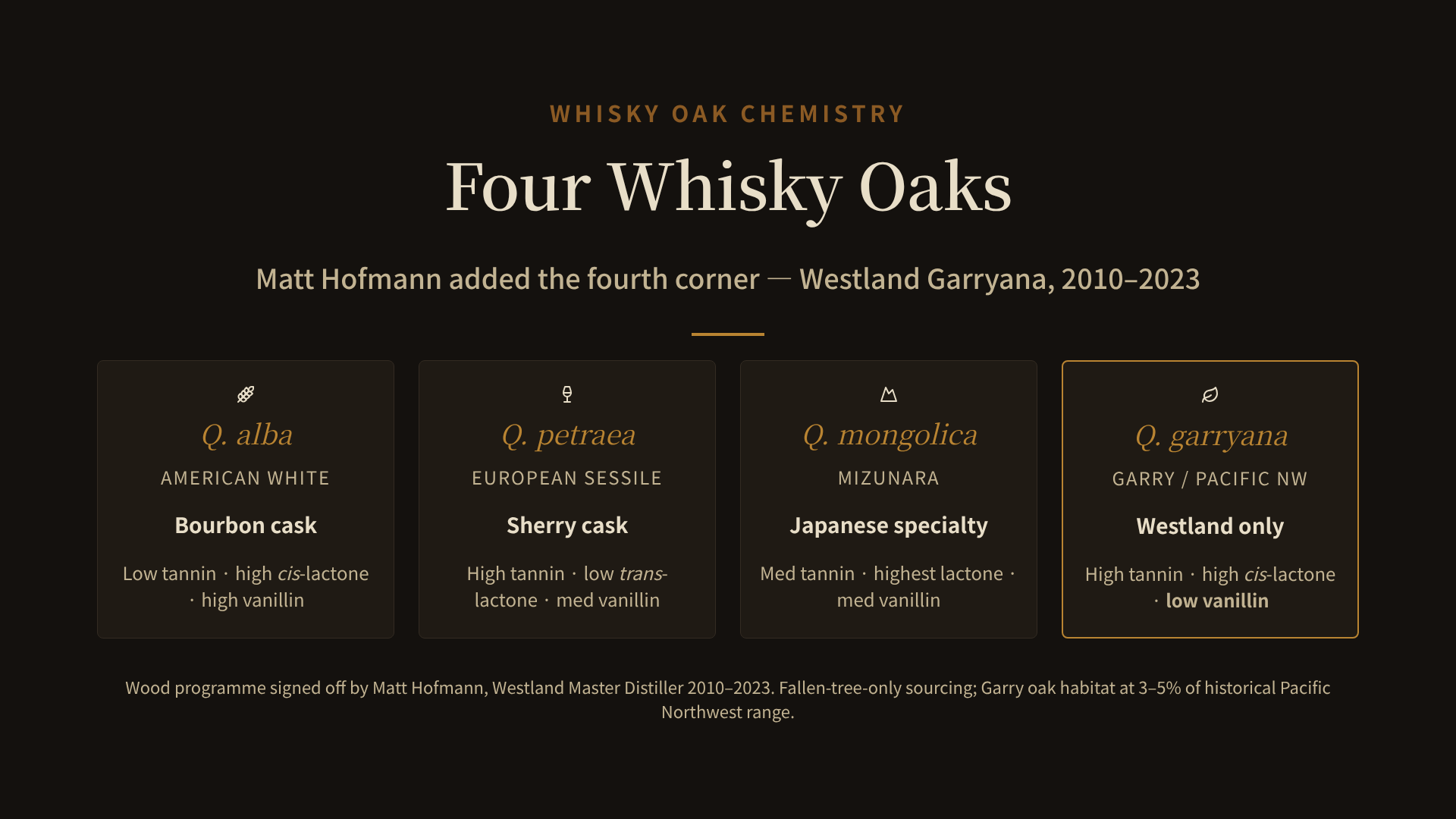
The four-oak comparison table
| Species | Section | Tannin | Whisky lactone | Vanillin | Cooper time | Typical use |
|---|---|---|---|---|---|---|
| Q. alba (American white) | Lepidobalanus | Low | Med–High (cis-dominant) | High | 18 mo air-seasoning | Bourbon cask, the global default |
| Q. petraea (European sessile) | Quercus s.s. | High | Low (trans-dominant) | Medium | 18–24 mo air-seasoning + 2 yr sherry-seasoning | Sherry-seasoned Macallan-style cask |
| Q. mongolica (Mizunara) | Lepidobalanus | Med–High | Highest | Medium–High | Axe-split staves, ~38 mm thick | Japanese specialty, sandalwood/coconut |
| Q. garryana (Garry oak) | Lepidobalanus | High | High (cis-dominant) | Low–Med | 36 mo air-seasoning, low-heat toast | Westland Garryana only, ~21% blend ratio |
Stuart MacPherson, the Master of Wood who ran the Macallan three-oak programme until 2022, had been working with the first three rows of that table for a decade when Hofmann started filling the fourth. See Macallan Oak Species Explained for the chemistry under those three; this article is the missing fourth row.
Edition 1.1, and why the blend ratio sits where it does
Westland Garryana Edition 1|1, released in October 2016, was bottled at 56.2% ABV, non-chill-filtered, in a run of 2,500 bottles. The composition published by Westland was striking: 21% of the whisky was distilled from pale malt and matured in new Garry oak, and the remaining 79% was a mix of malts (including peated) matured mostly in new Q. alba casks plus a small portion of used Q. alba. (Drinkhacker)
A bartender hearing “single-malt aged in Garry oak” will reasonably assume the bottle is 100% Garry oak. It is not, and there is a reason. The lactone-and-tannin numbers in the table above predict what happens if you fill a 200 L Garry oak cask with new-make and walk away for five years: the wood wins. The phenolic compounds and tannins are extracted faster than in Q. alba: partly because of the higher tannin baseline, partly because the wood grain is finer and the surface chemistry more reactive after that low-and-slow toast. Past about two to four years of contact, you get a spirit that tastes like the cask drank the distillate rather than the other way around.
Hofmann’s design choice was to use Garry oak as an accent species rather than as the structural backbone. The 21% Garry-oak-matured component sits inside an Q. alba envelope that gives the bottle its sweet bourbon-cask shoulder of vanilla and soft fruit, while the Garry oak contributes the clove, sage, green-vanilla, and forest-floor edge that nothing else in the whisky world delivers. The ratio is, in engineering terms, a deliberately asymmetric blend that lets the rare species speak without letting it take over the conversation. Later Garryana Editions (2017, 2018, and on through to the 10-year-old released in 2025) have shifted that ratio and introduced varying cask histories, but the principle has held: Garry oak is the accent, not the backbone. (American Whiskey Magazine on Edition 10)
The supply ceiling
The reason Westland is the only distillery with a programme like this is not creativity. It is access. Quercus garryana grows only in a thin Pacific Northwest band: southern British Columbia, western Washington, the Willamette Valley of Oregon, and a few isolated stands as far south as the California foothills. Within that band, the species has lost most of its historical habitat. The Sound Oaks Initiative puts Puget Sound losses at roughly 99% of historical Garry oak ecosystem. The Washington Department of Fish and Wildlife classifies the remaining habitat as critically imperilled. In Oregon, where the species reaches its broadest range, around 25% of historic oak habitat remains and only 1% of native prairies. (Sound Oaks Initiative)
You cannot plant Garry oak for whisky barrels. The species takes more than a century to reach mature stave-grade size, and the wood is brittle, twisted, and prone to checking, meaning a single cooper can easily reject the majority of staves milled from any given tree as unusable. The wild trees yield a low ratio of usable wood per log compared to Q. alba.
Westland’s policy, set early and held since, is to use only fallen trees: storm-down windfall, agricultural conversion clearances, urban-salvage trees that would otherwise go to the woodchipper. Westland is one of a small handful of Certified B Corporation whisky distilleries, and in 2022 Icons of Whisky named it Sustainable Distillery of the Year. (Westland: Garryana, A Rare Prospect) The supply pipeline goes: storm or developer drops a tree, a partner forester or sawmill notifies Westland, the log is milled into staves, the cooper sorts what is workable, the rest is firewood. The whole programme runs on what the Pacific Northwest is throwing away that week.
That is the wit of the design. The wood that goes into a Westland Garryana cask is, almost by definition, wood that somebody was about to discard. The casks that Hofmann managed to put under spirit in the early 2010s are the bottles you can drink today; the upper bound on annual Garryana production is set by Pacific Northwest weather and developer permits, not by Westland’s still capacity. There is no scaling lever to pull.
2017, and what changed
In December 2016 Rémy Cointreau, the French Cognac-and-spirits group that already owned LOUIS XIII, Rémy Martin, Cointreau, and several Scotch single malts, announced an agreement to acquire Westland. The deal closed in January 2017. Rémy’s stated rationale was American single-malt category exposure, and Westland was the most credible independent name in that nascent category. (Whisky Advocate) (The Spirits Business)
Hofmann stayed on as Master Distiller. The Garryana series continued: Edition 2 in 2017, then 3, 4, 5, 6, 7, 8, 9, and a 10-year-old aged release in 2025. The single-cask programme expanded. The Solum release added a Pacific Northwest peated bottle. The wood programme philosophy did not shift visibly.
In June 2023, after thirteen years as the Westland Master Distiller, the only one the distillery had ever had, Hofmann left. The bottles he filled in the early 2010s, including the casks that still feed the higher-aged Garryana releases coming out today, are now ageing on a clock that nobody at the distillery can wind back. (Bourbon Lens)
Why the bottle still tastes like Pacific Northwest
When I pour a Westland Garryana into a glass (Edition 1|1 if I am being old-fashioned, Edition 6 or 7 if I want to taste where the programme went), the part of the flavour profile that no other whisky in the world delivers is the green forest note: clove, damp sage, a faint conifer pitch, and a vanilla that has been tinted with something herbaceous rather than something sweet. That note is Quercus garryana talking. The wood-chemistry table above is the engineering shorthand for what the glass is telling me.
The single-malt market currently has more whisky-oak programmes than it has done at any time in history. Jim Swan demonstrated that small new-world distilleries can use heavily charred and re-charred shave-toast-rechar casks to compress maturation timelines; see Jim Swan’s STR Cask for the technique that became the new-world cooperage default. Bill Lumsden ran cask innovation at Glenmorangie around the same time Hofmann was buying his first Garry oak; see Glenmorangie Original’s tall still for one decision Lumsden made on the still side, and Glenmorangie fermentation for the wild-yeast Allta work that Brendan McCarron pursued on the fermentation side. Stuart MacPherson’s three-oak Macallan programme covered the Q. alba, Q. petraea, Q. mongolica corners. Westland filled the fourth.
What Hofmann did differently from those four was that he chose a species whose supply ceiling is set by ecology rather than by procurement budget. Macallan can buy more Spanish oak if the bodega supplies it. Glenmorangie can commission another sherry-seasoning contract if Domecq has capacity. Westland cannot order more Garry oak. It can only catch what the Pacific Northwest drops. The Garryana bottle in your hand is a finite-edition product not because the marketing department decided to limit it, but because the forest decided how big the harvest was that year.
The next time you pour one, taste for the clove and the green vanilla. That is the chemistry of a tree species that lost most of its range two centuries ago, salvaged from a storm-fall log somewhere outside Tacoma, sorted by a cooper who rejected three staves for every one he kept, toasted slowly enough to keep the lignin matrix from breaking, and then asked to spend ten years sitting against new-make spirit in a Seattle warehouse. The reason it tastes the way it does is that nothing else can taste like that, and the reason nothing else can is that there is no more Garry oak to go around.