The Adjustable Still: Alistair Cunningham Tried to Turn Reflux Into a Dial, and the Industry Quietly Said No
In 1955, in the drawing office of a grain distillery on the Clyde at Dumbarton, a chemical engineer named Alistair Cunningham and a draughtsman named Arthur Warren designed a still that was supposed to make every whisky at once. You could run it light. You could run it heavy. You could, in principle, dial it to anywhere in between and back again between batches, the way you’d retune an instrument between songs. It was the most ambitious thing anyone in Scotch had attempted with a pot still in a century, and the man who built it spent the rest of his career being remembered for something else entirely.
Cunningham is remembered — when he is remembered at all — as “Mr Ballantine’s.” He joined Hiram Walker’s Dumbarton complex as a teenage general apprentice in 1942, took a chemical engineering degree on a company training scheme, rose to managing director of Hiram Walker (Scotland), ran Allied Distillers, and retired in 1992 after fifty unbroken years, having kept Ballantine’s signature blend of forty-two single malts intact through every change of owner. (alt.obituaries) The staff called him “Big Al” behind his back. When he retired, the company bottled a special edition with his name on it. That is the legacy in the marketing material: a blender’s blender, a steward of a flavour.
But the thing an engineer would put on his own headstone is the still. And the still, by almost any commercial measure, failed.
What Cunningham was actually trying to solve
To see why the Lomond still is interesting, you have to understand the problem it was built for, and the problem was not flavour. It was logistics.
Around ninety per cent of the Scotch sold in the world is blended. A blend like Ballantine’s is a recipe of dozens of single malts, each contributing a specific character — light and floral here, oily and grassy there, a little weight from somewhere else. The blender needs reliable access to all of those characters. The traditional way to get them is to own, or trade for, the output of many different distilleries, each with its own fixed still geometry producing its own fixed style. Hiram Walker, hungry for a light, fruity malt for the Ballantine’s recipe and short on physical space to build new distilleries, wanted a shortcut. (Scotch Whisky)
Cunningham’s shortcut was radical. Instead of building four distilleries to make four styles, build one still that could make four styles. Make the spirit character a variable the operator could set, rather than a constant the architecture forced on you.
This is where it joins a story I keep coming back to on this site. Almost every distillery with a distinctive house character has solved the same underlying equation — how much reflux to run — and frozen the answer into hardware. Glenmorangie froze it into 5.14-metre stills in 1843. Glen Grant bolted a water-cooled purifier onto its lyne arms in 1872. Glengoyne does it by running the slowest spirit cut in the industry. Each of those is a single number, set once, lived with forever. Cunningham looked at that and asked the engineer’s question: why is it a constant? Why can’t it be a knob?
How the knob worked
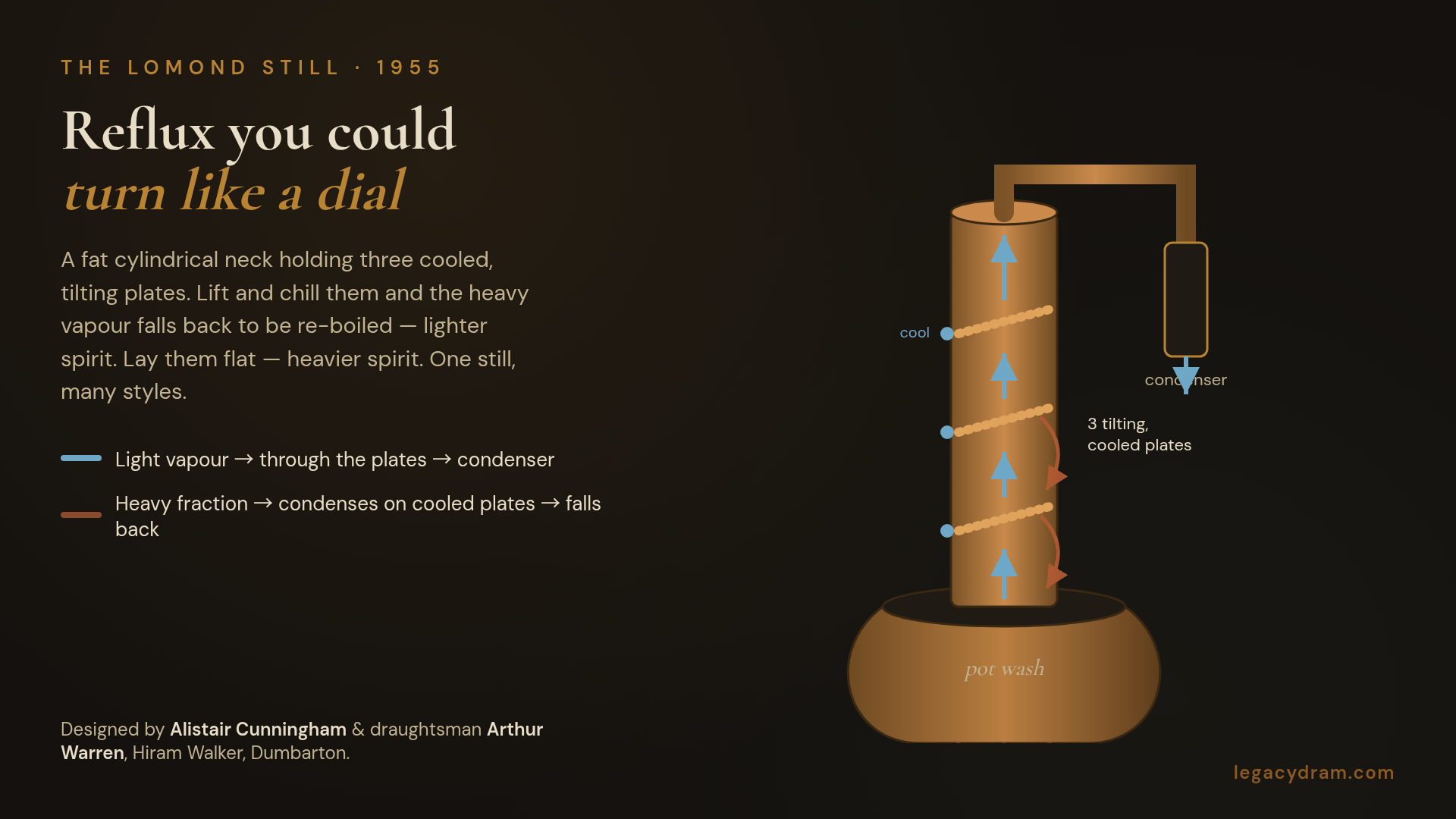
Reflux is the heart of it. When a still boils, vapour climbs the neck toward the condenser. Some of that vapour — the heavier, oilier, higher-boiling fraction — cools, condenses on the metal, and trickles back down to be boiled again, while the lighter molecules carry on to the condenser and into the bottle. More reflux means more re-boiling, more contact with the catalytic copper, and a lighter, cleaner, more delicate spirit. Less reflux means a heavier, oilier, meatier one. The amount of reflux is, in the most literal sense, the dial that sets the style.
In an ordinary pot still that dial is set by the shape of the copper: tall neck, more reflux; short fat neck, less. You can’t change it without rebuilding the still. Cunningham’s design changed it on the fly.
The Lomond still kept a conventional pot at the bottom and replaced the graceful swan neck with a fat cylindrical column — the malt drinkers who later saw one called it ugly, and they were not wrong. Inside that column sat three perforated copper plates that could be cooled with water, repositioned, and even removed, with the lyne arm angle adjustable on top of that. (Wikipedia) Cool the plates and tilt them to catch the rising vapour and you forced more condensation, more reflux, a lighter spirit. Back them off and the spirit came through heavier. One eleven-thousand-litre still, and the operator could move it across a range of characters that would normally require several distilleries. (Whiskipedia) On paper it was the most flexible pot still ever built in Scotland.
Where the still actually went
The first one went into Inverleven, the malt distillery tucked inside the Dumbarton grain complex, in the latter half of the 1950s. Paired with Inverleven’s existing wash still, the new spirit still technically constituted a second distillery, which Hiram Walker named Lomond — the name that stuck to the whole design. (Scotch Whisky) Then they propagated it. A Lomond still went into Glenburgie in 1958, where its output was bottled under the name Glencraig. One went into Miltonduff in 1964, producing a malt called Mosstowie. And one went up to Scapa, on Orkney, the windswept far north of the Hiram Walker map.
Read the dates forward and the verdict is brutal. Glencraig ran from 1958 to 1981. Mosstowie ran from 1964 to 1981. The original Lomond at Inverleven was mothballed in 1985, the distillery later demolished. Within a single generation, the most flexible pot still in Scotland had been switched off nearly everywhere it was installed. (Scotch Whisky)
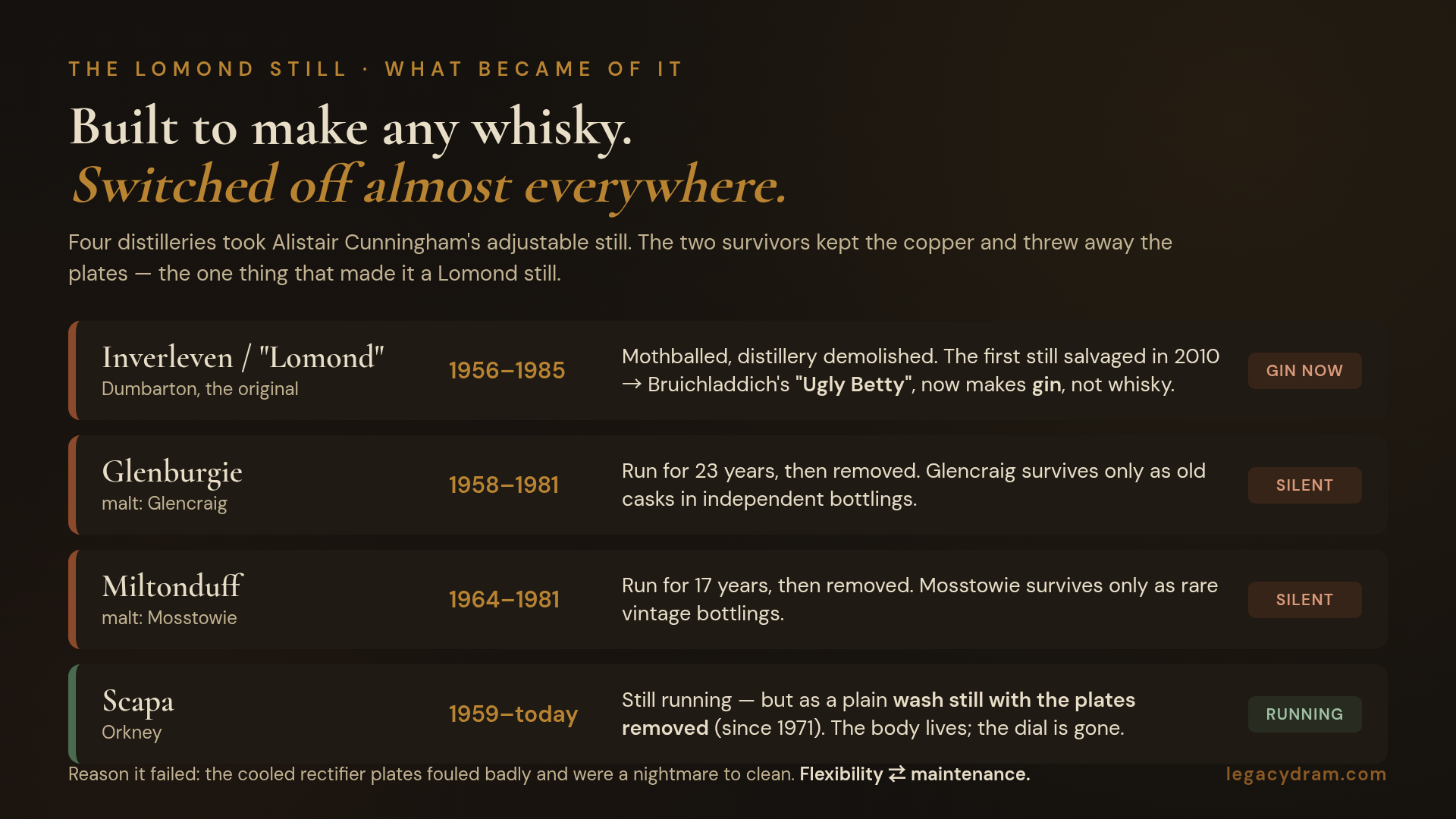
I would like to tell you the Lomond still failed because the world wasn’t ready for its genius. The truth is more deflating, and more human: it failed because nobody could clean it. The whole point of the design was the bank of plates in the neck. Those plates, sitting directly in the path of hot, particulate-laden vapour, fouled badly and were a nightmare to scrub. (Whiskipedia) Distillery crews hated them. Blenders, it turned out, would rather pull a known character from a dedicated still than wrestle a temperamental do-everything machine into making it. The flexibility Cunningham prized so highly was, on the still-house floor, a maintenance tax that nobody wanted to keep paying. The dial was real. The cost of turning it was higher than the value of the tune.
This is the trade-off at the centre of the whole story, and it’s worth naming plainly, because it has nothing to do with whether the engineering was clever. It was clever. Variable output ⇄ operational burden. Cunningham bought himself a range of styles and paid for it in cleaning hours, copper maintenance, and complexity. The same instinct that makes a Swiss Army knife appealing in the shop makes it the wrong tool on a job where you only ever needed the one blade — and where the knife jams.
The two that lived, and what they had to give up to do it
Two Lomond stills are still standing. Both survived by abandoning the very thing that made them Lomond stills.
Scapa kept its Lomond still and still runs it today — as a plain wash still, with the rectifier plates taken out. The plates came out around 1971; the official reasoning was that the tube-and-shell condensers downstream made the wash-still plates pointless. (Scotch Whisky) So the one Lomond still that never stopped working is a Lomond still in shape only. Its fat cylindrical neck still gives Scapa a heavier, oilier wash-still character than a slim swan neck would — there is genuine spirit-shaping in that wide column — but the adjustable plates, the knob, the entire premise, are gone. What survives is the body of the invention with its idea cut out.
The other survivor took a stranger road. When Inverleven was demolished, its original Lomond still — built by Ramsden of London, the very first of the line — was salvaged. In 2010, Bruichladdich hauled it across to Islay, nicknamed it “Ugly Betty,” and put it to work. Not making whisky. Making gin: it is the still behind The Botanist. (Whiskey Wash) The most flexible whisky still ever designed in Scotland ended up as a one-trick gin still, beloved precisely for the botanical job it does over and over.
There’s a footnote here that complicates the obituary, and I want to be fair to the idea rather than just to the man. The premise wasn’t worthless; it was early. Loch Lomond distillery built its own straight-neck rectifying stills on a closely related logic — a column you tune for style — and Michael Henry runs them to this day. InchDairnie installed new Lomond-derived stills in 2015. The thing Cunningham was reaching for — reflux as a parameter you set rather than a shape you’re stuck with — turned out to be a good idea attached to a bad cleaning regime. Later engineers kept the idea and solved the cleaning. He got there first and ate the cost of being first.
The man in the bottle, and the one who isn’t
Here is the part that stays with me.
Alistair Cunningham died in July 2010, in Paisley, aged eighty-four. (alt.obituaries) That was the same year his Inverleven still — the first Lomond, the prototype of his whole career’s most original thought — was lifted out of the rubble and shipped to Islay to make gin under a name that means ugly. I don’t know whether he knew. I hope he did, and I hope the wicked sense of humour his colleagues remembered him for was equal to the joke: that the engineer who tried to build a still that could make any whisky in the world had his masterpiece reborn, in the last year of his life, making something that isn’t whisky at all.
He got the special-edition bottle for the blend. He got “Mr Ballantine’s” carved into fifty years of company memory. What he did not get — what almost nobody gets — is recognition for the thing he was proudest of as an engineer, because that thing didn’t sell, didn’t scale, and didn’t survive in the form he drew it. The marketing remembers the flavour he protected. It does not remember the dial he invented.
When you taste a Scapa today, you are drinking from the last Lomond still in continuous whisky service, running with its heart removed. When you pour a Botanist and tonic, you are drinking from the first one, repurposed for a spirit it was never meant to make. Somewhere between those two glasses is the whole shape of Cunningham’s career: an idea good enough to keep, drawn in a form too costly to live with, surviving everywhere in pieces and nowhere in full. He set out to make a still you could tune like an instrument. The instrument outlived him. The tuning did not.
Related reading
- Bolt-On Reflux: Major James Grant’s 1872 Purifier and Dennis Malcolm’s 63 Years at Glen Grant — reflux as a cheap retrofit, kept for 154 years instead of thrown away
- The Reflux Equation: Why Glenmorangie’s Stills Are 5.14 Metres Tall — reflux frozen into architecture at founding
- Glengoyne’s Slowest Spirit Run: Robbie Hughes and Reflux by Patience — the same dial, set with the throttle instead of the geometry
- Loch Lomond’s Straight-Neck Rectifying Still: Michael Henry’s Tunable Column — the idea Cunningham reached for, with the cleaning problem solved
Sources
- alt.obituaries — Alistair Cunningham, 84, Scotch whisky expert known as ‘Mr Ballantine’s’
- Scotch Whisky: Whiskypedia — Lomond
- Whiskipedia — What is a Lomond Still?
- Lomond still (Wikipedia) — en.wikipedia.org/wiki/Lomond_still
- The Whiskey Wash — What is a Lomond Still?