Four Roses 10 Recipes: Jim Rutledge's 2×5 Grid
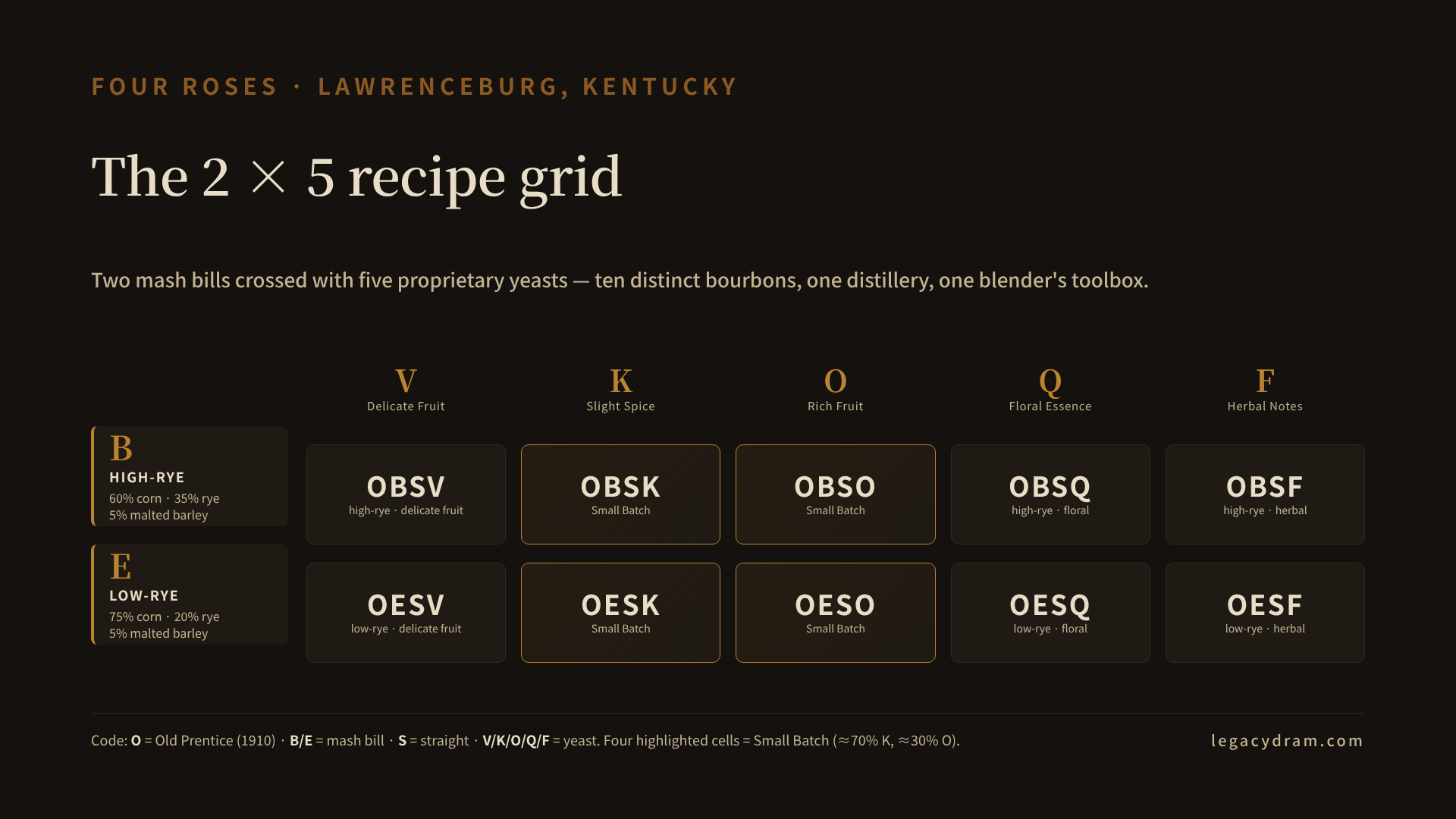
Four Roses ships ten bourbons out of one distillery in Lawrenceburg, Kentucky. Two mash bills, five yeasts, one still house, one warehouse complex. The grid is drawn on a whiteboard in every training deck the company hands out at tastings, and it looks like this: B × {V, K, O, Q, F} on the top row, E × {V, K, O, Q, F} on the bottom, ten cells, one bourbon per cell.
For anyone who thinks in feature matrices — which is most of the audience I write for — this is unusually clean. Bourbon houses do not tend to ship ten SKUs at the recipe level. Buffalo Trace runs three mash bills but does not name the yeast on the label. Jim Beam runs one mash bill for its flagship and does not name the yeast at all. Wild Turkey has one mash bill, one yeast, one entry proof, and I have written about the man who protected all three for seventy years. Four Roses is the outlier. Ten is a lot of cells to keep filled.
Jim Rutledge is usually written up as the man who made this possible. That is partly right and partly a genre problem. He did not design the 2×5 grid. It predates him by twenty-one years, and it was designed by a Montreal executive and an Ecuadorian yeast biologist he had never met. What Rutledge did was rotate the axis when the original grid collapsed, and then defend the rotated version for forty-nine years without ever fully getting to explain, on a label, what was in the bottle.
Where the ten came from
In 1945, Seagram’s blending team in Montreal, under Sam Bronfman, settled on ten target flavour profiles for the Four Roses straight bourbon they were then producing across a network of Kentucky sites. The number came from the blender’s ear, not from a factorial: ten discriminable slots was what the palate could tell apart in a blending session.
The 1945 grid, however, was not the same 2×5 grid you see on a tasting mat today. In 1945 it was 2 grain recipes × 1 yeast (the V strain) × 5 different Kentucky distilleries. The variance came from where the whiskey was made — different water, different cooperage, different microflora in the barrel houses — not from what was fermenting the wash. Ten cells, five of them geographic.
Between the 1960s and the early 1980s, Seagram closed those five distilleries one by one. By 1983, after the Calvert plant in Louisville shut, production was consolidated onto a single site in Lawrenceburg — the Old Prentice Distillery, built in 1910, whose Spanish-mission-style buildings still show up on every bottle box. The original grid, with five geographies, had collapsed to one geography and would have collapsed the ten recipes to two.
Someone chose, instead, to rotate the axis. Instead of 2 × 1 × 5 sites, the grid became 2 × 5 × 1 — two mash bills, five yeasts, one site. Ten recipes preserved. The yeast dimension had to be widened from one strain to five to hold the count.
The yeast library that made this possible was the work of a Seagram R&D biologist named Jose Pueblo, an Ecuadorian who spent decades at the Louisville research plant developing and cataloguing more than 3,500 yeast strains, of which the company retained roughly a tenth. From that library, five strains — V for delicate fruit, K for slight spice, O for rich fruit, Q for floral essence, F for herbal notes — were chosen to carry the geographic variance that the closed distilleries used to provide.
This is the part of the story that Rutledge did not write. When he walked into Seagram’s Louisville research plant on 14 November 1966, the 1945 grid was already twenty-one years old and Pueblo was already curating it. Rutledge was, at first, an operations man — a University of Louisville graduate who had intended to major in mechanical engineering and ended up with a marketing degree, working plant floors, then bottling, then warehousing, then in 1977 shipped to Seagram’s White Plains, New York corporate office out of the Industrial Engineering and Budgets group he had been heading. He came back to Kentucky operations in the 1980s and was named Master Distiller of Four Roses in 1994.
The nine years between the axis rotation (1983 at Calvert) and his mastership (1994) matter. He was in the building for the collapse. He watched the geographic dimension of the grid disappear and the yeast dimension take its place. When he took the top job, the rotated grid was eleven years old and running. It was his to inherit, not to invent.
The commercial argument against ten
Corporate marketing, then and now, does not love a matrix of ten. The reason is that most consumers ask, of any brand, “which one is the real one?” A brand with ten near-siblings does not answer that question well.
For most of the 20th century, Seagram declined to answer it in public. The 2×5 grid was internal engineering — a blender’s tool, not a consumer-facing story. The bottles that shipped were finished blends, and the blender picked which recipes to combine for the target flavour. From the outside, Four Roses looked like one product; from the inside, it was ten variables to a blend formula.
This is where the sad part of the American story sits. In the 1950s, Seagram pulled Four Roses straight bourbon out of the American market entirely and replaced it, domestically, with a blended American whiskey — the kind of blend whose bourbon fraction can descend, under 27 CFR §5.143, to as little as 20 percent. Under Sam Bronfman’s slogan “blending is an art,” Seagram treated the American Four Roses as a low-shelf grocery-store product. It sank. For four decades, if you saw Four Roses on an American shelf, it was a plastic-handle bottle nobody in the trade would defend.
Meanwhile, the straight bourbon — the one built from the 2×5 grid, the actual thing — kept shipping to Japan and to Europe. In Japan it was, for years, the best-selling bourbon in the country. Kirin, Seagram’s long-time Japanese importer, poured it in every hotel bar in Tokyo. The recipe was alive because a country that could not buy the plastic bottle wanted the glass one.
I want to write here that Jim Rutledge, throughout his Seagram years, secretly fought the blend and lobbied to bring the straight back. That would be the correct genre. In interviews he does speak with real feeling about wanting to restore it, and he was clearly delighted when it came back. But I have no evidence of an internal memo from him arguing the case, and I am not going to invent one. Bronfman’s successors held to Bronfman’s call, and Rutledge, a middle-ranking operations engineer for most of those decades, kept the plant running. That is the honest reading.
The rescue, when it came, was corporate. In 2000, Seagram’s parent conglomerate was carved up between Diageo and Pernod Ricard. In 2002, Kirin — the Japanese partner that had been distributing the straight bourbon in Japan since a 1971 partnership with Seagram, and had been receiving it there for decades before that — bought Four Roses outright out of the debris. Kirin’s first strategic decision was to kill the American blend and restore the straight bourbon to the American market as a premium product. This is where Rutledge, by then eight years into his mastership, finally got to advertise the grid he had been protecting.
What the grid actually gives a blender
The commercial products that Four Roses ships today, from the 2×5 grid, work like this.
Yellow Label, the standard bottling that carries the brand, is a blend of all ten recipes. The blender’s job on Yellow Label is to hit the house profile using every cell. It is the widest use of the grid.
Small Batch is a blend of four recipes: OBSK, OBSO, OESK, OESO. All four sit at the intersection of the two K and O yeasts (spice and rich fruit) with both mash bills. Publicly stated proportions place OBSK + OESK at around 70% of the blend and OBSO + OESO at 30%, so the spice yeast leads and the fruit yeast supports, with both grain recipes contributing at both yeasts.
Single Barrel ships one recipe at a time, unblended — historically the flagship has been OBSV (high-rye mash bill, delicate fruit yeast), and the store-pick programme lets bars and retailers select any of the ten as a single barrel. This is the one place where the 2×5 grid gets to be visible to the drinker. If you buy a store pick with OESK stamped on the label, you know exactly which mash bill and which yeast made it.
Small Batch Select and the annual Limited Edition Small Batch are curated multi-recipe blends whose composition changes year over year. Rutledge, in the years he was still master, wrote the Limited Edition specifications, and Brent Elliott has continued the practice.
For an engineer used to thinking in composable systems, this is what makes the Four Roses grid unusual. It is not that ten recipes exist — that could just be ten SKUs. It is that the ten recipes are the inputs to a blend function, and the blend function is what actually ships. Rutledge’s job, and Elliott’s job now, is not to distil ten bourbons and sell each of them. It is to keep the ten alive so that the blender has ten degrees of freedom the next time the target flavour needs to be hit.
If any one cell of the grid disappeared — if the F yeast died in storage, or the B mash bill were dropped for cost — the compose-time behaviour of every downstream product would shift. Yellow Label would not taste like Yellow Label. Small Batch would need reformulation. This is the systemic reason for holding all ten open.
Every one of the ten goes into the same barrel spec — new American white oak, #4 alligator char, the same industry-default cooperage most of Kentucky uses. Four Roses does not try to differentiate on the wood. The differentiation happens upstream, in the wash. What varies is the fermentation; the oak is the constant. Twenty miles up the road, Woodford Reserve differentiates on the wood instead. Four Roses chose to differentiate on the input.
Which is why the yeast library matters, and why the strains no longer live entirely in Kentucky. During the Seagram breakup, Rutledge and the R&D team moved the yeast samples out of the Louisville research plant that was being wound down. The strains went first to Alltech, a Nicholasville-based agricultural biotech just outside Lexington, then to White Labs in San Diego, where they are now maintained in a freeze-dried state as backup against the working cultures at Lawrenceburg. Ten cells, but the ten does not live in one building any more. It lives in a redundant array.
What he actually held for forty-nine years
Read Rutledge’s public statements against the facts on the ground and the honest sentence is: he inherited a grid designed by other people, held it intact through one corporate collapse and one corporate rescue, and handed it off in working order to his successor.
He did not invent the 2×5 arrangement — Sam Bronfman’s team did, in Montreal in 1945, and Pueblo grew the yeast library that made the rotated version possible. He did not personally win the fight to bring the straight bourbon back to America — Kirin did that, in 2002, as a corporate strategic decision by a Japanese importer who had held the recipe warm across the decades of the American exile. He did not choose to run the axis rotation from geography to yeast — that was a consequence of Calvert closing in 1983, a decision above the plant.
What he did do, and what is harder than the label makes it look, was keep the ten cells continuously producing across two ownership transitions, one axis rotation, and one full re-launch. Ten fermentation strains in parallel is not a hobby. Each needs its own propagation schedule, quarantine, and contamination watch. Any can lose vigour and quietly drift. The grid degrades if operations discipline slips.
He also, at the moment when the ten finally became visible to consumers after 2002, took the trouble to make them visible in a way that respected the engineering. The four-letter recipe code that shows up on Single Barrel labels — the O—S— sandwich with the mash-bill letter and the yeast letter inside — is the same code the plant floor uses. Rutledge did not translate the engineering into a marketing metaphor. He put the engineering itself on the bottle. That is a small thing and a rare thing.
On 1 September 2015, at seventy-one, Rutledge retired after forty-nine years with Seagram and Four Roses. Kirin’s executive team asked him to stay; he had decided otherwise. Brent Elliott, his deputy, took over. Elliott has, so far, changed nothing about the grid. The 2×5 still runs.
Rutledge went on to found his own distillery — J.W. Rutledge Distillery, in Kentucky — which raised money slowly and shipped very little compared to Four Roses. That is a reasonable retirement, and it is not the story worth remembering him for.
The story worth remembering is that in February 2026, Kirin announced it was selling Four Roses to E. & J. Gallo, the California wine giant, for roughly $775 million. Gallo will be the fourth serious ownership house — Paul Jones’s family founders, Seagram, Kirin, now Gallo — under which the 2×5 grid has been asked to keep shipping. Somewhere in the transaction data room there is a spreadsheet listing ten fermentation strains and two mash-bill compositions. That is the balance-sheet asset. That is what a working career of preservation actually is.
Pour a Small Batch tonight. The spice sits in front, the red fruit sits behind, the rye tickles the roof of the mouth, the finish is longer than a $35 bourbon has any right to be. Four cells of the grid, blended 70–30. The blender at Lawrenceburg who signed off on that pour is not Jim Rutledge. The recipe list on his clipboard, though, is the one Rutledge protected for forty-nine years while working, in turn, for a Canadian, a Frenchman, a Japanese, and — as of 2026 — an Italian-American vintner from Modesto.
None of those companies invented the grid. Four Roses is a preservation project too. Jim inherited the grid and kept it running. That is different from designing it, and it is worth writing down accurately, because it is the harder job.